
Pacific mealybug
Planococcus pacificus
Description
How to identify
The Pacific mealybug (Planococcus pacificus) is a member of the Pseudococcidae family, recognized as a significant pest of various agricultural and ornamental crops.
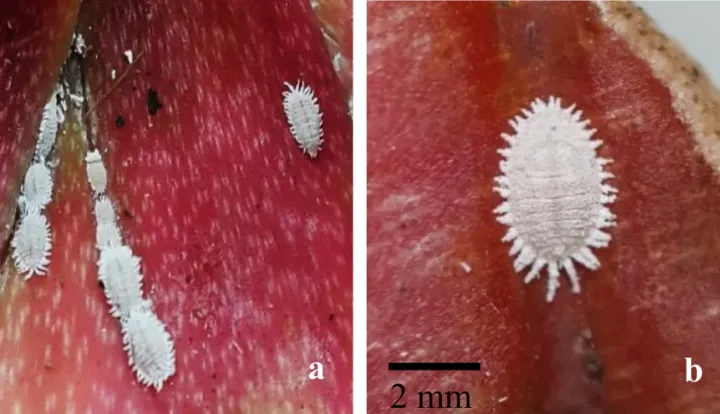
Adult females are oval-shaped and covered in a white, powdery wax secretion, which serves as a protective layer against environmental stress.
They lack wings and remain relatively stationary once they find a suitable feeding site, though first-instar nymphs, known as crawlers, are highly mobile.
Reproduction is sexual, and females deposit clusters of eggs inside protective ovisacs made of white, waxy filaments attached to the plant surface.
Morphological identification is critical, as they closely resemble other species within the Planococcus genus, requiring expert analysis for precise detection.
What it damages
This pest attacks a wide range of hosts, including grapevines, citrus trees, and various tropical plants, severely impacting their overall health.
By extracting plant sap, the mealybug weakens the host, causing stunted growth, leaf chlorosis, and in severe cases, the death of young shoots.
The secretion of honeydew promotes the growth of sooty mold, which impairs photosynthesis and reduces the market value of fruits and leaves.
Infestations often lead to premature fruit drop and the distortion of developing leaves, resulting in significant yield losses for farmers.
Persistent feeding by large colonies creates stress, making plants more susceptible to secondary infections and unfavorable climatic conditions.
When it appears
Population growth is highly dependent on temperature, with peak activity occurring during warm, humid periods of the growing season.
In greenhouses or indoor environments, the Pacific mealybug can complete multiple overlapping generations throughout the entire year.
The dispersal of mobile crawlers usually occurs during the warmest months, facilitating the rapid spread of the pest within a plantation.
Overwintering typically happens in sheltered areas like bark crevices or roots, which allows the population to persist until the next favorable season.
High relative humidity combined with warm temperatures significantly shortens the developmental cycle, leading to rapid population explosions.
Signs of infestation
Initial signs include the presence of small, white, cotton-like masses found in leaf axils, under leaf surfaces, or near the base of fruits.
Sticky honeydew residues on the foliage indicate that a mealybug colony is present and actively feeding on the upper parts of the plant.
Leaves affected by the infestation may show signs of yellowing, curling, and eventually dropping, which reflects the systemic damage to the plant.
A black, soot-like fungal growth covering the leaves and stems is a strong indicator of a long-standing mealybug infestation in the area.
- White waxy tufts on plant stems.
- Sticky residue on foliage.
- Presence of sooty mold.
- Deformed new growth.
Control measures
Strict phytosanitary inspections of imported nursery stock are essential to prevent the introduction of this pest into non-infested areas.
Cultural practices, such as pruning heavily infested branches and maintaining proper plant spacing, help to reduce the overall pest pressure.
Biological control agents, including parasitic wasps and predatory lady beetles, can effectively suppress mealybug populations in managed systems.
Chemical control focuses on applying systemic insecticides, which are most effective when targeted at the vulnerable crawler stage of the lifecycle.
Implementing an integrated pest management (IPM) program is recommended, using rotated active ingredients to prevent the development of pesticide resistance.
Discussion
No discussions yet — be the first.