
Tomato psyllid
Paratrioza
Description
How to identify
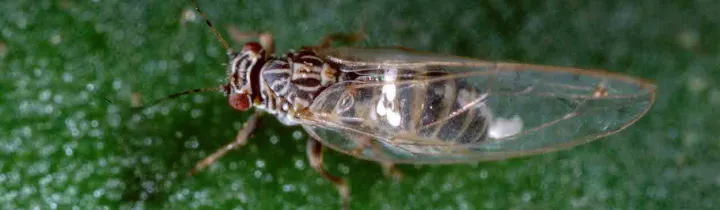
The tomato psyllid (Bactericera cockerelli), commonly known as the potato psyllid, belongs to the family Triozidae. These tiny insects, measuring only 2-3 mm, resemble miniature cicadas and are known for their ability to jump when disturbed.
Adults are typically dark-colored with a distinctive white or yellow marking on the thorax. Their wings are held roof-like over the body, and they are highly mobile, allowing them to disperse quickly across fields or greenhouses.
Eggs are small, oval, and yellow, attached to the leaf margins by tiny, hair-like stalks. This unique positioning makes them identifiable under a magnifying glass, distinguishing them from the eggs of other common greenhouse pests.
Nymphs go through five developmental stages (instars). They are flattened, scale-like, and range in color from yellowish-green to orange-brown. They are usually found on the underside of leaves, where they remain stationary while feeding.
The life cycle is temperature-dependent, with warmer conditions significantly accelerating reproduction. Multiple generations can occur within a single growing season, leading to rapid population explosions if left unchecked.
What it damages
The tomato psyllid primarily attacks solanaceous crops, including tomatoes, potatoes, peppers, and eggplants. They feed by piercing plant tissues and extracting sap, which weakens the overall health of the host plant.
A key issue is the injection of salivary toxins during feeding, which triggers a condition known as "psyllid yellows." This causes leaf curling, chlorosis, and the development of a reddish or purple tint in the foliage.
Beyond physical damage, the pest acts as a vector for the bacterium Candidatus Liberibacter solanacearum. This pathogen causes "zebra chip" disease in potatoes and severe stunting in tomatoes, rendering produce unmarketable.
Heavy infestations lead to drastic yield losses. In potatoes, the tubers may become misshapen or fail to develop properly, while in tomatoes, fruit set is severely reduced and the quality of the harvest is compromised.
The economic impact is profound, especially in regions where the associated bacterial diseases are prevalent. The combination of direct feeding damage and disease transmission makes this pest one of the most destructive in modern horticulture.
Signs of infestation
The first signs of infestation often include yellowing and curling of the upper leaves. This symptom can be mistaken for nutrient deficiencies or environmental stress, so closer inspection of the foliage is necessary.
The presence of honeydew on the leaves is a major indicator of psyllid activity. This sticky substance attracts sooty mold, which appears as a dark, dusty layer on the plant's surface, further hindering photosynthesis.
Plants affected by the toxin often show restricted internode growth, giving them a stunted, bushy, or rosette-like appearance. The overall plant architecture becomes distorted, and the ability to produce healthy flowers is severely limited.
Root system health may also decline due to the overall decline of the plant, making it more susceptible to soil-borne pathogens. In potato fields, the presence of these insects often coincides with significant harvest quality issues.
Monitoring using yellow sticky cards is the most effective way to detect the presence of adults before they lay large numbers of eggs. This allows for early intervention and targeted treatment strategies.
Control measures
Integrated Pest Management (IPM) is essential for controlling tomato psyllids. This involves a combination of cultural, biological, and chemical strategies to reduce the reliance on broad-spectrum pesticides.
Cultural practices include the removal of solanaceous weeds, which serve as alternate hosts. Proper crop rotation and the use of healthy, certified transplants are vital steps in preventing the introduction of the pest.
Chemical control focuses on the use of systemic insecticides that provide residual protection. It is important to rotate modes of action to manage potential resistance issues in psyllid populations.
In greenhouses, biological control agents such as predatory bugs, lacewings, and parasitic wasps can be highly effective. These natural enemies help maintain psyllid numbers below the economic threshold.
- Monitor fields using yellow sticky traps regularly.
- Implement rigorous sanitation to remove crop residues.
- Apply systemic insecticides during early development stages.
- Use protective screens in greenhouses to prevent entry.
Discussion
No discussions yet — be the first.