
Rice bug
Leptocorisa chinensis
Description
How to identify
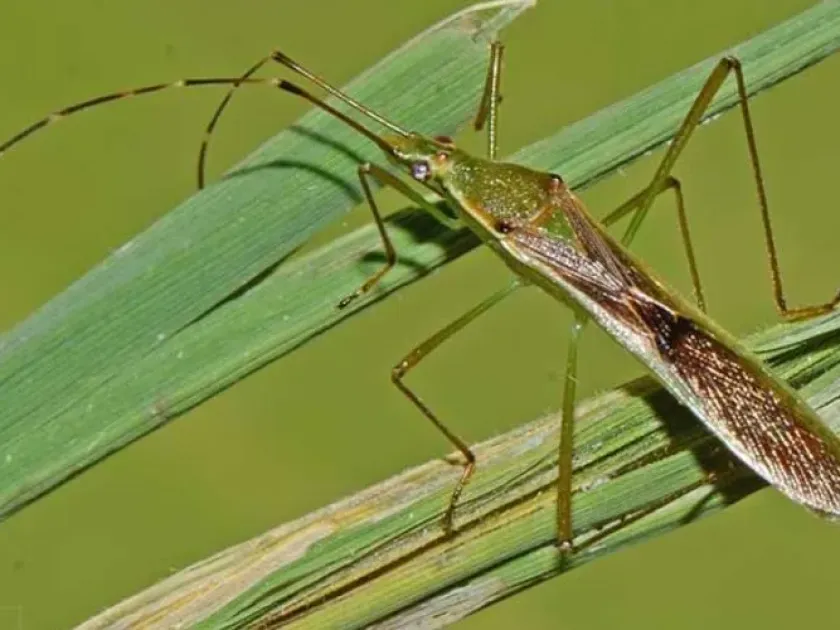
The rice bug, Leptocorisa chinensis, belongs to the Alydidae family, order Hemiptera. Adult insects have elongated, slender bodies with a yellowish-brown or greenish coloration, providing excellent camouflage among grass stems.
A distinctive feature of the imago is its long, slender legs and antennae, which are nearly the same length as the body. The head is equipped with a well-developed piercing-sucking mouthpart (proboscis) adapted for puncturing grain husks.
The eggs of this insect are oval-shaped and are typically laid in rows on the upper side of the leaves or leaf sheaths of the rice plant. They exhibit specific coloration that changes throughout the embryonic development process.
Nymphs resemble smaller versions of the adults but lack wings in the early stages. Throughout their development, they undergo several molts, gradually reaching sexual maturity.
The insect is predominantly secretive, displaying activity during the morning and evening hours, which makes it difficult to detect during the initial stages of plantation infestation.
What it damages
The primary target of the rice bug is the reproductive organs of cereal crops. Rice crops in the milk-to-dough grain stage are the most susceptible to damage.
Both adults and nymphs of all ages contribute to the damage. They feed by sucking the contents of the developing grain through a puncture in the husk.
In addition to rice, the pest can feed on wild grasses, which act as population reservoirs during the off-season. This expands the insect's food base and complicates population management.
Severe infestation leads to significant yield losses. Grains fail to develop to the required standards, becoming shriveled and losing their market value.
Beyond direct mechanical damage, the puncture sites can become entry points for fungal and bacterial infections, further reducing the overall quality of the harvested produce.
When it appears
The life cycle of the rice bug is closely linked to regional climatic conditions. In warmer climates, the insect can produce several generations within a single growing season.
The mass appearance of the pest in rice paddies coincides with the panicle emergence phase and subsequent grain filling. This is the period when the crop is most vulnerable.
Bugs typically overwinter as adults in leaf litter, dry grass, or under plant debris at the edges of fields. With the arrival of warm weather, they migrate to the crops.
The lifespan and development speed of nymphs depend on ambient temperature and humidity. Optimal conditions for rapid reproduction are high humidity and moderately warm weather.
Once the development cycle is complete and the primary crop is harvested, adult bugs move to weeds or retreat to overwintering sites until the next season.
Signs of infestation
The first sign of crop infestation is the appearance of characteristic dark or brownish spots on the grains at the puncture sites caused by the insect's proboscis.
When inspecting fields in the morning, one can observe characteristic aggregations of insects on rice panicles. The pests are quite mobile and will quickly fly away if approached or disturbed.
Damaged panicles often exhibit empty husks or the presence of underdeveloped, deformed grains that are easily separated during post-harvest cleaning.
Affected areas of the field may appear stunted. With high population density, a significant portion of the potential grain yield on infested panicles can be lost.
An indirect sign of the pest's presence is the accumulation of excrement on the leaves and stems of plants, which becomes visible to the naked eye during mass outbreaks.
Control measures
An essential element of protection is the removal of weed vegetation on field boundaries and surrounding areas, which serves as a refuge for the bugs during the autumn-winter period.
- Implementing crop rotation with non-host species.
- Adhering to optimal planting dates so that the grain filling phase does not coincide with the peak population of the pest.
- Monitoring insect populations using light traps or visual inspection of panicles.
- Employing biological control measures, including the preservation of natural entomophages (egg parasitoids).
- Applying systemic or contact insecticides when the pest population exceeds the economic injury level.
Discussion
No discussions yet — be the first.