
Hercothrips
Hercothrips
Description
How to identify
Hercothrips is a genus of insects belonging to the order Thysanoptera and the family Thripidae. These pests are characterized by a distinct reticulated (net-like) pattern on the surface of the adult's body, which is a primary diagnostic feature.
Adults are typically small, ranging from 1 to 1.5 mm in length, and possess dark brown or black coloration. The immature stages (larvae) are generally lighter in color, wingless, and tend to congregate on the undersides of leaves.
The life cycle involves several stages: egg, two larval instars, prepupa, pupa, and adult. The duration of the cycle is highly dependent on ambient temperature, with warmer conditions significantly accelerating the development rate.
Females deposit their eggs directly into the plant tissue, which provides protection from environmental extremes and some conventional contact insecticides. This reproductive strategy contributes to their success as significant agricultural pests.
Population growth is often rapid under dry, warm conditions. These environmental factors favor the transition between life stages and facilitate the quick establishment of large colonies within a cropping system.
What it damages
Hercothrips are polyphagous pests, capable of infesting a wide range of host plants, including legumes, cotton, various vegetable crops, and numerous ornamental species grown in greenhouses or open fields.
They feed by piercing plant cells and extracting the contents. This feeding action disrupts photosynthesis, weakens the plant, and causes stunted growth, which leads to significant yield losses in commercial agriculture.
In addition to direct physical damage, these thrips are potential vectors for various plant viruses. Such viral infections can lead to leaf curling, chlorosis, and severe deformations, often causing more damage than the thrips feeding themselves.
Severe infestations result in a silvering or bronzing effect on the foliage, followed by necrosis and premature leaf drop. The aesthetic and marketable quality of the produce is drastically reduced.
Plants under stress, particularly those suffering from water deficit or nutrient imbalance, are most susceptible to colonization and may suffer from total crop failure if management measures are not implemented.
Signs of infestation
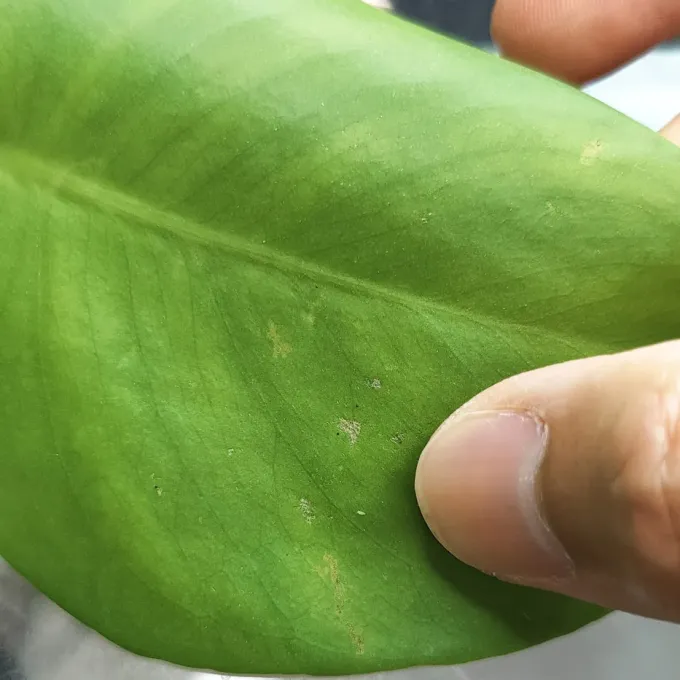
The initial signs of infestation are light-colored or silvery streaks appearing on the foliage. These marks are caused by the destruction of epidermal cells, which then fill with air.
Small black fecal spots found on the underside of the leaves are a diagnostic sign of thrips presence. These droplets are excreted by the larvae and adults and are easily visible upon close inspection.
During sunny periods, adults can be observed moving on the leaf surface. When disturbed, they often jump or perform short, quick flights, which can help in identifying their presence in the field.
Advanced infestations lead to leaf wilting, drying of leaf margins, and the development of a necrotic "net" pattern. The plant may appear generally unthrifty and significantly shorter than surrounding healthy crops.
Blue-colored sticky traps are highly effective for detecting the presence of adults before visual damage becomes widespread, allowing for early intervention in pest management programs.
Control measures
Integrated Pest Management (IPM) is the most effective approach for controlling Hercothrips. Cultural practices, such as crop rotation and the removal of alternative weed hosts, are essential to break the pest's cycle.
Maintaining adequate soil moisture and proper fertilization helps crops tolerate pest pressure. Rapid destruction of crop residues immediately after harvest prevents the pest from transitioning to nearby host plants.
Chemical control should be implemented using systemic insecticides when economic thresholds are reached. Rotation of different chemical classes is vital to prevent the development of insecticide resistance in populations.
Biological control, using predators such as predatory mites (e.g., Amblyseius spp.) or minute pirate bugs (Orius spp.), can be highly effective in greenhouse environments to suppress thrips populations.
- Regular monitoring of crop health.
- Use of blue sticky traps for early detection.
- Implementation of systemic insecticide applications.
- Sanitation of fields to remove reservoir hosts.
- Monitoring weather conditions to predict population spikes.
Discussion
No discussions yet — be the first.