
Hemerocampa tussock moths
Hemerocampa
Description
How to identify
The genus Hemerocampa belongs to the Erebidae family (formerly Lymantriidae), order Lepidoptera. These moths exhibit strong sexual dimorphism, with winged males and often flightless or vestigial-winged females.
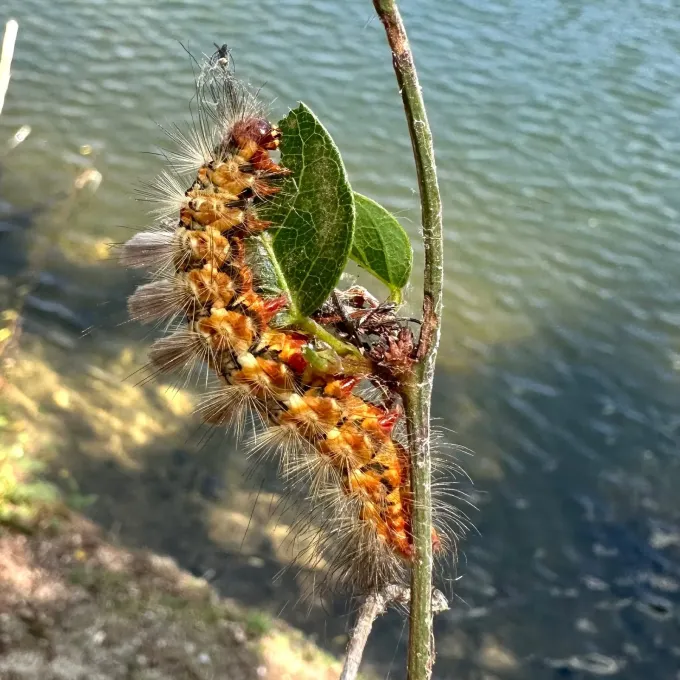
Larvae are easily identified by their dense tufts of hair, which serve as a defense mechanism. These hairs can cause skin irritation or allergic reactions in humans, so caution is advised when handling infested materials.
Adult moths are generally dull in color, blending seamlessly with bark, which provides excellent camouflage during their short adult lifespan.
The life cycle encompasses four stages: egg, larva (caterpillar), pupa, and adult. Development speed is highly dependent on ambient temperatures and host plant quality.
Overwintering occurs primarily at the egg stage, with eggs laid in protected masses on trunks or old cocoons, often covered in a protective foam-like secretion.
What it damages
Hemerocampa species are polyphagous, capable of feeding on a wide variety of deciduous trees, including oaks, birches, fruit trees, and various ornamental species.
Larvae possess chewing mouthparts that allow them to strip foliage entirely, often leaving only the midribs of leaves (skeletonization).
Severe infestations weaken trees significantly, reducing their vigor and making them susceptible to secondary environmental stressors or diseases.
Repeated defoliation over several years can lead to the decline and eventual death of young or weakened trees.
Beyond leaf damage, the destruction of buds in early spring can stunt growth and delay the tree's development for the entire season.
When it appears
Eclosion (hatching) typically begins in early spring, coinciding with bud break to ensure that newly emerged larvae have immediate access to fresh food.
The most active feeding period for larvae occurs throughout late spring and early summer, when foliage is most abundant and nutritious.
Pupation usually takes place in mid-summer, with caterpillars spinning cocoons in sheltered bark crevices or among folded leaves.
Adult emergence follows in the second half of summer, after which mating and egg-laying occur to prepare for the next generation.
The number of generations per year is largely determined by the local climate, typically ranging from one to two depending on the region.
Signs of infestation
The most visible sign of infestation is ragged, skeletonized, or entirely missing foliage throughout the tree canopy.
Egg masses appear as distinctive, greyish or yellowish foam-covered bumps on the bark or branches of host trees.
Significant amounts of caterpillar droppings (frass) accumulating on the ground or on lower branches indicate a large population feeding above.
Silken cocoons found in bark cracks or tucked within leaf clusters indicate that the insect has transitioned to the pupal stage.
Larvae may also be seen dangling from branches on silk threads, a common behavior when they move between tree parts or are dispersed by wind.
Control measures
Manual control involves scraping and destroying egg masses during the winter and early spring before they hatch.
Sticky bands or traps applied around trunks can prevent larvae from climbing back up if they are knocked off or migrate between trees.
Biological control using Bacillus thuringiensis (Bt) is highly effective against young larvae while remaining safe for beneficial insects and birds.
Chemical insecticides should be reserved for severe infestations and applied strictly according to local regulations and timing guidelines.
- Maintain tree health through proper fertilization and watering.
- Encourage natural predators like predatory wasps and birds.
- Remove and prune infested branches when populations are localized.
Discussion
No discussions yet — be the first.