
Mango mealybug
Rastrococcus mangiferae
Description
How to identify
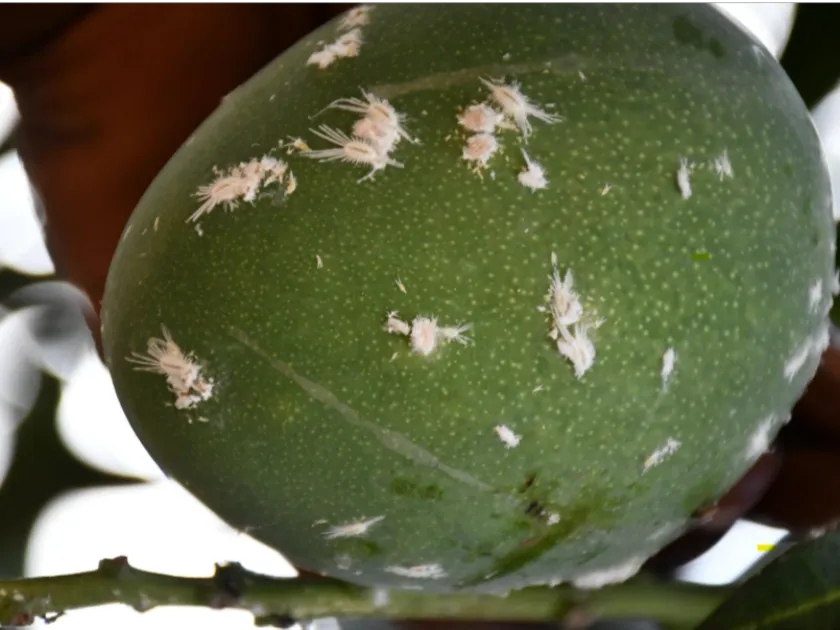
The mango mealybug (Rastrococcus mangiferae) is a member of the Pseudococcidae family within the Hemiptera order. It is a small, sap-sucking insect characterized by a waxy, white, powder-like covering on its body.
Adult females are oval-shaped and measure approximately 3 to 4 millimeters. They are relatively sedentary and secrete long, waxy filaments that form egg sacs, protecting their offspring from environmental stress.
The males are winged and significantly smaller than the females. Their role is restricted to reproduction, and they do not feed on plant tissues, living only for a very short period of their lifecycle.
The lifecycle encompasses egg, nymph, and adult stages. The female is highly prolific, laying hundreds of eggs, which allows the species to build up massive populations in a very short time.
This pest is noted for its ability to hide in crevices, bark, and underneath dense leaves, making it a difficult target for conventional sprays and manual observation.
What it damages
The mango mealybug attacks a wide range of hosts, primarily mango trees, but also citrus, guava, and various ornamental plants. It infests leaves, stems, shoots, blossoms, and fruits.
By constantly sucking sap, the insect drains the tree of vital nutrients. This causes leaf curling, stunting of growth, and the premature shedding of flower buds, leading to severe yield loss.
The pest excretes large quantities of honeydew, a sticky substance that collects on the foliage. This provides a substrate for sooty mold fungi to grow, covering the leaves in a black, photosynthetic-blocking layer.
The combined effect of sap loss and sooty mold reduces the overall health and vigor of the tree. Severe infestations can lead to total crop failure and, in extreme cases, the death of young plants.
Fruits that do develop are often malformed, covered in waxy secretions and mold, making them entirely unsuitable for market sale or local consumption.
When it appears
In its native tropical environment, the mango mealybug remains active throughout the year. Breeding occurs continuously without any seasonal diapause, facilitated by high temperatures and humidity.
Population peaks are often aligned with the flush of new vegetative growth on mango trees, as the soft, succulent tissues provide the most accessible food source for nymphs.
The dispersal of the pest is most frequent during windy conditions. Newly hatched nymphs, known as crawlers, are easily lifted by wind currents and transported to neighboring plants, spreading the infestation.
While development slows down during cooler periods, the pest maintains its presence in protected areas of the bark. In greenhouse environments, the pest can thrive 365 days a year.
High temperatures generally speed up the development process, resulting in overlapping generations and a rapid increase in the number of individuals across the orchard.
Signs of infestation
The first sign of infestation is the appearance of white, cotton-like masses on the underside of leaves and around the base of branches. These are the egg sacs produced by the females.
Leaf curling, yellowing, and general wilting are common symptoms of severe sap extraction. If a tree appears stressed without signs of water shortage, a mealybug infestation should be suspected.
Sticky residue or "honeydew" on leaves and branches is a clear indicator of a sucking pest colony. The presence of ants scavenging on the honeydew often points to the location of the infestation.
A black, sooty mold covering the canopy is a late-stage sign. It indicates that the colony has reached a high density and is severely compromising the plant's physiological processes.
Blossom blight or the failure of flowers to set fruit is another critical sign. The insects often congregate in inflorescences, sucking the moisture out of the developing reproductive organs.
Control measures
Controlling the mango mealybug requires an integrated pest management (IPM) approach that combines biological, chemical, and physical strategies.
Biological control is highly effective; the introduction or preservation of natural predators like ladybird beetles and parasitic wasps can significantly keep populations under check.
Chemical control usually involves the use of systemic insecticides that are absorbed into the plant's tissues, killing the pests when they feed. Horticultural oils are also used to suffocate the insects by penetrating their waxy coating.
Physical interventions include pruning infested branches to reduce the pest load. Proper sanitation of tools is essential to prevent the mechanical transfer of the pest between trees.
- Regular monitoring and scouting of orchard trees for early signs.
- Use of sticky bands on trunks to block ant movement and protect predators.
- Appropriate tree canopy thinning to improve sunlight and insecticide coverage.
- Strict quarantine regulations for new nursery stock entering the orchard.
- Application of soaps or oils as a low-toxicity treatment for minor localized infestations.
Taxonomy
- Latin name
- Rastrococcus mangiferae
- Order
- Hemiptera (bugs, aphids, leafhoppers)
- Family
- Pseudococcidae
- EPPO code
- RASTMA
Discussion
No discussions yet — be the first.