
Rastrococcus mealybug
Rastrococcus invadens
Description
How to identify
The mealybug Rastrococcus invadens is a member of the Pseudococcidae family, in the order Hemiptera. It is a highly invasive polyphagous pest that poses a significant threat to tropical and subtropical agriculture.
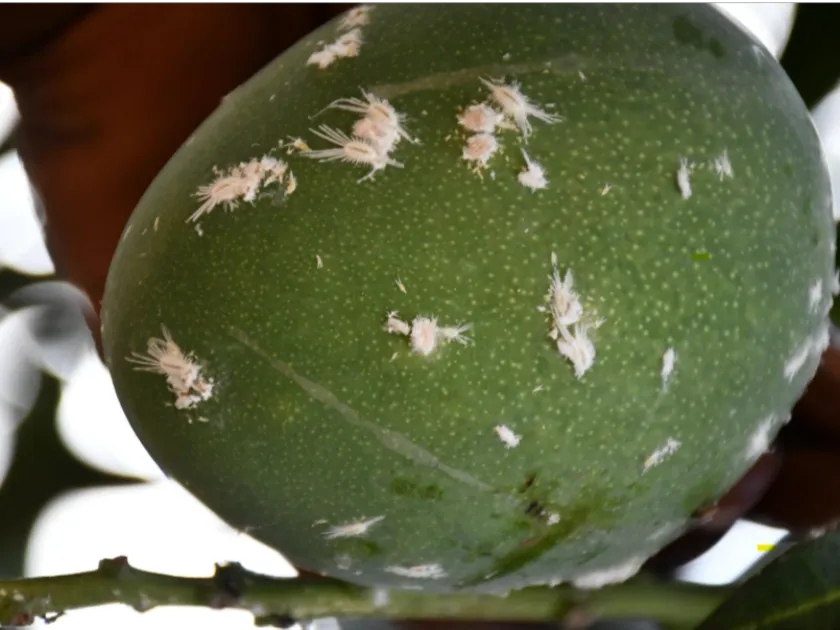
Adult females are oval-shaped and covered in a thick, white, waxy powder that resembles flour. Short waxy filaments fringe the body, giving the pest its characteristic "mealy" appearance.
The nymphs, known as crawlers, are tiny and extremely active. They are pale yellow and move across the plant surface to find suitable spots for feeding on nutrient-rich sap.
Adult males are small, winged, and do not feed during their short adult life. Their main purpose is to locate and fertilize the sedentary females, ensuring the continuation of the next generation.
Due to its high reproductive rate and lack of specialized natural predators in non-native areas, Rastrococcus invadens can cause devastating economic losses in fruit plantations.
What it damages
This pest attacks a vast range of crops, including citrus, mango, banana, papaya, and numerous ornamental plants, causing serious stress to the host.
By piercing and sucking sap from young shoots, leaves, and fruit, the mealybug weakens the plant's vascular system. This leads to stunted growth and reduced yields.
Severe infestations cause leaves to curl, yellow, and drop prematurely. Flowers and young fruit often fail to develop, leading to significant crop losses in industrial orchards.
The excretion of honeydew serves as a substrate for sooty mold fungus, which covers the foliage in a black layer, drastically reducing the efficiency of photosynthesis.
In addition to direct feeding damage, this mealybug can act as a carrier for various plant viruses, causing secondary infections that can be harder to manage than the pest itself.
When it appears
Rastrococcus invadens thrives in warm conditions, with optimal temperatures between 25°C and 30°C. In such climates, it reproduces continuously throughout the year.
Females deposit eggs into a protective waxy ovisac. This structure protects the eggs from dehydration and many environmental stressors, ensuring high hatching success rates.
The life cycle from egg to adult is short, often lasting between 30 to 40 days. This allows for multiple overlapping generations per year, leading to rapid population spikes.
Dispersal primarily occurs during the crawler stage. These small nymphs are easily carried by wind, rain, or through human intervention when transporting infested plant materials.
Populations tend to surge during periods of active plant growth when soft, succulent tissues are abundant, providing the perfect nutrition for the growing colonies.
Signs of infestation
The most noticeable sign of an infestation is the presence of white, cotton-like masses on the undersides of leaves, along leaf veins, and in the axils of young branches.
Sticky honeydew residues on leaf surfaces often attract ants, which aggressively protect the mealybugs from their natural predators, further exacerbating the problem.
Leaves may exhibit yellowing, curling, or overall wilting. In later stages, the black sooty mold film becomes clearly visible, coating leaves and stems in a dirty appearance.
Stunted development of young shoots or deformation of growing tips is a common indicator of a deep-seated infestation within the plant canopy.
- White cottony wax clusters on stems.
- Sticky honeydew on foliage.
- Development of black sooty mold.
- Deformation of growing tips.
- High ant activity around trees.
Control measures
Effective control starts with strict phytosanitary measures. Quarantine protocols and inspections of incoming nursery stock are essential to prevent the introduction of this pest.
Biological control using introduced parasitoid wasps, such as Gyranusoidea tebygi, has proven highly successful in managing populations in many affected regions.
When chemical intervention is required, systemic insecticides are the most effective. Because the wax repels water, surfactants or spreaders must be added to sprays to ensure coverage.
Pruning and destroying heavily infested branches helps reduce the overall pest pressure in the garden. Maintaining tree vigor through proper fertilization also helps plants resist damage.
Targeting ants is a crucial secondary control method. By managing the ants that protect the mealybugs, you allow beneficial predatory insects to move in and reduce the population naturally.
Taxonomy
- Latin name
- Rastrococcus invadens
- Order
- Hemiptera (bugs, aphids, leafhoppers)
- Family
- Pseudococcidae
- EPPO code
- RASTIN
Discussion
No discussions yet — be the first.