
Barber's mealybug
Puto barberi
Description
How to identify
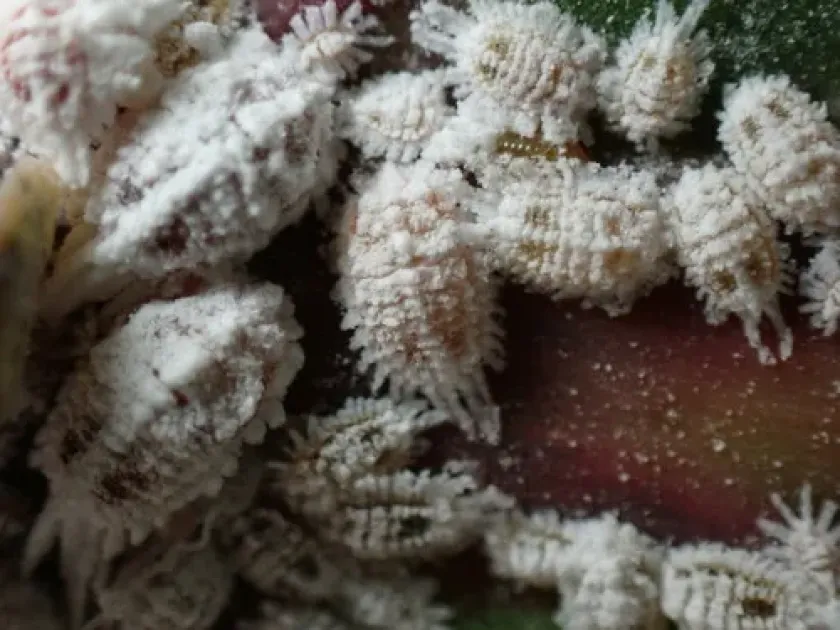
Barber's mealybug (Puto barberi) is a species of mealybug belonging to the family Putoidae. It is characterized by an oval, flattened body covered in a distinctive white, powdery waxy secretion that serves as a protective layer.
Unlike many other mealybug species, the adult females of Puto barberi maintain high mobility, possessing well-developed legs and antennae, allowing them to traverse plants efficiently.
Their life cycle consists of the egg stage, several nymphal instars, and adults. Females often lay eggs in loose waxy ovisacs, which provide necessary protection against environmental stressors.
This species is well-adapted to sheltered environments, frequently thriving in greenhouses or ornamental indoor gardens where consistent temperatures facilitate year-round reproduction.
As sucking insects, they possess piercing-sucking mouthparts that penetrate plant tissues to feed directly on phloem sap, impacting the plant's overall vitality.
What it damages
Barber's mealybug affects a diverse range of ornamental plants, greenhouse crops, and sometimes woody perennials, causing significant stress to infested hosts.
The primary damage is caused by the constant removal of plant nutrients, leading to stunted growth, reduced vigor, and in severe cases, the death of young shoots.
Infestation often results in chlorosis (yellowing of leaves), premature leaf drop, and bud deformation, which significantly ruins the aesthetic value of ornamental plants.
Furthermore, these insects excrete honeydew, a sugary substance that coats the leaves and serves as a medium for the development of sooty mold fungi.
Sooty mold growth can obstruct light absorption, effectively hampering the photosynthesis process and further weakening the host plant's defense mechanisms.
Signs of infestation
The most recognizable sign of infestation is the presence of white, cotton-like waxy masses clustered in the leaf axils, along stems, and in crevices of the bark.
Sticky residue on the foliage is a telltale sign of honeydew production, which often precedes the visible appearance of black sooty mold on leaf surfaces.
Plants infested with Puto barberi often exhibit generalized wilting or drooping, even when soil moisture levels are adequate, due to the loss of sap.
Increased ant activity around a plant is a common indicator, as ants are attracted to the sweet honeydew and often protect the mealybugs from natural predators.
Regular inspection of the underside of leaves and branch junctions is essential, as these insects prefer secluded areas to avoid disturbance and direct treatment.
Control measures
Effective management of Barber's mealybug starts with strict sanitation and quarantine protocols to prevent the introduction of the pest into new areas.
For early-stage or minor infestations, mechanical removal using a cotton swab dipped in isopropyl alcohol is an effective and safe approach for individual plants.
In cases of significant population density, systemic insecticides are necessary to ensure that the active ingredient is absorbed by the plant and reaches the hidden pests.
Consistency is key; follow-up treatments are vital to target newly hatched nymphs that may have survived previous applications due to their waxy protective coverings.
- Quarantine new plants before adding them to your collection.
- Use systemic insecticides for established infestations.
- Wipe down foliage with mild soap or alcohol solutions.
- Remove and destroy heavily infested plant parts.
Taxonomy
- Latin name
- Puto barberi
- Order
- Hemiptera (bugs, aphids, leafhoppers)
- Family
- Pseudococcidae
- EPPO code
- PUTOBA
Discussion
No discussions yet — be the first.