
Grape mealybug
Pseudococcus maritimus
Description
How to identify
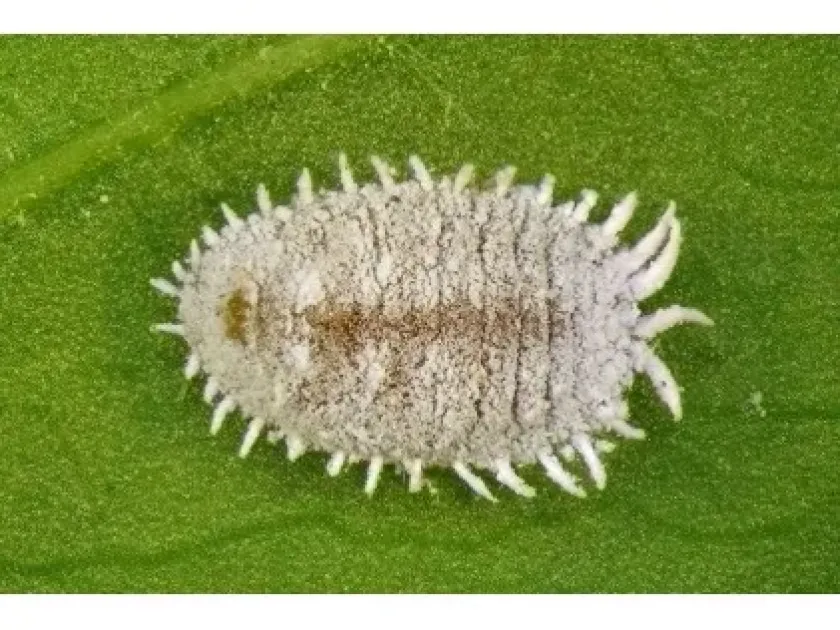
The grape mealybug (Pseudococcus maritimus) belongs to the order Hemiptera and the Pseudococcidae family. Adult females are oval-shaped, measuring approximately 3–4 mm in length, and are covered with a characteristic white, powdery wax.
The edges of the female body are equipped with short waxy filaments. Males are winged, significantly smaller, and lack functional mouthparts, meaning they do not feed and have a very short lifespan.
First-instar nymphs, known as crawlers, are pale yellow, highly mobile, and are the primary stage responsible for the dispersal of the pest throughout the vineyard.
These insects overwinter as nymphs or adult females, typically seeking refuge under loose bark, in cracks of the vine trunk, or in the soil near the root zone of the host plant.
Accurate identification is crucial, as various mealybug species resemble each other. Field diagnosis often relies on the presence of white, cotton-like masses on the woody parts of the vine.
What it damages
The grape mealybug is a polyphagous pest that affects grapes, citrus trees, pome fruits, and many ornamental plants, causing both direct and indirect damage to crops.
By sucking the sap from leaves, shoots, and fruit clusters, the insect causes the weakening of plant tissues, leading to stunted growth, leaf yellowing, and potential drop.
A major indirect threat is the production of honeydew, a sticky substance excreted by the insects. This serves as a substrate for the development of sooty mold, which blocks sunlight.
The sooty mold covers leaves and berries, severely hampering photosynthesis and ruining the aesthetic and market value of the grape clusters, making them unfit for sale.
In addition to physical damage, the mealybug can act as a vector for certain plant viruses, further complicating the management of infected vineyards.
When it appears
Pest activity begins in early spring, synchronized with the resumption of sap flow in the vines. The overwintered population emerges as temperatures consistently exceed 10–12 degrees Celsius.
The life cycle involves multiple generations per season, usually three to four depending on the climate. Warm, dry weather conditions significantly accelerate the development of each generation.
Peak population density usually occurs during the summer months, as the insects move to the clusters to feed on the pedicels and berries, protected by the foliage and grape skin.
As autumn approaches and temperatures drop, the insects begin their migration toward hibernation sites. They move downwards to the trunk or to the ground to survive the winter months.
In protected greenhouse environments, the grape mealybug may skip diapause, potentially remaining active and reproducing throughout the entire year if conditions remain stable.
Signs of infestation
The most visible sign of infestation is the presence of white, wax-like cottony masses, which are egg sacs deposited by females in bark crevices or cluster stems.
Sticky, shiny surfaces on the leaves or fruit indicate the presence of honeydew. This liquid often attracts ants, which are frequently seen tending to the mealybug colonies.
The appearance of a dark, powdery coating (sooty mold) on leaves and bunches is a clear indication that the mealybug colony has been established for a prolonged period.
General vine decline, characterized by chlorotic foliage, poor shoot development, and premature leaf drop, often signals that the infestation has reached a critical stage.
Careful inspection of the clusters often reveals individuals hiding under the berry skins or within the tight cluster structure, where they are shielded from environmental factors.
Control measures
Integrated Pest Management (IPM) is the most effective approach. Cultural practices, such as removing old bark and pruning infested wood, can significantly reduce the overwintering population.
Controlling ant populations is vital, as ants provide protection to mealybugs against their natural predators, such as ladybird beetles and parasitic wasps.
Chemical control should be timed with the emergence of the crawler stage, as they are the most vulnerable. Systemic insecticides are preferred to reach the insects in protected areas.
Biological control methods, including the release of beneficial insects like Cryptolaemus montrouzieri, offer sustainable alternatives for managing populations in various environments.
- Ensure proper canopy management to improve spray coverage.
- Monitor pest levels regularly using pheromone traps.
- Avoid over-fertilization with nitrogen, which can increase pest susceptibility.
- Apply treatments during the early crawler phase for maximum efficacy.
Taxonomy
- Latin name
- Pseudococcus maritimus
- Order
- Hemiptera (bugs, aphids, leafhoppers)
- Family
- Pseudococcidae
- EPPO code
- PSECMA
Discussion
No discussions yet — be the first.