
Long-tailed mealybug
Pseudococcus longispinus
Description
How to identify
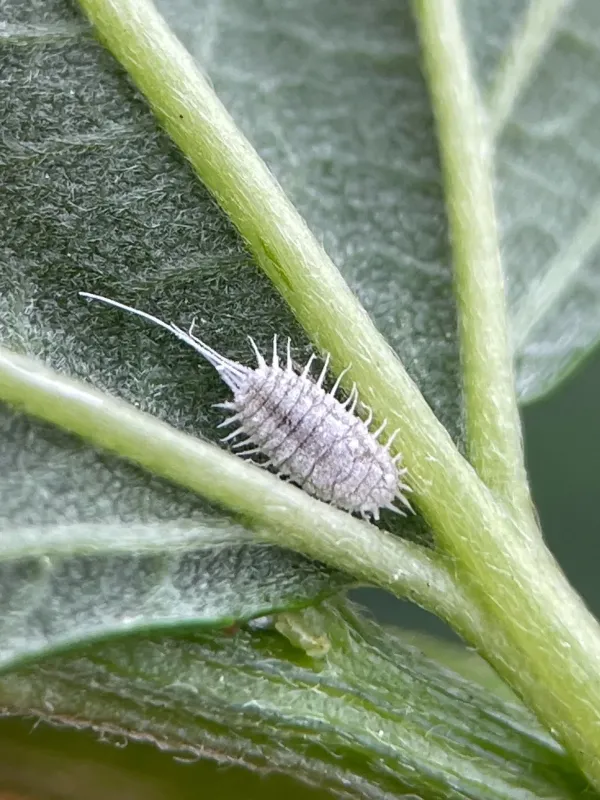
The long-tailed mealybug (Pseudococcus longispinus) is a common pest belonging to the Pseudococcidae family. These insects are small, oval-shaped, and covered in a fine, white, waxy powder that provides protection from environmental stressors.
The most distinctive morphological feature of this species is the presence of very long, slender waxy filaments at the rear of the body. These filaments are often longer than the insect's own body, serving as a reliable identification marker.
Unlike many other mealybug species that lay eggs in cottony ovisacs, the long-tailed mealybug is ovoviviparous. They give birth to live nymphs, which allows for continuous population growth on the host plant throughout the year.
Adult males are rarely seen; they are winged, do not feed, and exist solely for mating. The primary damage is caused by the sedentary adult females and the highly mobile first-instar nymphs, known as crawlers.
These pests prefer sheltered habitats on the plant, such as leaf axils, underneath leaves, near the root crown, or within tightly packed foliage, making them difficult to detect until the infestation becomes established.
What it damages
This species is a highly polyphagous pest capable of infesting a diverse array of indoor and outdoor plants. It is particularly destructive to citrus, tropical foliage plants, palms, ferns, and various succulents.
The insects damage plants by inserting their mouthparts into the phloem and sucking out plant sap. This process causes stunted growth, yellowing, leaf distortion, and premature leaf drop in severe cases.
A significant aspect of their damage is the production of honeydew, a sugary, sticky substance excreted during feeding. This honeydew serves as a growth medium for sooty mold, a fungus that covers leaves in a dark layer.
Sooty mold accumulation significantly interferes with photosynthesis by blocking light, which further weakens the host plant's health and reduces its aesthetic value. In ornamental plants, this is often the primary reason for failure.
Consistent feeding and the resulting systemic weakening make the plant more susceptible to other secondary infections, including viral pathogens, which can be exacerbated by the constant damage to the plant's vascular system.
When it appears
In greenhouses, offices, and indoor environments, the long-tailed mealybug reproduces continuously, having no true seasonal diapause. This makes them a persistent threat to indoor horticulture throughout the entire year.
The lifecycle from egg to adult is typically completed in about 30 days under favorable temperatures (around 25°C). The absence of predators in closed environments often leads to rapid population explosions.
Crawler nymphs are highly active and can disperse by walking from one plant to another, especially if the foliage of adjacent plants touches. They can also be carried by air currents or human contact during plant handling.
During the winter months, when indoor heating reduces relative humidity, the plants' natural defense mechanisms are stressed, and the dry air often allows mealybug populations to expand even more rapidly.
Monitoring should be conducted on a weekly basis, especially for susceptible species, to ensure that infestations are caught before the pest spreads across the entire plant collection.
Signs of infestation
The most reliable sign of an infestation is the presence of white, cotton-like masses found in protected plant areas. These are the waxy secretions produced by the mealybugs to shield their colonies.
Another clear indicator is the presence of sticky honeydew on the foliage or the surface beneath the plant. If the leaves feel tacky to the touch, it is a definitive sign that a large population is feeding.
Yellowing, curling, and distortion of the foliage are physiological responses to the extraction of sap. If the tips of the shoots appear wilted despite regular watering, a mealybug infestation should be suspected.
The appearance of a dark, powdery coating (sooty mold) on the leaves is a sign of an advanced infestation. This indicates that the population has been feeding for an extended period, requiring urgent control.
- White, fuzzy, cotton-like wax clusters on stems and leaf axils.
- Sticky honeydew deposits on leaves and surrounding surfaces.
- Yellowing and distortion of leaves and tender growth.
- Growth of black sooty mold on the foliage surface.
- Overall loss of vigor, slow growth, and plant wilting.
Control measures
For minor infestations, mechanical removal using a cotton swab dipped in rubbing alcohol is effective. This helps physically disrupt the colony and break the waxy protective layer.
Systemic insecticides, particularly those containing neonicotinoids, are generally the most effective method for controlling well-established populations. These chemicals are absorbed by the plant and kill the pests as they feed.
Since the waxy coating protects the insects from contact sprays, multiple applications (usually 3 to 4) spaced 7–10 days apart are necessary to target nymphs as they emerge and before they become adults.
Quarantine is essential for all new plants brought into an environment. New plants should be isolated and carefully inspected for at least three to four weeks before being placed near existing healthy plants.
Good horticultural practices, such as providing adequate ventilation and avoiding excess nitrogen fertilizer, help maintain plant health, making them less attractive and better equipped to withstand minor pest pressure.
Taxonomy
- Latin name
- Pseudococcus longispinus
- Order
- Hemiptera (bugs, aphids, leafhoppers)
- Family
- Pseudococcidae
- EPPO code
- PSECAD
Discussion
No discussions yet — be the first.