
Citrus mealybug
Planococcus citri
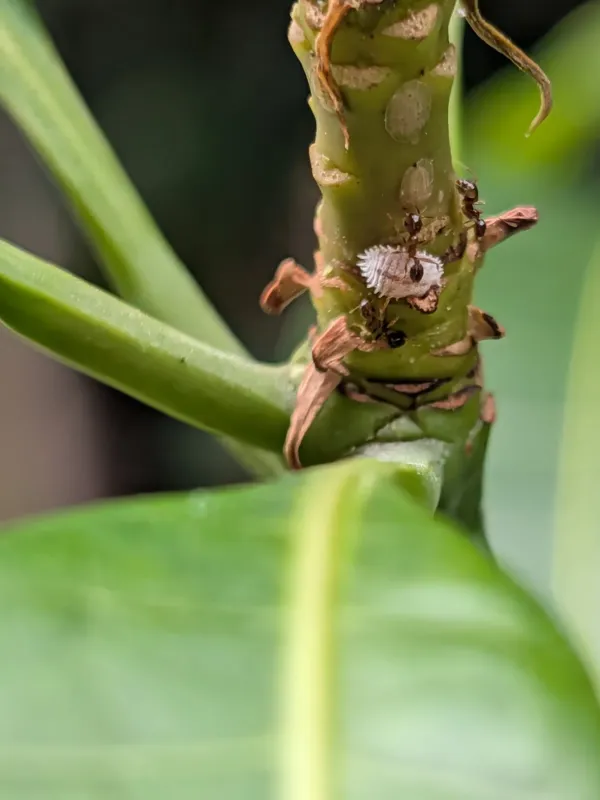
Description
How to identify
The Citrus mealybug (Planococcus citri) is a member of the Pseudococcidae family within the order Hemiptera. Adult females are oval-shaped, about 3-4 mm long, and covered in a powdery white wax.
Males are winged, smaller than females, and do not feed, as their only role is mating. First-instar nymphs, known as crawlers, are very mobile and lack the characteristic waxy coating.
Females lay eggs in loose, cottony-looking sacs composed of waxy filaments. These white masses are commonly found in sheltered areas of the host plant.
The life cycle can be completed in just a few weeks under warm temperatures, allowing for multiple overlapping generations per year, especially in greenhouses.
They are widely distributed globally and are considered one of the most serious pests for citrus and various tropical and ornamental greenhouse plants.
What it damages
This pest is a polyphagous insect that infests a vast range of hosts, including citrus fruits, vineyards, coffee plants, and numerous ornamental species.
By feeding on phloem sap, the mealybug weakens the plant structure and extracts essential nutrients, which stunts overall growth and development.
During feeding, they inject toxic saliva into plant tissues, which often results in chlorosis, leaf deformation, and early abscission of flower buds and fruit.
The honeydew excreted by the bugs accumulates on the surface of the leaves, promoting the rapid growth of sooty mold, which blocks sunlight and reduces photosynthesis.
Severe infestations can lead to the complete decline or death of young or stressed plants, making them highly susceptible to secondary pathogen infections.
Signs of infestation
The most visible sign of an infestation is the presence of white, cottony masses of wax tucked away in leaf axils, underneath leaves, or along the stems.
Plants often exhibit a sticky, glistening appearance on their foliage due to the accumulation of honeydew secretions deposited by the mealybugs.
A black, powdery layer of sooty mold often develops on the honeydew, giving the plant a dirty and unhealthy look, hindering its physiological processes.
Affected plants show signs of yellowing leaves, premature leaf drop, and distorted new growth. Fruit quality is significantly reduced in infested orchards.
- White, cotton-like wax clusters.
- Shiny, sticky residue on foliage.
- Sooty mold growth on leaves.
- Stunted or twisted shoots.
- Ant activity around the plant.
Control measures
Effective management begins with quarantine procedures for new plants to prevent the introduction of the pest into clean collections or greenhouse environments.
For small-scale infestations, manually wiping the insects off with a cotton swab soaked in isopropyl alcohol or mild insecticidal soap is a safe and effective approach.
Systemic insecticides, particularly those containing neonicotinoids or spirotetramat, are standard tools for controlling large populations in commercial agricultural settings.
Biological control using beneficial insects like Cryptolaemus montrouzieri (the mealybug destroyer) can provide excellent results, especially in greenhouse climates.
Controlling ant populations is vital, as ants protect mealybugs from natural enemies and actively transport them to new, healthy parts of the plant.
Taxonomy
- Latin name
- Planococcus citri
- Order
- Hemiptera (bugs, aphids, leafhoppers)
- Family
- Pseudococcidae
- EPPO code
- PSECCI
Discussion
No discussions yet — be the first.