
Planococcus mealybug
Planococcus
Description
How to identify
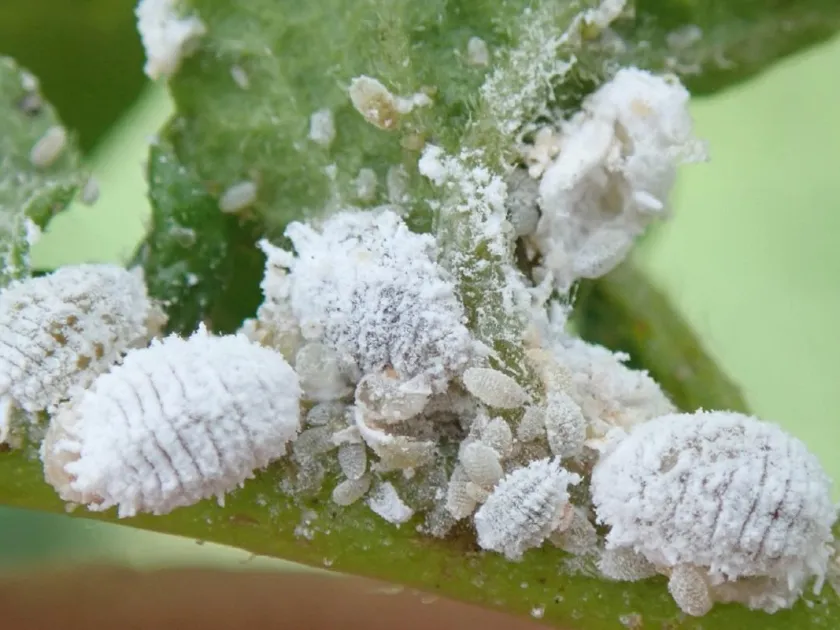
The Planococcus mealybugs are members of the order Hemiptera and the family Pseudococcidae. Adult females are oval-shaped insects covered with a white, powdery, or waxy substance that acts as a protective layer.
A key diagnostic feature is the presence of short waxy filaments along the perimeter of the body. Males are rarely seen, as they are winged and short-lived, serving primarily for reproduction, whereas females remain sedentary for most of their lives.
The crawler stage represents the most mobile and vulnerable part of the life cycle. These tiny larvae lack the heavy waxy coating and move across the plant surface in search of suitable feeding sites, making them easier targets for control.
Environmental factors heavily influence their population growth. Planococcus thrives in warm, humid conditions, typically between 25°C and 28°C, which accelerates the maturation process and the number of generations per year.
Each female produces a cottony egg sac, often containing hundreds of eggs. This reproductive strategy ensures that even a small initial infestation can rapidly escalate into a significant colony if not managed timely.
What it damages
These pests are generalists, attacking a wide variety of plants including grapevines, citrus trees, coffee, and ornamental species. They infest stems, leaf axils, fruits, and even subterranean roots.
In vineyards, these mealybugs gather under the bark and in grape clusters. By extracting phloem sap, they cause fruit drop, stunted vine growth, and overall reduced crop yield and quality.
Feeding results in the excretion of honeydew, a sugary liquid that encourages the growth of sooty mold. This black fungal coating blocks photosynthesis and severely stresses the plant’s health.
Severe infestations cause yellowing and premature leaf fall. Young plants and nursery stock are particularly susceptible, often suffering from reduced vigor or even mortality when subjected to high populations.
Beyond direct damage, they serve as vectors for various plant viruses. By moving between plants, they can facilitate the spread of viral diseases that can destroy entire orchard blocks or ornamental collections.
When it appears
In outdoor environments, Planococcus activity usually begins in late spring as temperatures rise. The peak population density typically occurs during the mid-summer months when environmental conditions are most optimal.
In greenhouses and indoor settings, these pests can reproduce continuously throughout the year. The lack of distinct seasonal cycles allows for overlapping generations and constant pressure on plant health.
As autumn approaches, reproduction slows down, but the pests continue feeding in protected areas like bark fissures, leaf bases, or dense foliage where the microclimate remains warmer.
Spread across fields or nurseries often occurs through crawler dispersal, assisted by wind, splashing water during irrigation, or by ants that transport the mealybugs to new feeding grounds.
Consistent monitoring is essential throughout the growing season, especially in high-density plantings where air circulation is limited and humidity tends to remain higher.
Signs of infestation
The most recognizable sign of an infestation is the presence of white, cotton-like masses on stems and the underside of leaves. These masses protect the egg-laying females.
Sticky honeydew on leaf surfaces often attracts ants, which protect the mealybugs from natural predators. Seeing an unusual abundance of ants on a plant is a major red flag.
Deformation of new growth, such as curled leaves or stunted tips, indicates that the mealybugs are actively extracting sap. The plant may lose its vigor and stop developing normally.
The development of a black, sooty fungal layer is a clear sign that the mealybug population has been present long enough to produce significant amounts of honeydew.
- White cottony masses in leaf axils or on stems.
- Sticky honeydew residue on foliage and fruit.
- Black sooty mold growth on plant surfaces.
- Distorted or stunted new growth.
- High ant activity around the plant.
Control measures
Effective management requires an integrated approach. Start by mechanically removing heavily infested plant parts or washing the plants with high-pressure water to reduce the population.
Ant control is crucial, as ants provide protection for mealybugs against natural enemies. Using physical barriers on tree trunks can help isolate the plant canopy from ant interference.
Biological control involves releasing natural predators such as Cryptolaemus montrouzieri (a predatory beetle) or parasitic wasps, which are highly effective in controlled environments like greenhouses.
Systemic insecticides are generally preferred for chemical control because contact sprays often fail to reach mealybugs hidden under the protective waxy layer or in cracks in the bark.
Strict quarantine protocols for new plant material are essential to prevent the introduction of Planococcus into clean areas. Regular inspections and early intervention are the most cost-effective strategies.
Taxonomy
- Latin name
- Planococcus
- Order
- Hemiptera (bugs, aphids, leafhoppers)
- Family
- Pseudococcidae
- EPPO code
- PLANSP
Discussion
No discussions yet — be the first.