
Solenopsis mealybug
Phenacoccus solenopsis
Description
How to identify
The Solenopsis mealybug (Phenacoccus solenopsis) is a serious agricultural pest belonging to the Pseudococcidae family. It is a soft-scale insect characterized by a white, waxy, mealy secretion that covers its body, providing protection against predators and desiccation.
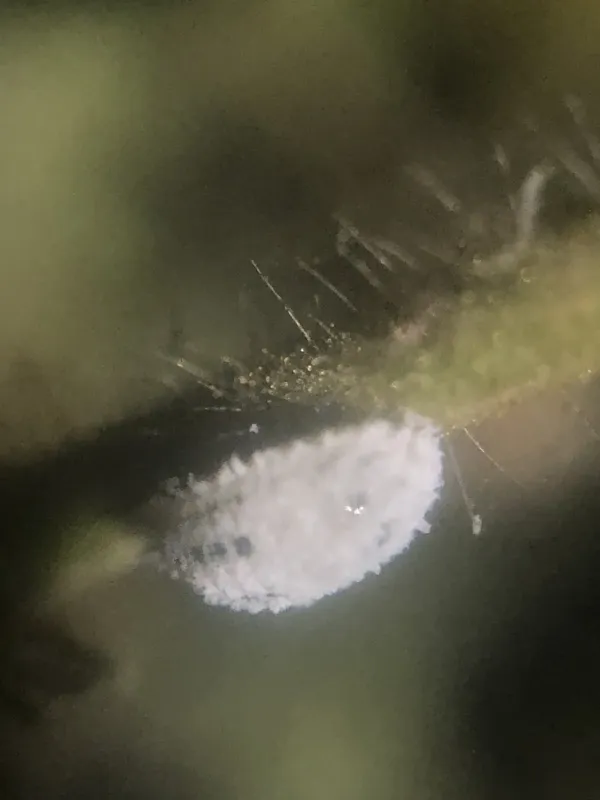
Adult females are oval-shaped, measuring 2-4 mm, and are typically found in clusters on leaves, stems, and fruits. They have a distinct grayish or white appearance due to the dense waxy covering, often with darker spots visible along the dorsal surface.
This species is highly prolific, reproducing primarily through parthenogenesis. A single female can produce several hundred eggs within a waxy ovisac, allowing for rapid population growth in favorable conditions.
The first instar nymphs, known as crawlers, are very mobile and are the primary stage responsible for the dispersal of the pest between plants via wind, water, or human activity.
Due to its wide host range and high reproductive rate, Phenacoccus solenopsis is considered an invasive pest in many parts of the world, capable of causing significant economic losses.
What it damages
The pest is a polyphagous insect that attacks hundreds of plant species, including economically important crops like cotton, tomatoes, peppers, and various ornamental plants. It feeds by inserting its stylets into the plant tissue and sucking phloem sap.
Feeding causes physiological disruption, leading to stunted growth, yellowing (chlorosis), and leaf curling. The plant's overall vitality is severely reduced, which often results in the abscission of leaves, buds, and young fruits.
Mealybugs excrete large amounts of honeydew, a sticky, sugary substance that coats the plant surfaces. This serves as an excellent substrate for the growth of sooty mold, which blocks sunlight and hinders photosynthesis.
Severe infestations can lead to the death of entire plants if not addressed promptly. In cotton crops, specifically, this pest can cause significant damage to bolls, affecting both fiber quality and total yield.
The damage is compounded by the fact that the pest is difficult to eradicate once it is established, as it thrives in diverse environments and hides in crevices of the plant.
When it appears
The population dynamics of the Solenopsis mealybug are heavily influenced by temperature and humidity. It thrives in hot, arid to semi-arid conditions, with an optimal temperature range between 25°C and 35°C.
In temperate climates, the pest is most active during the summer months when environmental conditions allow for multiple rapid generations. Under these optimal conditions, a generation can complete its cycle in as little as 20 to 30 days.
In greenhouse environments, the pest remains active year-round due to the stable, warm climate. This continuous cycle makes greenhouse management particularly challenging compared to open-field systems.
As temperatures rise during the spring and summer, the mobility of crawler nymphs increases, leading to a wider dispersal across the crop canopy.
The pest is capable of surviving the winter in a quiescent state or by migrating to perennial weed hosts, which serve as reservoirs for re-infestation when the season begins.
Signs of infestation
Early detection is crucial for managing the Solenopsis mealybug. The most obvious sign is the appearance of white, cotton-like masses on the undersides of leaves, along the stems, and in the leaf axils.
The presence of sticky honeydew on the leaves is a key indicator, often appearing before the mealybugs themselves are noticed. This sticky residue attracts ants, which may protect the mealybugs from their natural enemies.
Sooty mold growth, appearing as a black, powdery layer on leaves and stems, indicates that the infestation has been present for a significant period of time.
Plants often exhibit signs of stress, such as yellowing leaves, tip dieback, or deformed growth, which may be mistaken for nutrient deficiencies or other diseases.
- cottony white masses on plant stems and leaves;
- sticky honeydew residue;
- black sooty mold on foliage;
- yellowing and wilting of plant parts;
- stunted terminal growth and leaf abscission.
Control measures
Integrated Pest Management (IPM) is the most effective approach to controlling Phenacoccus solenopsis. This involves a combination of chemical, biological, and cultural methods to reduce the pest population below economic thresholds.
Chemical control focuses on the use of systemic insecticides that are absorbed by the plant, ensuring that the pest is exposed to the toxicant during feeding. It is vital to rotate insecticides with different modes of action to prevent the development of resistance.
Biological control agents, such as predatory beetles (e.g., Cryptolaemus montrouzieri) and parasitoid wasps, can be highly effective in reducing mealybug numbers, particularly in protected agriculture.
Cultural practices include the removal and destruction of infested weeds, which act as secondary hosts, and the use of clean, certified nursery stock to prevent the introduction of the pest into the field or greenhouse.
Regular scouting using yellow sticky traps and visual inspections is essential for the early detection and timely application of control measures to prevent a full-scale outbreak.
Taxonomy
- Latin name
- Phenacoccus solenopsis
- Order
- Hemiptera (bugs, aphids, leafhoppers)
- Family
- Pseudococcidae
- EPPO code
- PHENSO
Discussion
No discussions yet — be the first.