
Solanum mealybug
Phenacoccus solani
Description
How to identify
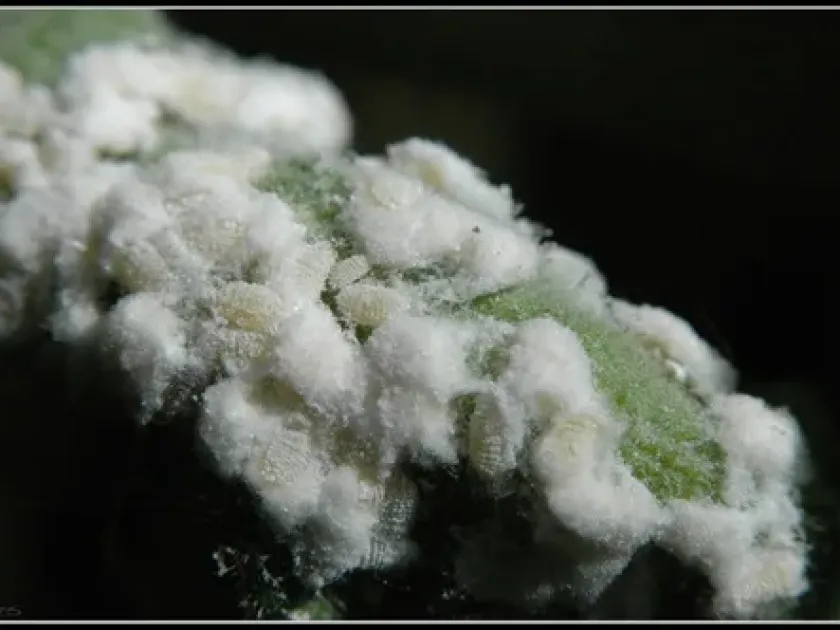
The Solanum mealybug (Phenacoccus solani) is a member of the family Pseudococcidae, belonging to the order Hemiptera. These pests are characterized by their small size and a distinctive white, waxy, mealy secretion covering their bodies.
Adult females are typically oval and measure 2–3 mm in length. This waxy layer acts as a highly effective barrier against moisture loss and external contaminants, making the application of contact pesticides particularly challenging.
Mobile nymphs, often called crawlers, are pale yellow and move actively across the plant foliage. Their high mobility allows for rapid colonization of healthy tissues and neighboring plants within a greenhouse environment.
The life cycle includes egg, nymphal, and adult stages. In favorable conditions, such as high humidity and consistent warmth, multiple generations can occur continuously throughout the growing season.
Males of the species are rarely observed, as they are winged and short-lived, playing a minimal role in the visible infestation compared to the stationary and reproductive females.
What it damages
This pest is a significant polyphagous insect, capable of infesting a wide range of horticultural crops. The most affected include solanaceous plants like tomatoes, potatoes, eggplants, and peppers.
In addition to commercial vegetables, Phenacoccus solani is a frequent nuisance on indoor ornamental plants, causing damage to citrus trees, fuchsias, and various succulent species.
The insects target vital parts of the plant, including shoots, leaf petioles, and buds. They pierce the plant tissue to suck out cellular sap, significantly weakening the plant's overall vigor.
Heavy infestations lead to stunted growth, leaf deformation, chlorosis, and premature senescence of the foliage, which results in a substantial decrease in yield and aesthetic value.
As they feed, mealybugs excrete large amounts of honeydew, a sticky substance that promotes the growth of sooty mold, further interfering with photosynthesis and plant health.
Signs of infestation
The most prominent sign of infestation is the appearance of white, cottony masses in the leaf axils, on the undersides of leaves, and near the growth points of the stems.
Sticky residue on leaves or nearby surfaces is a key indicator of infestation. This sugary honeydew often attracts ants, which frequently protect the mealybug colonies from natural predators.
Affected plants often display signs of decline, such as wilting despite adequate watering, yellowing leaves, and a general lack of vitality as the pest depletes the plant's nutrients.
The presence of black, velvety sooty mold on the leaves is a secondary sign that indicates a significant population of mealybugs has been feeding on the plant for some time.
Regular monitoring of stem junctions and the undersides of leaves is crucial, as the insects prefer these sheltered spots to hide and feed away from direct sunlight.
Control measures
Managing Phenacoccus solani requires an integrated pest management (IPM) strategy. Given their waxy coating, simple contact sprays are often insufficient for complete eradication.
Cultural practices, such as inspecting new plants before introducing them to the garden, removing and destroying heavily infested plant parts, and maintaining plant hygiene, are the first line of defense.
Biological control agents, such as predatory beetles or parasitic wasps, can be highly effective in greenhouse settings to keep populations below the economic threshold without toxic chemicals.
Systemic insecticides are the most effective chemical method. These chemicals are absorbed by the plant and translocated to the tissues where mealybugs feed, ensuring more reliable long-term control.
- Quarantine new plants carefully.
- Prune and destroy heavily infested areas.
- Utilize systemic insecticides during irrigation.
- Monitor populations using yellow sticky traps.
Taxonomy
- Latin name
- Phenacoccus solani
- Order
- Hemiptera (bugs, aphids, leafhoppers)
- Family
- Pseudococcidae
- EPPO code
- PHENSL
Discussion
No discussions yet — be the first.