
Mealybug Phenacoccus miruku
Phenacoccus miruku
Description
How to identify
Phenacoccus miruku is a member of the Pseudococcidae family, commonly known as mealybugs, within the order Hemiptera. These insects are easily recognized by the waxy, mealy-like secretion that covers their bodies.
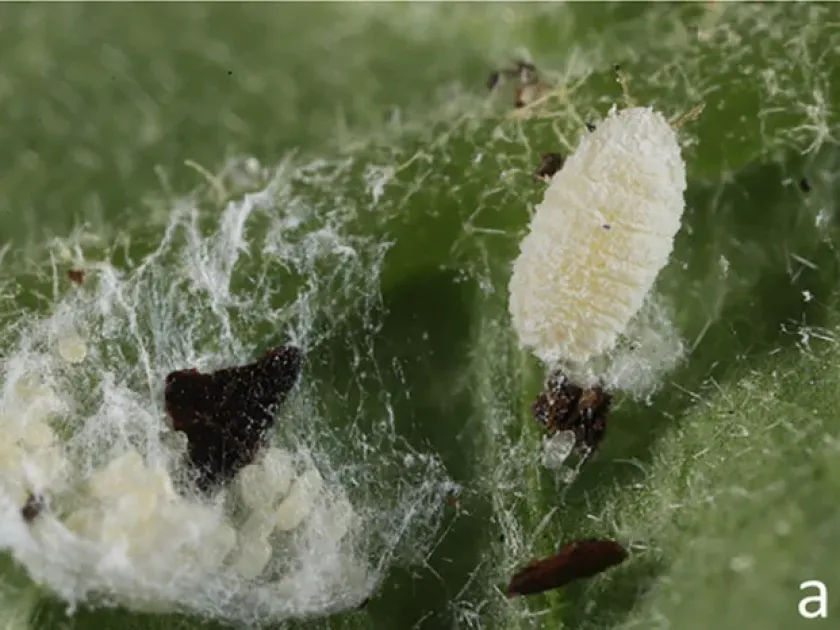
Adult females are typically oval-shaped, displaying colors ranging from off-white to pale pink. Males, which are rarely seen, possess wings and are capable of flight, which facilitates the search for mates.
A distinctive morphological feature of this species is the presence of long waxy filaments along the perimeter of the body. These projections act as a camouflage and offer protection against environmental stressors.
The life cycle encompasses egg, nymph (instar), and adult stages. Females produce hundreds of eggs, which are carefully tucked into protective ovisacs made of dense, white, thread-like waxy materials.
This species is highly adaptable to various microclimates. It thrives particularly well in greenhouse environments characterized by consistent temperatures and high humidity levels.
What it damages
This pest is a polyphagous insect that infests a diverse range of ornamental, fruit, and vegetable plants. It frequently attacks indoor foliage and greenhouse crops, causing significant agricultural losses.
The primary damage is caused by the nymphs and adult females extracting sap from tender shoots, leaves, and flower buds. This nutrient depletion leads to stunted growth and wilting.
Feeding activity leads to the excretion of honeydew, a sugary substance that serves as a substrate for sooty mold. This black fungal growth inhibits photosynthesis, further weakening the plant.
Severe infestations manifest as leaf deformation, premature bud drop, and chlorosis. If left unchecked, the plant may suffer from overall decline and eventual death.
Phenacoccus miruku also acts as a potential vector for various plant pathogens. By moving between host plants, they can facilitate the transmission of viral diseases that compromise crop quality.
Signs of infestation
The first indicator of an infestation is the presence of white, cottony masses in leaf axils or on the undersides of leaves. These clusters are often mistaken for fungal growth at first glance.
A sticky film of honeydew on leaf surfaces or the surrounding substrate is a clear sign of active feeding. This substance often attracts secondary pests, such as ants, which guard the colony.
Curling of young leaves and distortion of growing tips are common symptoms of localized sap depletion. Plants may appear generally lusterless and lack typical growth vigor despite sufficient watering.
Yellowing or chlorotic spots on leaves often precede necrotic tissue development as the plant's metabolic processes are disrupted by the feeding pressure.
Detailed inspections of hidden crevices, such as stem junctions and root crowns, are necessary to detect early-stage populations before they spread to other parts of the plant collection.
Control measures
Effective management of Phenacoccus miruku requires an integrated approach that utilizes mechanical, biological, and chemical control strategies tailored to the infestation level.
Mechanical removal is viable for mild infestations; wiping affected areas with alcohol-soaked swabs or insecticidal soap can effectively reduce the population of adults and egg masses.
Biological control agents, such as predatory beetles or specific parasitoid wasps, can be deployed in greenhouse settings to provide sustainable suppression of the pest population.
Chemical control involving systemic insecticides is often necessary for persistent infestations. These chemicals are absorbed by the plant, providing long-lasting protection against internal and external feeders.
Preventive measures remain the most critical aspect of control: enforcing strict quarantine procedures for new arrivals and maintaining optimal growing conditions help minimize the risk of outbreaks.
Taxonomy
- Latin name
- Phenacoccus miruku
- Order
- Hemiptera (bugs, aphids, leafhoppers)
- Family
- Pseudococcidae
- EPPO code
- PHENMK
Discussion
No discussions yet — be the first.