
Cassava mealybug
Phenacoccus manihoti
Description
How to identify
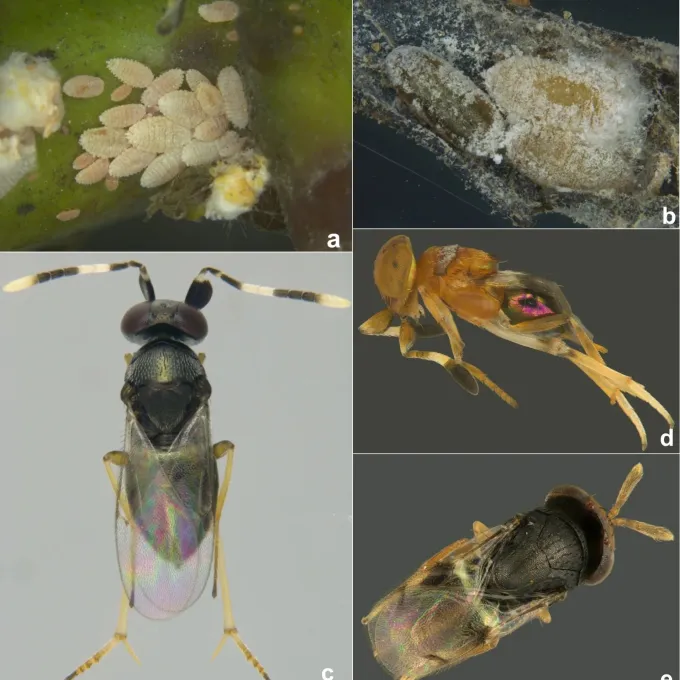
The cassava mealybug (Phenacoccus manihoti) belongs to the order Hemiptera and the family Pseudococcidae. Adult females are oval-shaped and covered with a white, powdery wax that acts as a protective shield against environmental stressors.
This species reproduces through parthenogenesis, meaning females do not require fertilization to lay eggs. This biological trait allows for rapid population growth and colonization of host plants.
First-instar nymphs, known as crawlers, are highly mobile and are primarily spread by wind currents. This wind-assisted dispersal is the main mechanism for the infestation of new cassava fields.
The life cycle is heavily influenced by temperature and humidity, with development often completing within a few weeks under favorable tropical conditions.
As a specialized pest, Phenacoccus manihoti is perfectly adapted to the physiology of the cassava plant, allowing it to thrive and cause significant damage in short timeframes.
What it damages
The primary host for this pest is cassava (Manihot esculenta). The mealybugs aggregate on apical buds, young leaves, and succulent stems, where they insert their stylets to suck phloem sap.
Mass infestations lead to severe stunting, leaf curling, and distortion of the growing points. The plant's inability to photosynthesize properly results in significant biomass reduction.
The damage extends to the root system, where the lack of nutrients transported from the leaves severely limits the development of storage tubers, drastically reducing overall yield.
Mealybugs excrete honeydew, a sticky substance that promotes the growth of sooty mold. This fungus blocks sunlight and further reduces the plant's capacity for photosynthesis.
In severe cases, the plant may suffer from "witches' broom" symptoms, where excessive side-branching occurs, leading to stunted, unproductive bushes and substantial economic losses.
Signs of infestation
The most common sign is the presence of white, cotton-like masses on the undersides of leaves and in the crevices of growing tips, which represent the wax covers of the mealybugs.
Plants display visible signs of distress, including yellowing leaves, tip curling, and a generally dwarfed appearance. The apical growth points may stop developing altogether.
The presence of honeydew on the leaves, followed by the development of a dark sooty mold, indicates active mealybug infestation. Ants are frequently found attending the colonies to feed on the honeydew.
Wilted stems and a lack of vigor are characteristic of plants that have been heavily colonized for an extended period, signaling that the mealybug population is high.
Early detection is possible through periodic field scouting, specifically targeting the tips of young cassava plants where the mealybugs first establish their colonies.
Control measures
Classical biological control is the gold standard for managing Phenacoccus manihoti, primarily through the release of the parasitic wasp Anagyrus lopezi, which specifically targets this pest.
Cultural control measures involve the use of clean, mealybug-free planting material. Cuttings can be treated with heat or mild insecticidal dips to ensure they are free of eggs and nymphs before planting.
Maintaining proper distance between new and existing infested fields helps in slowing down the spread of wind-borne crawlers across large agricultural areas.
While systemic insecticides can be used, they are generally avoided in large-scale cassava production due to cost and the risk of disrupting natural biological control agents.
- Release of Anagyrus lopezi as a biocontrol agent.
- Selection of mealybug-resistant cassava varieties.
- Strict quarantine on the movement of infected cassava cuttings.
- Removal and destruction of highly infested plant materials.
Taxonomy
- Latin name
- Phenacoccus manihoti
- Order
- Hemiptera (bugs, aphids, leafhoppers)
- Family
- Pseudococcidae
- EPPO code
- PHENMA
Discussion
No discussions yet — be the first.