
Madeira mealybug
Phenacoccus madeirensis
Description
How to identify
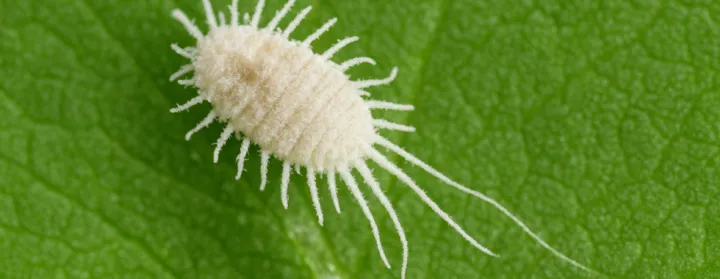
The Madeira mealybug (Phenacoccus madeirensis) is a member of the Pseudococcidae family. The adult female is oval-shaped, measuring 2–3 mm in length, and is covered with a characteristic white, powdery waxy secretion.
Unlike some other mealybug species, P. madeirensis lacks long wax filaments at the posterior end, giving it a more compact appearance. The body color under the wax layer is typically light gray or brownish.
Males are rarely observed; they are winged and much smaller than females. Their main purpose is to locate females for reproduction, as they do not feed during their adult stage.
The life cycle includes the egg stage, three nymphal instars, and the adult stage. Females lay their eggs in a protective, loose, cottony mass known as an ovisac, often found in sheltered areas of the plant.
This species is highly adaptable and thrives in warm environments, making it a persistent pest in greenhouses, nurseries, and indoor plant collections worldwide.
What it damages
The Madeira mealybug is a highly polyphagous pest, infesting over 50 host plants, including citrus, grapes, hibiscus, various ornamental shrubs, and vegetable crops.
Damage occurs when the insects insert their stylets into plant tissues to feed on sap. This constant removal of nutrients results in stunted growth, chlorosis, and general decline of the host plant.
The pest excretes large quantities of honeydew, which accumulates on the leaves and stems. This sticky substance provides an ideal substrate for the growth of sooty mold, which impairs photosynthesis.
Feeding also results in the injection of toxins, leading to distorted leaf growth, curling, and the premature shedding of flower buds or leaves.
In commercial agriculture, infestations lead to significant economic losses due to the unsightliness of ornamental plants and reduced productivity in fruiting species.
When it appears
In greenhouses and interior landscapes, the Madeira mealybug is active year-round. Development is continuous, as the controlled climate prevents the pest from entering a dormancy phase.
Developmental rates are heavily influenced by temperature, with warmer conditions significantly accelerating the maturation process from egg to adult in as little as three weeks.
In outdoor settings, populations peak during the warmer months. Infestations often begin when infested indoor plants are moved outdoors during the summer, allowing the pest to spread to landscape plants.
During colder periods, the pest survives by finding refuge in protected plant parts such as bark crevices, leaf axils, or the root collar near the soil surface.
High population densities often emerge following periods of environmental stability, where the lack of natural predators and favorable temperatures allow for exponential growth.
Signs of infestation
The most noticeable sign of infestation is the presence of white, cottony masses on the undersides of leaves, along leaf veins, and at the junctions of stems and branches.
Sticky honeydew on the foliage is a key diagnostic indicator. Over time, this honeydew turns black as sooty mold colonizes the surface, giving the plant a dirty appearance.
Plants may exhibit signs of stress, such as yellowing leaves (chlorosis), leaf distortion, or wilting. Growth tips may become twisted or fail to develop normally.
In severe cases, you may find clusters of small, mobile, yellowish crawlers on the stems or near the crown of the plant, often mistaken for dust or fungal debris.
- White, cotton-like wax deposits
- Sticky residue on foliage
- Presence of black sooty mold
- Leaf curling and yellowing
- Stunted shoot growth
Control measures
Integrated Pest Management (IPM) is essential for controlling the Madeira mealybug. This includes strict quarantine measures for any new plant material brought into a greenhouse or home.
Mechanical control is effective for light infestations; wiping affected areas with a cotton swab dipped in isopropyl alcohol can physically remove insects and their egg masses.
Chemical control should prioritize systemic insecticides like neonicotinoids or insect growth regulators. These move through the plant's vascular system, providing protection against hidden insects.
Repeated applications are crucial because the waxy covering of the adults often protects them from contact insecticides. Treatments should be spaced 7–10 days apart to target newly hatched nymphs.
Maintaining optimal plant health is key. Avoid excessive nitrogen fertilization, which creates soft, succulent tissue that is highly attractive to mealybugs and facilitates faster reproduction.
Taxonomy
- Latin name
- Phenacoccus madeirensis
- Order
- Hemiptera (bugs, aphids, leafhoppers)
- Family
- Pseudococcidae
- EPPO code
- PHENMD
Discussion
No discussions yet — be the first.