
Cereal mealybug
Phenacoccus graminicola
Description
How to identify
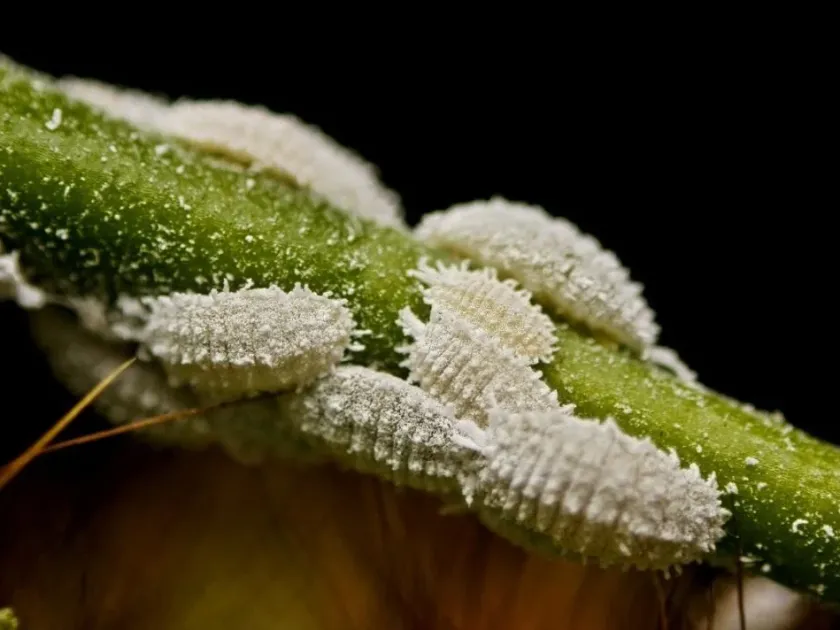
The cereal mealybug (Phenacoccus graminicola) is an insect belonging to the Pseudococcidae family within the order Hemiptera. They are characterized by a soft, oval body covered with a white, powdery waxy secretion.
Adult females are generally 3–5 mm in length and possess well-developed legs, which enable them to move effectively across the plant surfaces to locate feeding sites.
Males of this species are rarely observed. They are smaller, possess a pair of wings, and, unlike females, do not feed during their adult stage, focusing solely on reproduction.
The nymphs, or crawlers, are mobile and covered in a fine waxy layer. This stage is crucial for the pest's dispersal as they can easily be carried by wind to neighboring plants.
Because they often hide within the leaf sheaths or near the base of the stems, they are frequently overlooked until the infestation has reached a critical density.
What it damages
This pest is a specialist that primarily targets plants within the Poaceae family. It feeds by inserting its stylets into the plant tissue to suck sap, causing significant stress.
Key agricultural crops affected include wheat, barley, oats, and millet. Wild grasses in and around fields also act as essential hosts for the development of populations.
The damage is most severe during the vegetative growth phase. Constant sap extraction weakens the plant, reducing its ability to allocate nutrients to the developing spike.
Infested plants exhibit stunted growth, chlorosis of the leaves, and in severe cases, partial or total failure of spike development, leading to lower grain weight and yield losses.
The accumulation of honey dew, an excretory byproduct of the mealybug, creates a substrate for sooty mold growth, further hindering photosynthesis and overall plant health.
When it appears
Winter survival is typically achieved through eggs or nymphs that overwinter in protected environments, such as crop debris, deep in leaf sheaths, or within the soil.
As temperatures rise in the spring, usually exceeding 10–12 degrees Celsius, the nymphs resume activity and migrate towards the developing shoots of the cereal crops.
The number of generations per season is determined by local climatic conditions. In favorable warm years, multiple overlapping generations can occur, leading to population explosions.
The peak of infestation is usually observed during the late spring to mid-summer period, coinciding with the rapid growth phase of the cereals, from booting to heading.
As autumn approaches and plants reach maturity or senesce, the mealybug populations search for overwintering sites, entering a period of diapause until the following spring.
Signs of infestation
The most visible symptom is the presence of white, cotton-like masses of waxy filaments, which indicate the presence of females and their egg sacs under leaf sheaths.
Affected plants show distinct yellowing and curling of the leaves. In the field, this often manifests as localized patches of discolored and unhealthy-looking plants.
The honey dew secretions make the plant surface sticky, which eventually attracts dark sooty mold fungi, giving the stems and leaves a blackened appearance.
Overall crop vigor is significantly reduced, with stunted stems and poorly filled heads being the primary indicators for field scouts during harvest preparation.
- White waxy tufts under leaf sheaths.
- Sticky residue on stems and leaves.
- Black sooty mold fungus on the plant surface.
- Yellowing and premature drying of lower leaves.
- Significant stunting and grain weight loss.
Control measures
Cultural control is the first line of defense, involving the removal of crop residues and deep plowing to destroy overwintering populations within the soil and stubble.
Effective weed management is vital, as wild grass species serve as reservoirs for the pest when primary crops are absent or not yet available.
Chemical control should be implemented using systemic insecticides. These are necessary to reach the pests that are well-protected beneath the dense leaf sheaths.
Timing of applications is critical; treatments are most effective if applied before the female produces the thick, waxy protective layer that shields her eggs.
Biological control, encouraging natural enemies like ladybird beetles and parasitic wasps, plays a vital role in preventing the mealybug population from reaching economic injury levels.
Taxonomy
- Latin name
- Phenacoccus graminicola
- Order
- Hemiptera (bugs, aphids, leafhoppers)
- Family
- Pseudococcidae
- EPPO code
- PHENGM
Discussion
No discussions yet — be the first.