
Mexican mealybug
Phenacoccus gossypii
Description
How to identify
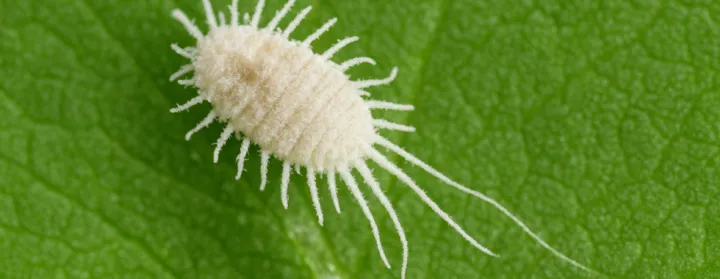
The Mexican mealybug (Phenacoccus gossypii) belongs to the Pseudococcidae family within the Hemiptera order. It is a small sap-sucking insect characterized by a body covered in a white, waxy, flour-like secretion.
Adult females have an oval-shaped body reaching up to 3–4 mm in length. They possess well-developed legs, which enable them to move actively across the plant to find the most suitable feeding sites.
Males of this species are rarely encountered and differ significantly from females; they possess a single pair of wings, well-developed antennae, and are capable of flight. However, their life cycle is extremely short and focused solely on mating.
The eggs are laid in loose, white ovisacs made of waxy filaments. A single female can lay up to 500 eggs, ensuring rapid population growth under favorable environmental conditions.
First-instar nymphs, known as "crawlers," are highly mobile and can be easily dispersed by wind or gardening equipment to neighboring plants.
What it damages
This pest is a polyphage, meaning it attacks a wide variety of agricultural and ornamental crops. Major hosts include cotton, citrus, chrysanthemums, hibiscus, and many other types of greenhouse plants.
The insect prefers to colonize growth points, the undersides of leaves, petioles, and branch junctions. These areas have the highest concentration of cell sap, which facilitates the pest's feeding process.
During feeding, mealybugs excrete sticky honeydew, which serves as a substrate for the growth of sooty mold. This leads to leaf blackening and inhibits the plant's photosynthesis process.
Severe infestations cause shoot deformation, premature leaf drop, and bud abscission. Plants show stunted growth and lose their aesthetic value; in cases of high population density, total plant death is possible.
A specific threat posed by this mealybug is its ability to act as a vector for various phytopathogenic viruses, which significantly increases the negative impact on agroecosystems.
When it appears
In greenhouses and indoor environments, the pest can reproduce year-round, cycling through multiple generations. The development rate is directly influenced by temperature, with 25–30 degrees Celsius being optimal.
In open-field conditions within warm climates, activity begins in the spring when temperatures consistently exceed the developmental threshold. Population peaks are typically observed in the second half of the summer.
The life cycle from egg to adult takes approximately 3–4 weeks under optimal conditions. This allows the population to rapidly increase in size throughout a single growing season.
In autumn or when temperatures drop, development slows down, but the pest continues to feed until significant frosts occur. In greenhouses, the mealybug can survive on weeds or plant debris.
The most critical time for monitoring is during the stage of intensive plant growth, when young, tender shoots are formed, which are most attractive for nymph colonization.
Signs of infestation
The primary external sign is the appearance of characteristic white, fluffy formations that look like small cotton tufts. These are usually detected in leaf axils and along the veins.
The presence of a sticky film on the leaf surface is a reliable indicator of sucking insect activity. Upon closer inspection, black spots of sooty mold are often visible against this film.
Yellowing and curling leaves often point to a hidden colony of mealybugs that are extracting nutrients from unopened buds.
When inspecting the underside of the leaves, one can spot small, mobile nymphs. Unlike adults, these nymphs lack the dense waxy coating and appear more transparent.
A decline in the plant's overall vigor, loss of decorative quality, and poor flowering also serve as indirect signals that require careful inspection for the pest using a magnifying glass.
Control measures
The foundation of control is strict quarantine measures during the import of planting material. It is essential to inspect new plants regularly before introducing them into collections or greenhouses.
Mechanical removal of infested plant parts is effective for isolated outbreaks. Regular washing of plants with a soap solution, which dissolves the protective waxy layer, also proves beneficial.
Biological control methods, such as utilizing natural enemies (entomophagous insects) like ladybird beetles or parasitic wasps, yield good results in greenhouse environments.
Chemical methods involve the use of systemic insecticides capable of penetrating plant tissues. Products based on neonicotinoids are effective as they act when the pest ingests the plant sap.
- Regular monitoring and the use of sticky traps.
- Timely removal of host weeds.
- Rotation of chemical products to prevent pesticide resistance.
- Maintaining proper humidity, as dry air promotes rapid population reproduction.
Taxonomy
- Latin name
- Phenacoccus gossypii
- Order
- Hemiptera (bugs, aphids, leafhoppers)
- Family
- Pseudococcidae
- EPPO code
- PHENGO
Discussion
No discussions yet — be the first.