
Ash mealybug
Phenacoccus fraxinus
Description
How to identify
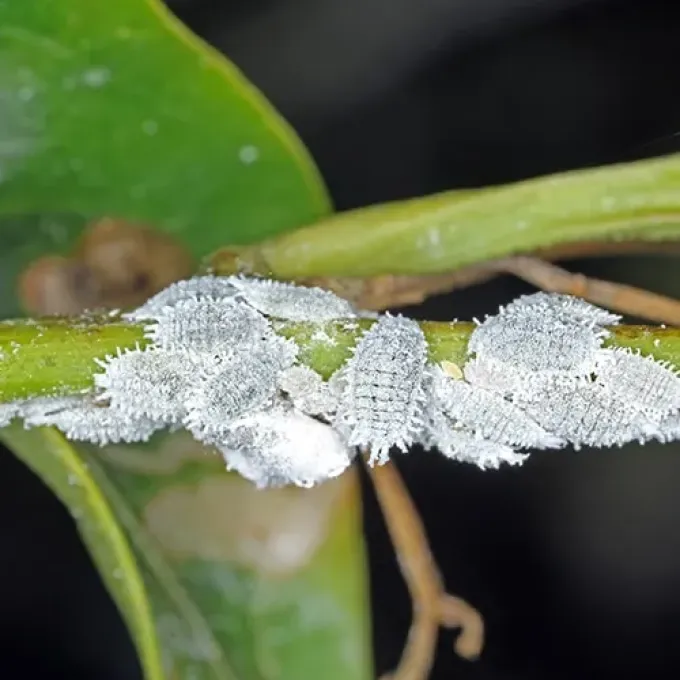
The Ash mealybug (Phenacoccus fraxinus) is a member of the Pseudococcidae family, known for being a specialized pest of ash trees. The adult female is characterized by an oval, slightly flattened body covered with a thick, white, waxy secretion that acts as a protective shield.
Adult females are typically sedentary, while the nymphs, known as crawlers, are mobile and allow the species to disperse throughout the tree canopy or even be carried by the wind to nearby hosts. The insects are small, usually measuring between 2 to 4 millimeters in length.
Their bodies range from light yellow to pale pink, but this is rarely seen due to the dense waxy coating. This wax is hydrophobic and makes the pests highly resistant to common contact insecticides and environmental stress.
Systematically, they are classified under the order Hemiptera. They possess piercing-sucking mouthparts, which are perfectly adapted to tap into the phloem of ash trees, causing systemic nutrient depletion in the host.
Expert identification requires a thorough inspection of the bark and branch junctions, where these insects tend to aggregate. Understanding their morphology is essential for distinguishing them from other similar scale insects found on deciduous trees.
What it damages
The Ash mealybug primarily attacks trees in the Fraxinus genus. By feeding on the sap, these insects divert vital resources away from the tree's growth processes, particularly affecting young shoots, leaves, and tender bark.
Severe infestations lead to stunted growth, yellowing and premature dropping of leaves, and the drying of branch tips. In the case of young trees, high populations of this pest can even cause the death of the entire specimen if left untreated.
A significant secondary effect of their feeding is the production of honeydew. This sticky substance covers the leaves and bark, creating an ideal substrate for sooty mold to grow, which impairs the tree's ability to perform photosynthesis.
The weakened trees are often targeted by secondary pests, such as wood-boring beetles, which exploit the reduced chemical defenses of the tree. This combined pressure often leads to the long-term decline of the canopy structure.
In ornamental and forest nurseries, the presence of mealybugs leads to aesthetic and economic losses. Infested trees are often rejected for sale due to their poor appearance and the risk of spreading the pest to new locations.
When it appears
The life cycle of the Ash mealybug is synchronized with the physiological stages of the ash tree. They overwinter as fertilized females or late-stage nymphs, hiding in crevices of the bark or other protected areas on the trunk.
As spring temperatures rise, the insects become active and begin feeding. During this period, females produce wax ovisacs to protect their eggs, marking the beginning of the new generation cycle.
The emergence of crawlers, which typically occurs in early summer, is the period of highest risk. These mobile nymphs move rapidly across the tree to find optimal feeding sites, and it is during this phase that they are most susceptible to control measures.
Multiple generations can occur throughout the growing season, depending on local climate conditions. This high reproductive rate allows populations to explode quickly if weather conditions are favorable and natural predators are absent.
By late autumn, the activity levels drop significantly. The insects retreat into their overwintering sites, often clustered in groups on the bark, to survive the cold months before the cycle restarts in the spring.
Signs of infestation
The most distinctive sign of an infestation is the appearance of white, cotton-like masses on the bark of twigs and at the base of leaf petioles. These masses are the wax-covered females and their egg-laying sites.
A sticky, shiny residue on leaves or branches, often accompanied by a black, soot-like fungal growth, is a classic indication that the mealybug colony is well-established and currently feeding on the plant's sap.
Deformed, curled, or chlorotic (yellowed) leaves are symptoms of severe nutrient stress. If a tree shows thin foliage during the height of the growing season, it is a strong indicator of a sap-sucking pest infestation.
Upon closer inspection, one may notice bark cracking or the appearance of gumming in the areas where the colony is concentrated. This is the tree's defensive response to the physical damage caused by the insects' mouthparts.
Stunted development of the crown and the presence of dead branch tips are late-stage symptoms. Detecting these signs early is crucial for saving the tree from further damage or potential death.
Control measures
Effective management begins with good cultural practices, such as pruning out and destroying heavily infested branches to reduce the overall population and remove potential overwintering sites.
Systemic insecticides are generally the most effective way to treat ash mealybugs. Products containing active ingredients like imidacloprid can be absorbed by the tree and provide long-term protection against the sap-sucking pests.
Biological control methods involve encouraging natural enemies, such as predatory lady beetles, which can significantly reduce mealybug populations if chemical use is minimized or avoided.
Horticultural oils can be used to manage early infestations. When applied correctly, these oils coat the insects and physically block their breathing pores, providing a non-toxic alternative for the environment.
- Monitor the canopy regularly, especially during the crawler emergence period in late spring.
- Apply systemic insecticides according to the product label instructions.
- Encourage local beneficial insect populations in the landscape.
- Perform dormant pruning to remove infested branches and reduce overwintering sites.
Taxonomy
- Latin name
- Phenacoccus fraxinus
- Order
- Hemiptera (bugs, aphids, leafhoppers)
- Family
- Pseudococcidae
- EPPO code
- PHENFX
Discussion
No discussions yet — be the first.