
Hawthorn mealybug
Phenacoccus dearnessi
Description
How to identify
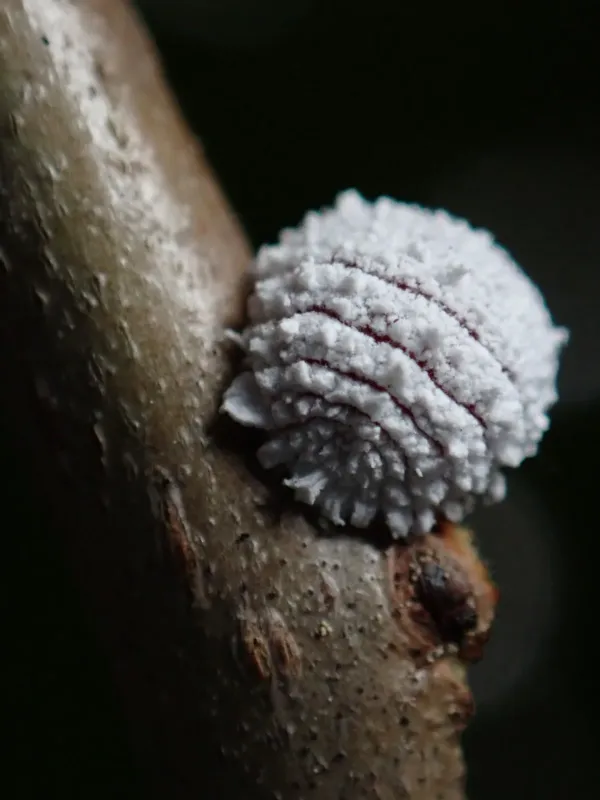
The hawthorn mealybug (Phenacoccus dearnessi) belongs to the Pseudococcidae family. These insects are characterized by a waxy, white, flour-like secretion that covers their bodies, providing them with effective protection against environmental stressors and predators.
Adult females are oval-shaped and typically measure 2–3 mm in length. They are largely sessile, meaning they remain attached to a specific spot on the bark or branches of the host plant throughout their adult life, feeding on plant sap.
The first-instar nymphs, known as "crawlers," represent the only mobile stage of the insect's life cycle. They are yellowish-brown, lack the thick waxy coating of the adults, and are capable of actively moving across the bark to colonize new parts of the host plant.
Reproduction is sexual, although adult males are rarely encountered due to their extremely short lifespan and lack of mouthparts. Females produce white, fluffy wax ovisacs where they deposit their eggs, often hiding them in bark crevices.
Positive identification in the field is challenging due to the pest's small size and its similarity to other scale insects. Accurate determination often requires professional microscopic examination of morphological features.
What it damages
The hawthorn mealybug primarily infests members of the Rosaceae family, including hawthorn, apple, pear, plum, and mountain ash. It can also occasionally affect various ornamental shrubs in urban landscapes and nurseries.
By inserting their stylets into the plant tissue, these insects extract vital sap. This constant drainage of nutrients leads to reduced tree vigor, stunted shoot growth, and a significant decrease in the quality and quantity of fruit production.
Severe infestations often result in visible damage to the bark, including cracking and localized distortion. In extreme cases, young branches may wither and die, and trees may experience premature leaf drop, weakening the entire plant.
Mealybugs secrete honeydew, a sugary byproduct of their feeding. This substance facilitates the growth of sooty mold, a black fungal layer that coats leaves and stems, further hindering photosynthesis and overall plant health.
Continued stress caused by heavy infestations makes trees more susceptible to secondary pathogens and climate-induced stressors, which can jeopardize the long-term viability of the orchard or ornamental planting.
When it appears
The pest overwinters as second-instar nymphs, seeking shelter in protected areas such as bark cracks or under bud scales. During the cold months, they remain dormant and do not feed, waiting for the return of favorable temperatures.
Development resumes in early spring as the temperature rises. Once the tree begins its seasonal activity, the nymphs resume feeding, gaining the energy required to reach adulthood and prepare for the reproductive phase.
The peak emergence of crawlers generally coincides with the flowering period of many fruit trees. This timeframe is critical for management, as the crawlers are most vulnerable to control measures before they develop their protective waxy covering.
Depending on the climatic zone, the hawthorn mealybug may complete one or two generations per year. Warm, extended summers significantly accelerate the life cycle, potentially leading to higher pest population densities by the end of the season.
As autumn approaches and temperatures begin to drop, the final generation of nymphs begins the search for suitable overwintering sites on the tree's trunk or main branches to endure the winter season.
Control measures
Integrated Pest Management (IPM) for this species begins with cultural practices. Proper pruning to remove heavily infested branches and scrubbing old bark can significantly reduce the overwintering population of nymphs.
Dormant oil applications in late winter or early spring are highly effective. These oils coat the nymphs, preventing gas exchange and effectively suffocating them before they emerge from their winter refuges.
Chemical control during the growing season focuses on targeting the mobile crawler stage. Systemic insecticides can be applied when crawlers are active, ensuring the chemical reaches the insect before it forms a protective wax layer.
Encouraging natural predators such as ladybirds, lacewings, and parasitic wasps is essential. Maintaining a biodiverse environment around the orchard helps keep mealybug populations below the economic injury level naturally.
- Regular monitoring of tree bark during the dormant season is recommended.
- Avoid overuse of broad-spectrum insecticides that kill beneficial predatory insects.
- Ensure trees receive adequate irrigation to help them recover from nutrient loss caused by feeding pests.
Taxonomy
- Latin name
- Phenacoccus dearnessi
- Order
- Hemiptera (bugs, aphids, leafhoppers)
- Family
- Pseudococcidae
- EPPO code
- PHENDE
Discussion
No discussions yet — be the first.