
Azalea mealybug
Phenacoccus azaleae
Description
How to identify
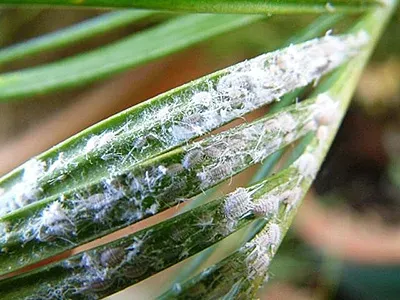
The azalea mealybug (Phenacoccus azaleae) belongs to the Pseudococcidae family within the order Hemiptera. These small insects are characterized by their white, waxy, mealy-like body covering.
Adult females are oval-shaped and typically measure 2 to 3 mm in length. They are usually found in clusters on the stems, leaf axils, and undersides of leaves.
Males are rarely observed; they are smaller than females, possess wings, and are responsible for searching out females for reproduction.
First-instar nymphs, known as crawlers, are the most active stage of the life cycle. They move across the plant surface to find suitable feeding sites.
This species is highly adapted to greenhouse conditions, where constant temperatures allow for continuous generations throughout the year.
What it damages
The primary hosts of this pest are plants in the Ericaceae family, particularly azaleas and rhododendrons, which can suffer severe growth decline.
These insects pierce plant tissues and suck the sap, which leads to stunted development and distorted leaves and shoots.
The feeding process drains the plant of essential nutrients, resulting in overall weakening and potential loss of flowers.
Excreted honeydew serves as a food source for sooty mold fungi, which coat the leaves in a black layer, effectively blocking the plant's ability to photosynthesize.
Severe infestations can lead to premature leaf drop, branch dieback, and in extreme cases, the total death of the host plant.
When it appears
Under controlled greenhouse or indoor environments, the azalea mealybug breeds continuously, with no specific dormant season.
In outdoor settings, activity usually commences in the spring, once temperatures remain consistently high enough for the crawlers to thrive.
Generation time is temperature-dependent; warmer conditions significantly accelerate the life cycle, leading to rapid population explosions.
The pest survives during unfavorable periods by hiding in sheltered spots like bark crevices, bud scales, or near the soil line.
Peak crawler activity often coincides with the arrival of soft, new succulent plant growth during the spring and early summer months.
Signs of infestation
The most distinctive sign is the appearance of white, cotton-like masses, especially in the crotches of branches or along the leaf veins.
Leaves often appear sticky or shiny due to the accumulation of honeydew excreted by the feeding mealybugs.
The growth of black sooty mold on the leaf surfaces is a strong indicator that a mealybug infestation has been present for some time.
Yellowing, curling, and abnormal shape of new leaves are symptoms caused by the feeding activity and toxin injection from the insect's saliva.
The physical presence of the insects themselves is an obvious sign, typically visible when inspecting the undersides of leaves during care routines.
Control measures
Prevention is the best approach, which includes strict quarantine measures for any new plants introduced to a collection.
For minor infestations, manual removal using a cotton swab dipped in rubbing alcohol can effectively reduce the population size.
Systemic insecticides, particularly those containing neonicotinoids or specific insect growth regulators, provide excellent long-term control.
A sequential application strategy is crucial, with treatments spaced 10–14 days apart to ensure that newly hatched nymphs are also eliminated.
- Improve air circulation to reduce humidity;
- Avoid excessive nitrogen fertilization;
- Use biological controls such as predatory beetles;
- Prune and destroy heavily infested branches.
Taxonomy
- Latin name
- Phenacoccus azaleae
- Order
- Hemiptera (bugs, aphids, leafhoppers)
- Family
- Pseudococcidae
- EPPO code
- PHENAZ
Discussion
No discussions yet — be the first.