
Oat mealybug
Phenacoccus avenae
Description
How to identify
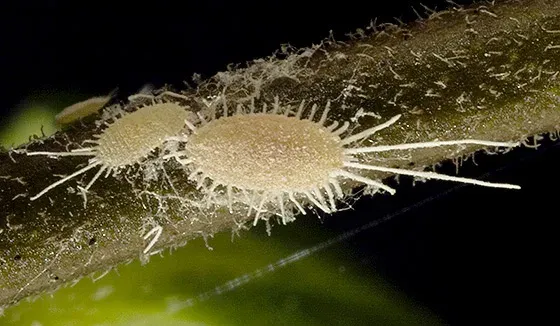
The oat mealybug (Phenacoccus avenae) is a member of the Pseudococcidae family within the order Hemiptera. These insects are easily identified by the white, cotton-like waxy secretion that covers their bodies and protects their egg masses.
Adult females are typically oval-shaped, measuring between 3 and 5 mm in length. They are largely sessile, meaning they remain attached to the plant surface, extracting sap to sustain their lifecycle. Their legs are weakly developed, limiting their mobility.
Males, conversely, are winged and much smaller. They are rarely seen as their primary purpose is to locate females for mating. The first-instar nymphs, known as crawlers, are the most active life stage and are responsible for the dispersal of the infestation across fields.
The lifecycle is heavily influenced by environmental factors, with warm and dry weather conditions promoting rapid development. The species typically overwinters in the egg or early nymphal stage, often sheltered within soil crevices or beneath plant debris.
As a specialist pest, this insect primarily targets grasses and cereals, exploiting the nutritional resources of these plants throughout the growing season.
What it damages
The primary hosts for Phenacoccus avenae are members of the Poaceae family, including oats, wheat, barley, and rye. Wild grasses often serve as secondary hosts, allowing the pest to persist in areas where cereals are not currently planted.
These mealybugs prefer to inhabit hidden spaces on the plant, such as leaf sheaths, stems, and the areas near the base of the plant. This cryptic nature allows the infestation to progress unnoticed until significant damage has already occurred.
By feeding on the phloem sap, the insects deprive the plant of essential nutrients and water. This leads to chlorosis, stunted growth, and a noticeable reduction in the vigor of the infested stalks.
Severe infestations often result in reduced grain yield and lower seed quality. The plant's inability to maintain normal metabolic processes under the pressure of sap removal directly impacts grain development and weight.
The excretion of honeydew is another major problem. This sugary residue leads to the growth of sooty mold, which coats the leaves and further inhibits the plant's ability to perform photosynthesis, compounding the physical damage caused by the feeding.
Signs of infestation
The most reliable sign of an oat mealybug infestation is the presence of white, wax-like masses found tucked into the leaf sheaths or near the nodes. When plants are parted, these clusters of pests are clearly visible against the green tissue.
Plants struggling with an infestation often exhibit signs of physiological distress, such as yellowing, wilting, and curling leaves. The overall height of the crop in infested patches may be uneven due to stunted development.
The presence of sticky honeydew on the foliage is a telltale sign that insects are actively feeding. Often, this substance is accompanied by an increased presence of ants, which defend the mealybugs from natural predators.
In later stages, the leaves and stems may become darkened due to the development of sooty mold. This layer of fungus gives the crop a dirty, diseased appearance and is a clear indicator of a long-standing mealybug colony.
At the field level, damage often appears as localized yellowing or blighted areas that do not recover despite adequate irrigation or fertilization, suggesting the presence of root- or stem-feeding pests.
Control measures
Integrated pest management (IPM) for the oat mealybug focuses on cultural practices that minimize the likelihood of colonization. Eliminating wild grass hosts is one of the most effective ways to reduce initial populations.
Crop rotation remains a fundamental strategy. By rotating infested fields with non-host crops, farmers can disrupt the pest’s lifecycle and decrease the local population density over time.
Biological control, which involves the protection of natural predators like lacewings, predatory gall midges, and various parasitoid wasps, is essential. Reducing the use of broad-spectrum pesticides helps maintain these beneficial insect populations.
When infestation levels exceed the economic injury threshold, systemic insecticides are recommended. These products are effective because they are translocated throughout the plant tissues, reaching the hidden insects.
- Regular scouting of cereal fields during the tillering stage.
- Deep tillage after harvest to bury and destroy overwintering sites.
- Strategic use of systemic pesticides only when necessary.
- Maintaining field hygiene to prevent the buildup of secondary host populations.
Taxonomy
- Latin name
- Phenacoccus avenae
- Order
- Hemiptera (bugs, aphids, leafhoppers)
- Family
- Pseudococcidae
- EPPO code
- PHENAV
Discussion
No discussions yet — be the first.