
Maple scale
Phenacoccus aceris
Description
How to identify
The maple scale (Phenacoccus aceris) is a member of the Pseudococcidae family, commonly known as a mealybug, which affects a wide variety of deciduous trees.
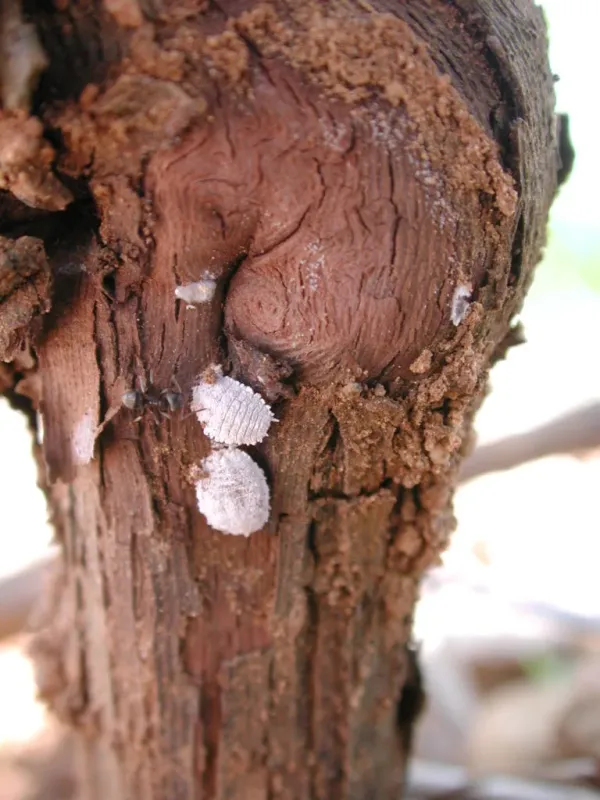
Adult females are oval-shaped, 3–5 mm in length, and are covered with a white, waxy, mealy secretion that makes them look like small cotton tufts on the bark.
The nymphs, known as crawlers, are very small, yellowish, and highly mobile, allowing them to disperse quickly across the host plant to find suitable feeding sites.
Males are much smaller than females, possess wings, and are capable of flight, while the females remain sessile (stationary) for most of their adult life.
They are usually found in sheltered areas such as bark crevices, near buds, or along the undersides of branches, making them difficult to spot in the early stages.
What it damages
This pest attacks various woody plants including maple, linden, birch, and fruit trees such as apple, pear, and plum, as well as various berry bushes.
By feeding on the sap of young shoots and leaves, the insect weakens the tree's overall vigor and can lead to stunted growth and branch dieback.
A major side effect of infestation is the production of honeydew, a sticky substance that promotes the growth of sooty mold, blocking photosynthesis and disfiguring leaves.
Severe infestations result in yellowing, premature leaf drop, and overall physiological stress, which makes the host plant more susceptible to other pathogens.
While mature trees can often withstand minor infestations, young or newly planted trees may suffer significant damage or mortality if the population is not controlled.
When it appears
The maple scale has one generation per year, overwintering as second-instar nymphs tucked away in the bark or near dormant buds.
In early spring, when temperatures rise, the nymphs emerge from hibernation, migrate to young shoots, and begin feeding on plant sap.
Egg-laying occurs in late spring to early summer, with females producing white, fluffy ovisacs that protect the eggs until the crawlers hatch.
The crawlers (first instar) emerge in mid-summer and move to the underside of leaves, where they continue to feed and grow throughout the warmer months.
As autumn approaches, the nymphs migrate back from the leaves to the woody stems to find protected overwintering sites before the onset of winter frost.
Control measures
Managing the maple scale requires a strategic approach that targets the pest during its most vulnerable life stages, specifically the crawler phase and the dormant season.
Dormant season treatments, such as horticultural oils applied in early spring, are highly effective as they smother the overwintering nymphs on the bark.
During the growing season, systemic insecticides are recommended when crawlers are active, as these provide better coverage against the sheltered, stationary adults.
- Pruning and destroying heavily infested branches to reduce the pest population.
- Promoting healthy tree growth through proper irrigation and balanced fertilization.
- Encouraging natural predators such as lady beetles and lacewings to assist in control.
Monitoring the trees during the spring and early summer is essential to catch early signs of infestation and prevent the scale from spreading throughout the landscape.
Taxonomy
- Latin name
- Phenacoccus aceris
- Order
- Hemiptera (bugs, aphids, leafhoppers)
- Family
- Pseudococcidae
- EPPO code
- PHENAC
Discussion
No discussions yet — be the first.