
Maple mealybug
Phenacoccus acericola
Description
How to identify
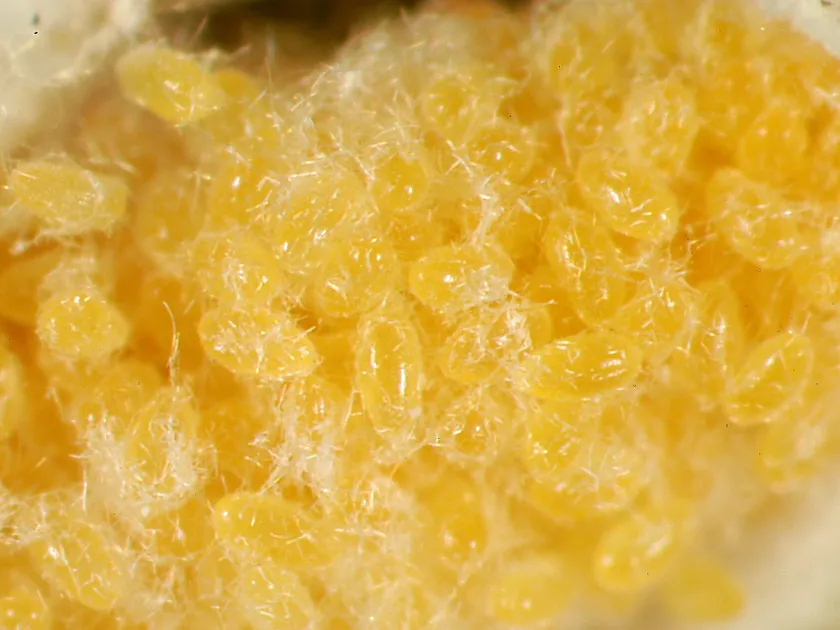
The maple mealybug, scientifically known as Phenacoccus acericola, belongs to the Pseudococcidae family within the Hemiptera order. These small insects are easily recognized by the white, cottony wax filaments that cover the female's body.
Adult females are sedentary, living mainly on the undersides of leaves. Their white, fluffy appearance makes them look like small white patches or even a light fungal infection to the untrained eye.
Males are rarely seen; they are winged, small, and do not feed as adults. Their sole purpose is to locate and fertilize the females, after which they have a very short lifespan.
The crawlers (first-instar nymphs) are the most mobile stage. They are tiny, yellow, and active, crawling across the foliage to find optimal feeding sites before settling down to develop further.
The visual signature of an infestation is characterized by clusters of white, woolly egg sacs attached to leaf undersides, which remain stuck even in windy or rainy conditions.
What it damages
As the name suggests, this pest primarily targets various maple species, including sugar maples, red maples, and silver maples. It causes physiological stress to the host tree.
Feeding is carried out by sucking plant sap from the foliage. This process saps the tree of essential nutrients, leading to chlorosis, leaf drop, and overall thinning of the tree's canopy.
A major side effect of the feeding is the production of honeydew, a sticky substance that falls onto lower leaves and branches. This creates a substrate for sooty mold to grow.
Sooty mold covers the leaves in a black, powdery layer, which hinders photosynthesis. This significantly weakens the tree's ability to store energy for the winter months.
In cases of severe infestation, the cumulative stress can result in branch dieback and, if left unchecked, the eventual mortality of the infested tree.
When it appears
The life cycle begins in early spring, as overwintering females emerge from their hiding spots under the bark of the trunk to migrate toward the newly emerging leaves.
During the spring and early summer, females feed and begin producing egg sacs. The peak of crawler activity usually occurs in mid-summer, making it a critical window for intervention.
As autumn approaches, females often migrate back toward the trunk or thick branches to find suitable crevices for overwintering during the dormant season.
Depending on the latitude and climate, this pest may complete one or two generations per year. Warmer climates generally support faster reproduction and higher population counts.
Monitoring should be most intense during the late spring to mid-summer period when nymphs are active and searching for new sites on the foliage.
Control measures
Managing the maple mealybug requires a combination of cultural and chemical strategies. Keeping trees healthy through proper watering and pruning is the first line of defense.
Systemic insecticides, applied either as a soil drench or trunk injection, are highly effective because the pesticide is absorbed into the tree's vascular system, protecting the foliage.
Dormant oil sprays applied to the trunk and main branches in early spring can help suppress the population by suffocating the overwintering females before they move onto the leaves.
For smaller landscape trees, manual removal of infested leaves or branches can be effective if the infestation is caught early and remains localized.
- Use predatory insects such as lady beetles and lacewings to naturally control populations.
- Ensure good air circulation within the canopy through proper thinning.
- Avoid over-fertilizing with nitrogen, which can increase the tree's attractiveness to sucking insects.
- Inspect surrounding vegetation as the mealybug can occasionally jump to other woody ornamental species.
Taxonomy
- Latin name
- Phenacoccus acericola
- Order
- Hemiptera (bugs, aphids, leafhoppers)
- Family
- Pseudococcidae
- EPPO code
- PHENAE
Discussion
No discussions yet — be the first.