
Juniper mealybug
Paracoccus juniperi
Description
How to identify
The juniper mealybug (Paracoccus juniperi) is a small sap-sucking insect belonging to the family Pseudococcidae, which causes significant damage to ornamental conifers.
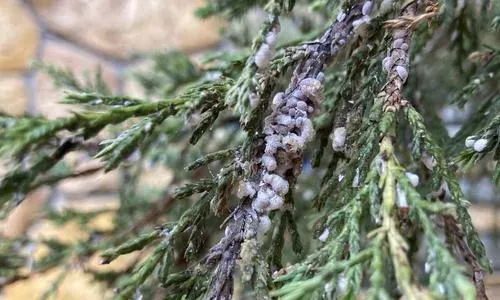
Adult females are approximately 2–3 mm long, oval-shaped, and are typically covered in a characteristic white, powdery wax secretion that serves as a protective layer.
Males are rare, winged, and short-lived, playing a minor role in the infestation process, as the primary damage is caused by the stationary or semi-stationary females.
The juvenile stages, known as crawlers, are highly mobile and are responsible for the initial infestation and spread of the pest across the host plant's canopy.
They are masters of concealment, often residing deep within the needles, at the base of shoots, or tucked under the protective scales of the host tree's bark.
What it damages
This pest primarily targets juniper species (Juniperus), although it frequently affects other cupressaceous plants like arborvitae, cypress, and yew trees.
By extracting plant sap, the mealybugs drain vital nutrients, which leads to stunted growth, discoloration of the foliage, and the distortion of younger shoots.
The feeding process creates stress in the tree, making it highly susceptible to secondary attacks from environmental factors and opportunistic fungal pathogens.
Sooty mold often develops on the sticky honeydew secreted by the insects, which clogs the stomata of the needles and severely inhibits the plant's ability to photosynthesize.
Severe and persistent infestations can eventually lead to branch dieback and, in young or unhealthy plants, the total decline of the specimen over several seasons.
When it appears
Overwintering typically occurs in the nymph stage or as fertilized adult females, tucked away in bark crevices or protected sites within the dense foliage of the host.
Activity resumes in early spring when rising temperatures trigger the emergence of crawlers, which begin to migrate toward the most succulent parts of the tree.
Population density typically peaks during the mid-summer months, coinciding with the period of intense reproduction and egg-laying within protective waxy sacs.
Depending on the climatic zone, the juniper mealybug may produce several overlapping generations per season, making management particularly challenging.
The damage persists throughout the entire growing season, with activity tapering off only as temperatures drop significantly in the late autumn months.
Signs of infestation
The most reliable sign of an infestation is the appearance of white, cotton-like masses on the needles and stems, which house the female mealybugs and their eggs.
A sticky residue known as honeydew coating the foliage is an early indicator that sap-sucking insects are active within the canopy, even if they are not immediately visible.
The presence of a black, powdery substance (sooty mold) growing on the stems and leaves is a classic symptom of a heavy, long-standing mealybug colony.
Progressive yellowing or browning of the needles, often starting from the center of the plant and moving outwards, indicates a severe loss of plant vitality.
In cases of heavy infestation, branch tips may look stunted or twisted, and needles may drop prematurely, leaving sparse areas throughout the tree's structure.
Control measures
Early detection through regular inspection of your conifers is the most critical step in managing the juniper mealybug before it reaches damaging levels.
Mechanical removal of infested branch tips can be effective for smaller, localized infestations and is a good practice for reducing the overall pest load.
Systemic insecticides, particularly those containing neonicotinoids or spirotetramat, are generally recommended as they are absorbed by the plant to kill feeding insects.
Repeated applications spaced 10–14 days apart are necessary to effectively target newly emerged crawlers that are not protected by the waxy covering of the adults.
Maintaining overall plant health through adequate irrigation and proper fertilization helps the tree withstand the feeding pressure and recover faster from damage.
Taxonomy
- Latin name
- Paracoccus juniperi
- Order
- Hemiptera (bugs, aphids, leafhoppers)
- Family
- Pseudococcidae
- EPPO code
- PACOJU
Discussion
No discussions yet — be the first.