
Palm mealybug
Palmicultor palmarum
Description
How to identify
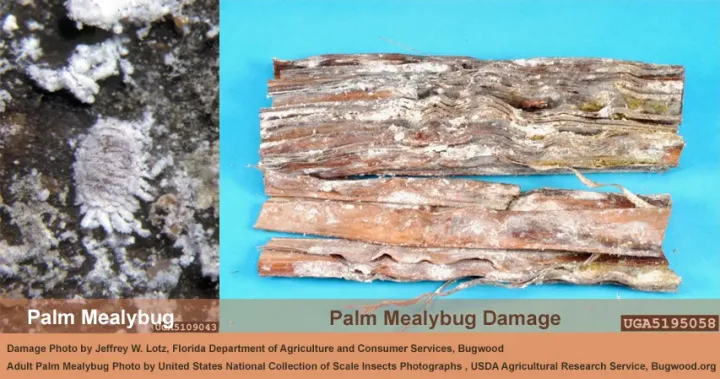
The palm mealybug (Palmicultor palmarum) is a member of the Pseudococcidae family, suborder Coccinea. This small, sap-sucking insect is characterized by a white waxy secretion covering its body, which serves as a shield against external environmental stressors and chemical treatments.
Adult females have an oval, flattened body, typically 3-4 mm long, covered in a powdery substance. Males are rarely encountered; they are winged, significantly smaller than females, and do not feed, as their primary biological purpose is mating.
The nymphs, known as "crawlers," are highly mobile during the early stages of their life cycle. They actively seek suitable feeding sites on the host plant, a behavior that facilitates rapid spread within greenhouses or indoor plant collections.
This species favors cryptic locations, such as the bases of leaf petioles, growth points, and crevices between stem scales. Due to their coloration, which blends in with the waxy debris, these insects often remain undetected until a significant infestation occurs.
Taxonomically, this pest is a specialized parasite of palm species, meaning that its detection necessitates immediate quarantine of the affected specimen and thorough inspection of all surrounding vegetation.
What it damages
The primary hosts are various species of palm trees, including both ornamental indoor varieties and commercial plantings in tropical regions. Mealybugs feed by piercing plant tissues with their stylets and extracting essential cell sap.
In addition to direct physiological stress, Palmicultor palmarum promotes secondary infections. In areas of high pest density, sooty mold fungi quickly develop, feeding on the sticky honeydew secretions produced by the mealybugs.
Damaged plant tissues gradually yellow, deform, and wither. Heavy infestations lead to stunted growth, premature leaf drop, and the death of the apical meristem (growth point), ultimately resulting in the loss of aesthetic value or death of the plant.
The pest utilizes various transport vectors, including human handling, contaminated tools, and infested nursery stock, which underscores the importance of strict sanitary practices in horticultural settings.
The damage caused by this mealybug is particularly devastating to young saplings, as their delicate tissues are more susceptible to the toxins injected during feeding, resulting in severe necrotic tissue changes.
When it appears
In indoor environments, greenhouses, and homes, the palm mealybug can reproduce year-round, lacking a distinct seasonal diapause, provided temperatures remain above 18-20 degrees Celsius.
The temperature optimum for pest development coincides with the conditions preferred by most decorative palms. An accelerated life cycle is frequently observed in environments with low humidity and poor air circulation.
Periods of intense population growth often coincide with spring and summer, when active vegetative growth provides an abundance of tender tissues suitable for both adults and early-instar nymphs.
During the winter, when light levels and temperatures decrease, the metabolic rate of the mealybug slows down, yet they continue to feed while hiding deep within leaf axils, rendering them largely inaccessible to contact-based insecticides.
In natural habitats, population densities may fluctuate based on rainfall patterns; however, in controlled agricultural settings, the population density is entirely dependent on the management practices implemented by the agronomist.
Signs of infestation
The primary indicator of infestation is the appearance of white, "cottony" masses at the base of leaves or along the central vein. These masses are egg sacs, inside which the female lays her eggs.
Sticky residue on leaf surfaces, commonly known as "honeydew," is a classic symptom. The subsequent development of black sooty mold on this residue confirms the presence of an established colony.
Stunted growth, yellowing, and deformation of young leaves are frequently observed, with new foliage often emerging damaged or exhibiting necrotic spots resulting from the insects' feeding activity.
Close inspection reveals the insects themselves, which appear as sluggish, oval-shaped bodies coated in a powdery secretion. They are typically found in clusters within secluded areas, such as the junctions of stems and leaves.
In advanced stages, the plant appears unkempt and loses vigor, as the root system ceases to function optimally due to the overall physiological stress inflicted upon the entire plant organism.
Control measures
Mechanical removal of pests using cotton swabs dipped in isopropyl alcohol or soapy water is effective only during the initial stages of infestation when population numbers remain low.
Regular maintenance routines, such as cleaning the palm canopy with a gentle shower and wiping down leaves, help reduce the overall population and inhibit the ability of crawlers to establish new colonies.
The use of systemic insecticides, such as those containing imidacloprid or other neonicotinoids, serves as the most effective defense strategy. These substances are absorbed into the plant's sap, rendering it toxic to sap-sucking insects.
- Quarantine affected plants immediately to prevent the spread to healthy specimens.
- Thoroughly disinfect pruning tools after every use.
- Conduct routine inspections, focusing on leaf bases and petioles.
- Adjust ambient humidity levels to discourage the creation of favorable micro-habitats for the pest.
Biological control methods include the introduction of specialized natural predators, such as the mealybug destroyer beetle (Cryptolaemus montrouzieri), which is highly effective in greenhouse environments.
Taxonomy
- Latin name
- Palmicultor palmarum
- Order
- Hemiptera (bugs, aphids, leafhoppers)
- Family
- Pseudococcidae
- EPPO code
- PALTPA
Discussion
No discussions yet — be the first.