
Coconut mealybug
Nipaecoccus nipae
Description
How to identify
The coconut mealybug (Nipaecoccus nipae) is a small insect in the Pseudococcidae family, belonging to the order Hemiptera. These pests are known for their distinct waxy coating.
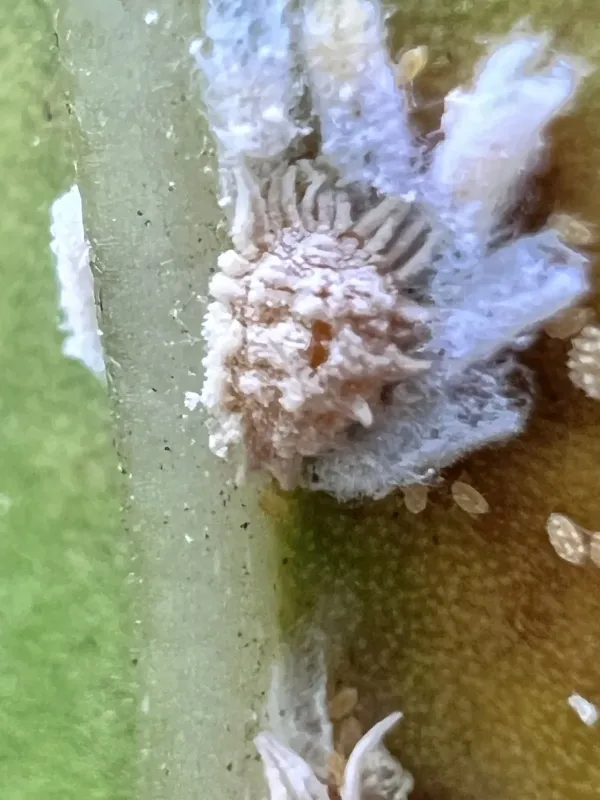
Adult females are oval-shaped, typically measuring 2–3 mm in length, and vary in color from brownish-yellow to a reddish-brown hue.
They are characterized by the production of white, cotton-like waxy secretions that protect both the adult females and their egg masses on the host plant.
The life cycle includes egg, nymph, and adult stages. The first-instar nymphs, often called crawlers, are mobile and are primarily responsible for spreading the infestation to other parts of the plant.
Males are winged and significantly smaller than females, serving only the purpose of mating, while the females remain relatively sedentary once they find a suitable feeding site.
What it damages
This pest has a wide host range, attacking various tropical and subtropical crops, including palms, citrus, avocado, mango, and several ornamental greenhouse plants.
Damage is caused by the insects inserting their piercing-sucking mouthparts into plant tissue to extract phloem sap, which deprives the plant of essential nutrients.
As a result, heavily infested plants exhibit stunted growth, leaf yellowing, chlorosis, and in severe cases, premature leaf drop and the death of young seedlings.
In addition to sap extraction, the mealybugs excrete honeydew, which promotes the growth of sooty mold, a black fungus that covers leaves and impairs photosynthesis.
The infestation significantly reduces the marketability of fruits and the aesthetic quality of ornamental plants, making them highly susceptible to secondary infections.
When it appears
In tropical environments, the coconut mealybug reproduces continuously throughout the year, with multiple overlapping generations occurring in a single season.
In temperate zones, the pest is primarily a greenhouse threat, where stable temperatures allow it to maintain active populations regardless of the time of year.
The development cycle is temperature-dependent; warmer conditions significantly accelerate the maturation of nymphs, leading to rapid population surges.
During colder months, populations may decline in outdoor environments, but in indoor facilities, the pest remains a persistent problem that requires constant vigilance.
Monitoring should be most intensive during periods of high humidity and heat, which are optimal for the growth and survival of the nymphs.
Signs of infestation
The first sign of infestation is typically the appearance of white, cottony masses on the undersides of leaves, along leaf veins, and in the axils of petioles.
Sticky honeydew residues on the foliage, often followed by a thick layer of black sooty mold, serve as a clear indication of a mealybug presence.
General plant health declines, characterized by wilting, yellowing of leaves, and an overall lack of vigor despite regular watering and fertilization.
- Visible white wax clusters on stems and leaf undersides.
- Presence of ants, which form symbiotic relationships with the mealybugs to harvest their honeydew.
- Deformation or stunting of young shoots and terminal buds.
Small, slow-moving crawlers can often be seen on the foliage during early infestation stages when examined closely with a hand lens.
Control measures
Effective management requires a combination of physical, chemical, and biological strategies to keep populations under control and prevent widespread damage.
Small infestations can be managed by manually removing the mealybug colonies with a cotton swab dipped in rubbing alcohol or insecticidal soap.
Systemic insecticides are generally the most effective way to treat larger infestations, as they are absorbed by the plant and kill the insects during feeding.
For sustainable control, biological agents such as predatory beetles (e.g., Cryptolaemus montrouzieri) or parasitic wasps can be introduced to keep populations suppressed.
Preventive measures, including strict quarantine of new plant material and regular inspection of greenhouse stock, are essential to stop the spread of this pest.
Taxonomy
- Latin name
- Nipaecoccus nipae
- Order
- Hemiptera (bugs, aphids, leafhoppers)
- Family
- Pseudococcidae
- EPPO code
- NIPANI
Discussion
No discussions yet — be the first.