
Australian mealybug
Nipaecoccus aurilanatus
Description
How to identify
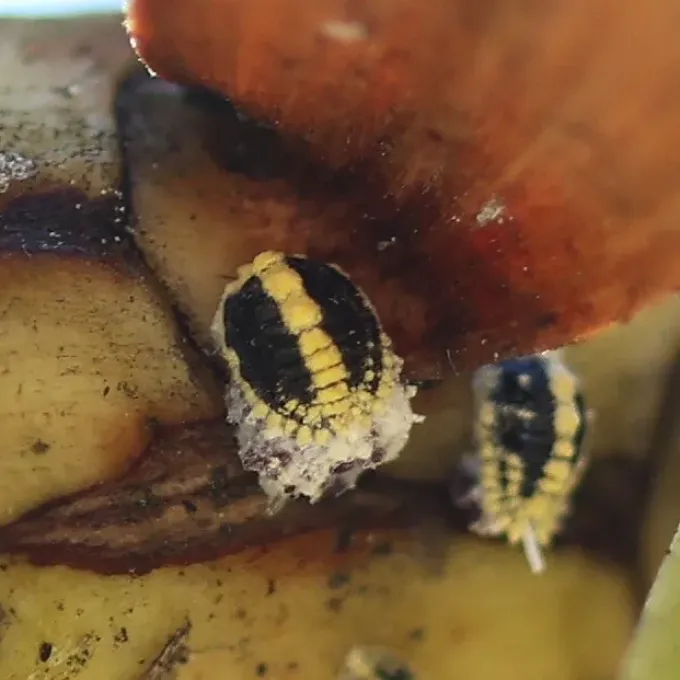
The Australian mealybug (Nipaecoccus aurilanatus) is a scale insect belonging to the family Pseudococcidae. Adult females are distinguished by their rounded, dark purple or reddish-brown bodies.
The insects are covered in a dense, golden-yellow or whitish waxy secretion. This protective layer is characteristic of the species and gives them a fuzzy, mealy appearance, helping them blend into the foliage.
Male specimens of this species are rarely observed, as they have a very short lifespan and a brief, mobile life stage. Females are flightless and remain mostly sedentary, spending their lives feeding on the host plant.
The nymphs, known as crawlers, are tiny and transparent, making them difficult to spot. These nymphs are highly active and responsible for the spread of the infestation to new parts of the plant.
Adults tend to cluster in protected crevices, such as the axils of needles or leaves, where they anchor themselves to extract nutrients from the plant's vascular system.
What it damages
The primary hosts of the Australian mealybug are coniferous plants, most notably those of the genus Araucaria. These plants are highly susceptible to infestation and can suffer significant physiological stress.
Beyond conifers, the pest may attack various other ornamental plants in indoor or greenhouse settings, often causing stunted growth and a general decline in plant vigor.
By using their piercing-sucking mouthparts, the mealybugs extract sap, depriving the host plant of essential nutrients. This feeding process causes localized tissue damage and overall systemic weakness.
Heavy infestations are characterized by severe chlorosis, leaf or needle drop, and the deformation of growing tips. Without intervention, the plant may lose its aesthetic value and die.
The continuous loss of sap also makes the host plant more susceptible to secondary attacks by fungi or other opportunistic pests, complicating the recovery process.
Signs of infestation
The most recognizable sign of an infestation is the presence of white or yellow, cottony waxy masses clustered around the base of needles or on branch stems.
Infested plants often produce large amounts of honeydew, a sticky sugary excretion. This substance frequently attracts sooty mold, which manifests as a dark, unsightly film on the needles and branches.
Leaves or needles may become yellow, brittle, or distorted. The plant often exhibits a sickly appearance, with reduced terminal growth and a thinning canopy that indicates long-term feeding damage.
Inspecting the stems and undersides of leaves will reveal the insects themselves, which appear as small, dark, fuzzy spots that do not move when disturbed.
Wilting of young shoots and an overall loss of structural integrity in the plant's architecture are common late-stage indicators of a well-established colony.
Control measures
For small infestations, physical removal using a cotton swab dipped in isopropyl alcohol is an effective way to eliminate individual insects without damaging the plant.
Systemic insecticides are generally the most successful control method for larger colonies, as the chemical is absorbed by the plant, poisoning the pests through ingestion.
Horticultural oils and insecticidal soaps can be applied as contact sprays. These products work by suffocation and breaking down the waxy protective layer of the mealybugs.
Strict quarantine procedures should be implemented for all new plants to prevent the introduction of this pest into an established collection or commercial greenhouse.
- Regular monitoring of host plants.
- Maintaining optimal environmental conditions to reduce stress.
- Using biological control agents such as predatory beetles.
- Systematic pruning of heavily infested plant parts.
Taxonomy
- Latin name
- Nipaecoccus aurilanatus
- Order
- Hemiptera (bugs, aphids, leafhoppers)
- Family
- Pseudococcidae
- EPPO code
- NIPAAU
Discussion
No discussions yet — be the first.