
Nipaecoccus
Nipaecoccus
Description
How to identify
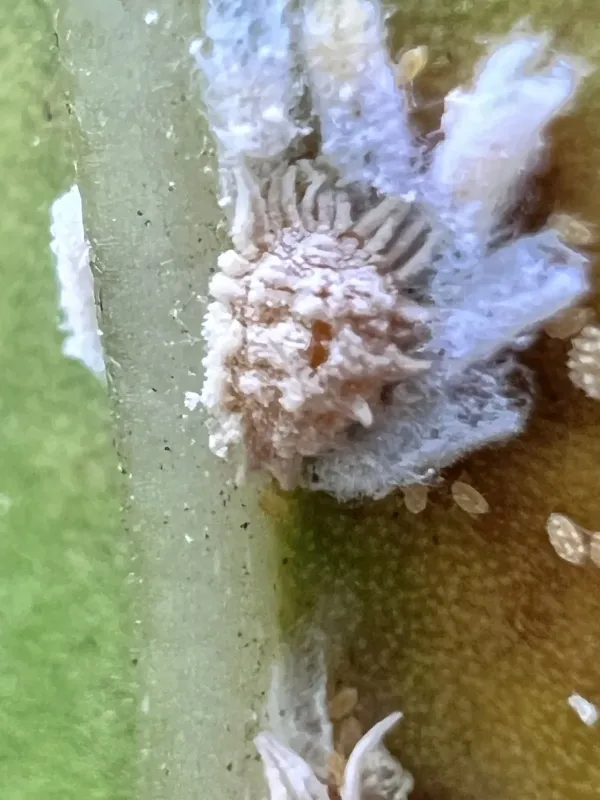
Nipaecoccus is a genus belonging to the mealybug family (Pseudococcidae) within the order Hemiptera. These small sucking insects are characterized by females covered in white waxy secretions that protect them from environmental stressors.
Adult females have an oval body typically measuring 3–4 mm in length. Males are rarely seen, possessing wings and specialized structures for mating, while females remain sedentary or slow-moving throughout their entire lifespan.
A key identification feature is the presence of specific waxy filaments or appendages along the edges of the body. While the actual body color ranges from pink to dark brown, the dense mealy coating gives the insect a white or grayish appearance.
Females deposit eggs within loose, waxy "ovisacs" (egg sacs). This structure provides essential protection for the eggs against predation and dehydration caused by direct sunlight.
The first-instar nymphs, known as "crawlers," are the only mobile stage capable of active dispersal or wind-borne travel to adjacent plants. This stage is the most vulnerable point for targeted contact insecticide applications.
What it damages
Nipaecoccus is a polyphagous pest affecting a wide range of hosts, including fruit trees, citrus, ornamental shrubs, and houseplants. It is particularly notorious for causing significant losses in vineyard and coffee plantations in subtropical climates.
The pest primarily congregates in leaf axils, on young shoots, petioles, and fruit stalks. By using its piercing-sucking mouthparts, it extracts cellular sap, leading to overall plant exhaustion and stunted growth.
Beyond mechanical damage, Nipaecoccus excretes abundant honeydew, which serves as a substrate for sooty mold fungi. This mold covers leaves with a black layer, blocking light and inhibiting photosynthesis.
Heavy infestations lead to premature leaf drop, deformation of new shoots, and reduced market quality of fruits. In severe cases, individual branches may desiccate, or the entire plant may perish.
The pest can also act as a vector for various plant viral diseases, making it a critical threat in commercial horticultural operations. Strict population control is necessary to prevent the spread of phytopathogens.
When it appears
The life cycle of Nipaecoccus is strictly governed by temperature. In warm regions, the pest can complete several generations per year, with reproduction occurring almost continuously in stable warm conditions.
Overwintering occurs as adults or older nymphs in sheltered locations such as bark crevices or root zones. Activity levels increase significantly as spring temperatures rise and day lengths increase.
Population peaks typically occur during hot summer months when insect metabolism accelerates. This period is marked by massive emergence of crawlers, which actively colonize new sections of the host plant canopy.
During autumn, as temperatures and daylight hours decrease, reproductive rates slow down. Pests begin searching for overwintering sites to survive the cold season.
In greenhouses or controlled indoor environments, Nipaecoccus can develop year-round, posing significant challenges for agronomists and requiring constant monitoring to prevent outbreaks.
Signs of infestation
The first visual sign of infestation is the appearance of a white "cottony" residue on various plant parts. This residue consists of aggregated waxy secretions and ovisacs produced by the mealybugs.
Careful inspection reveals the insects themselves, usually clustered on the underside of leaves along veins or in branch nodes. Infested colonies are often accompanied by sticky honeydew deposits on the stems and leaves.
The development of black sooty mold on foliage serves as an indirect but critical indicator of high pest density. Plants affected by sooty mold appear weakened and exhibit noticeably slower growth compared to healthy plants.
Leaf deformation, curling, yellowing, and wilting are common symptoms of chronic feeding by the colony, which disrupts the plant's vascular system and causes localized tissue death.
On fruits, an infestation may manifest as irregular ripening or spotting, directly reducing the commercial value of the crop. In extreme cases, fruits may deform or drop prematurely.
Control measures
Effective management of Nipaecoccus requires an integrated approach that combines cultural, biological, and chemical methods. Regular pruning and removal of heavily infested plant parts are essential first steps.
Preventive measures include maintaining optimal planting density to ensure proper canopy ventilation. Excessive nitrogen fertilization should be avoided as it stimulates flush growth, making the plants more susceptible to infestation.
Biological control involves the use of natural enemies, such as predatory beetles of the genus Cryptolaemus or various parasitic wasps. These natural enemies can significantly suppress populations when released at the correct time.
Chemical control is most effective during the crawler emergence stage. Systemic insecticides (such as neonicotinoids or organophosphates) are often utilized as they are absorbed by the plant and kill the pests during feeding.
- Washing plants with potassium soap solutions or alcohol for small-scale infestations.
- Application of horticultural oils that smother the insects by blocking their spiracles.
- Rigorous inspection of incoming nursery stock to prevent accidental introduction.
- Removal of old, loose bark where pests may find refuge for overwintering.
Taxonomy
- Latin name
- Nipaecoccus
- Order
- Hemiptera (bugs, aphids, leafhoppers)
- Family
- Pseudococcidae
- EPPO code
- NIPASP
Discussion
No discussions yet — be the first.