
Neotrionymus mealybug
Neotrionymus
Description
How to identify
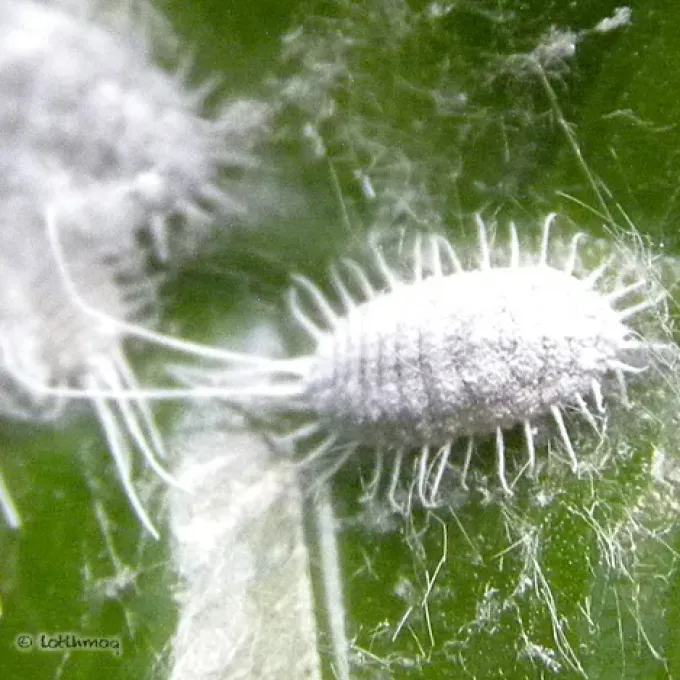
The Neotrionymus mealybug belongs to the family Pseudococcidae, order Hemiptera. These insects are small and characterized by an oval body covered in a white, powdery wax secretion that gives them their common name.
These pests prefer to reside in concealed habitats, typically hiding under the leaf sheaths of cereal grasses. The females often form cottony, white egg sacs in these locations to protect their offspring from environmental stress.
The nymphs, often called "crawlers," are highly mobile in their early stages, facilitating the spread of the infestation within the field. Adults are largely sedentary, dedicating their energy to sap-feeding.
Sexual dimorphism is quite pronounced: females retain a larval-like appearance, while adult males develop wings, allowing them to search for mates during their short adult life cycle.
Because they are specialized at living in narrow, tight spaces between the stem and the leaf sheath, they can remain undetected for a long time, making regular field inspections crucial.
What it damages
The primary hosts for this pest include various grass species and cereal crops. They frequently migrate to agricultural fields from wild grasses that act as reservoirs during the off-season.
By feeding on plant sap, these mealybugs drain vital nutrients from the host plant. They typically aggregate at the base of the stem, causing significant physiological stress to the plant.
Damage is most severe during the active growth phases of the crop, such as tillering and stem elongation. Disruption of the vascular system leads to stunted growth and reduced vigor.
The honeydew excreted by the mealybugs serves as a substrate for sooty mold growth. This covering prevents proper photosynthesis and further weakens the plant's structural integrity.
Massive infestations lead to significant yield losses, as the plants fail to produce healthy ears or reach their full potential, directly impacting grain quality and agricultural profitability.
When it appears
The activity begins in early spring when temperatures rise, triggering the emergence of overwintering nymphs that begin feeding on young shoots of winter cereals.
The peak of population growth usually occurs in late spring and early summer, coinciding with the most rapid growth stages of the cereal crops. Warm, humid conditions favor their reproduction.
Climate plays a major role in their development, with multiple generations possible within a single growing season under optimal environmental conditions, leading to quick population explosions.
As autumn approaches, the insects move to protected microhabitats such as plant debris or the root zones of perennial grasses to survive the cold months.
They are well-adapted to surviving fluctuations in climate, using their waxy secretions to provide a layer of protection against minor temperature and moisture variations.
Signs of infestation
The first indicator of a Neotrionymus infestation is the appearance of white, woolly substances near the base of the leaf blades. This residue is a clear sign of an active colony.
Infested plants often show signs of chlorosis, where leaves turn yellow and curl. The plant growth is noticeably stunted compared to unaffected parts of the field.
The presence of a sticky honeydew film on the stems and leaves is another indicator. This substance is often attractive to ants, which can act as indirect indicators of an infestation.
- White, cotton-like wax clusters at leaf bases.
- Stunted plant height and yellowing of foliage.
- Sticky honeydew residues on stems.
- Development of black sooty mold on the lower plant parts.
- Increased ant activity around the base of the crop.
For a definitive diagnosis, peeling back the leaf sheath reveals the insects themselves, which often appear as flat, static, oval-shaped pests tightly pressed against the stem.
Control measures
Effective management begins with agronomic practices, such as controlling weeds in and around fields to remove alternative hosts that harbor the pest throughout the year.
Implementing proper crop rotation and deep soil tillage helps disrupt the life cycle of the mealybug, significantly reducing the survival rate of the overwintering population.
Chemical control is required when population densities exceed the economic threshold. Systemic insecticides are necessary because contact-based treatments are often ineffective against pests hiding under leaf sheaths.
Timing is critical: applications should be made early in the season to prevent the population from reaching high levels that are difficult to manage with systemic chemicals.
Integrated pest management should include the protection of natural enemies, such as lady beetles and parasitic wasps, which can naturally suppress mealybug populations in the field.
Taxonomy
- Latin name
- Neotrionymus
- Order
- Hemiptera (bugs, aphids, leafhoppers)
- Family
- Pseudococcidae
- EPPO code
- NTRNSP
Discussion
No discussions yet — be the first.