
Ugandan mealybug
Maconellicoccus ugandae
Description
How to identify
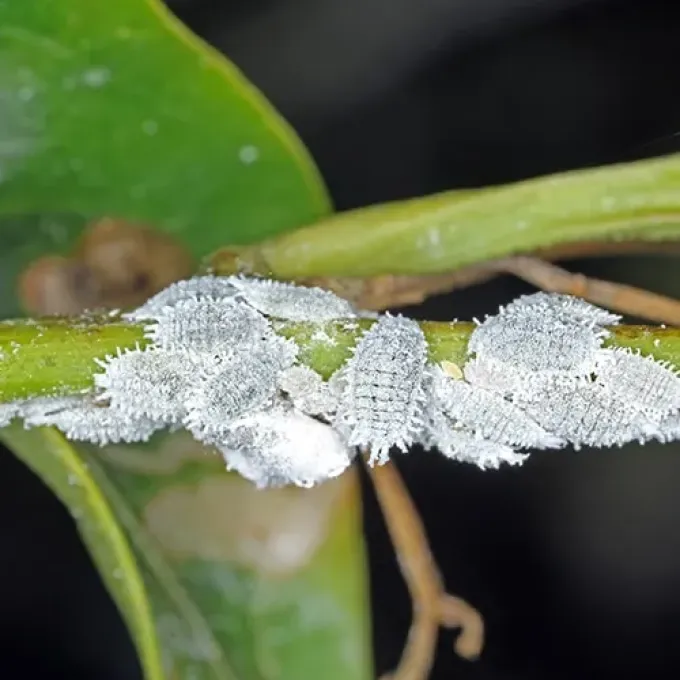
The Ugandan mealybug (Maconellicoccus ugandae) is a member of the Pseudococcidae family. It is easily recognized by the waxy, powdery substance that covers its body, providing both physical protection and camouflage against predators.
Adult females are generally sedentary and congregate in sheltered areas of the host plant, such as leaf axils, under bark scales, or on the undersides of leaves. They often form dense colonies hidden by their white, woolly secretions.
Taxonomically, this species is closely related to other major mealybug pests. Accurate identification often requires expert analysis of adult female morphology, as field identification can be confused with other common mealybug species.
The life cycle includes egg, nymph (crawler), and adult stages. Females lay eggs in protective ovisacs, which shield the next generation from environmental stress and natural enemies until the crawlers emerge.
Population dynamics are heavily influenced by temperature and humidity. Favorable, warm, and humid conditions significantly shorten the generation time, allowing for explosive population growth during specific seasons.
What it damages
This pest affects a wide range of host plants, including tropical fruit trees, ornamental shrubs, and various greenhouse crops. Its feeding habits can cause extensive damage to plant health and vigor.
By piercing plant tissues and extracting sap, the mealybug redirects essential nutrients away from the plant. This leads to reduced growth, chlorosis, and in severe cases, the death of young shoots or even the entire plant.
A major indirect threat is the production of honeydew. This sticky substance promotes the growth of sooty mold, which covers the leaf surface, effectively blocking photosynthesis and reducing the overall productivity of the plant.
Infested plants often show signs of stunted growth, yellowing leaves, and premature leaf drop. The presence of these insects also significantly lowers the marketability and aesthetic value of ornamental plants.
When left unchecked, the damage caused by Maconellicoccus ugandae can lead to substantial economic losses, particularly in commercial nurseries and high-value fruit production systems.
Control measures
Effective management of Maconellicoccus ugandae requires an integrated approach. The first line of defense is strict quarantine and inspection of all incoming plant material to prevent the introduction of the pest.
Biological control is highly encouraged, especially in protected environments. The introduction of natural predators, such as the ladybird beetle Cryptolaemus montrouzieri, has proven to be an effective strategy for suppressing mealybug populations.
Chemical control should target the highly mobile crawler stage, which is the most vulnerable point in the life cycle. Systemic insecticides are preferred as they move through the vascular system of the plant to reach the feeding pests.
Cultural practices, including pruning and disposing of heavily infested branches, help reduce the immediate pest load. Keeping plants healthy and maintaining optimal growing conditions also enhances their natural resistance.
- Regular monitoring of plant foliage and stem joints.
- Use of horticultural oils to break down the protective waxy covering.
- Rotation of chemical classes to prevent resistance buildup.
- Sanitation to eliminate reservoirs of the pest in the greenhouse.
Taxonomy
- Latin name
- Maconellicoccus ugandae
- Order
- Hemiptera (bugs, aphids, leafhoppers)
- Family
- Pseudococcidae
- EPPO code
- MCNLUG
Discussion
No discussions yet — be the first.