
Hibiscus mealybug
Maconellicoccus hirsutus
Description
How to identify
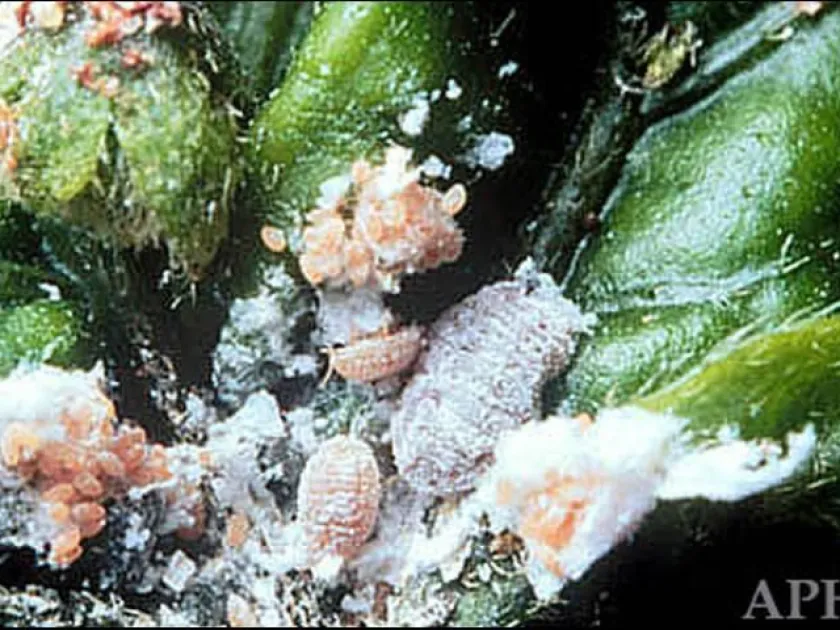
The hibiscus mealybug (Maconellicoccus hirsutus) belongs to the family Pseudococcidae. Adult females are small, roughly 3 mm long, and covered in a characteristic white, powdery wax layer that serves as a primary defense mechanism.
The life cycle involves eggs, nymphs (crawlers), and adults. Females lay hundreds of eggs within a protective cottony ovisac, which often appears pinkish due to the density of eggs inside.
The pest thrives in warm climates, where the absence of winter dormancy allows for up to 15 overlapping generations per year. The crawler stage is highly mobile and easily dispersed by wind, tools, or human activity.
Sexual dimorphism is distinct: males are winged and short-lived, as they do not feed and exist solely for reproduction, while females remain sedentary once they begin feeding.
The insect's ability to remain cryptic in hidden plant crevices makes it a challenging species for early detection in nurseries and agricultural fields.
What it damages
This invasive polyphagous pest targets over 200 host plants, including significant crops like citrus, coffee, grapes, and various ornamental hibiscus species.
Feeding is performed by piercing plant tissues and extracting sap. During this process, the insect injects toxic saliva that induces stunted growth, deformed leaves, and shortened internodes.
Severe infestations often result in the phenomenon known as "bunchy top," where terminal shoots grow in a compact, rosette-like cluster due to inhibited cellular expansion.
Yield loss is significant, as the pest causes massive flower bud drop and physiological weakening of the host plant, rendering it susceptible to secondary stressors.
The infestation is exacerbated by the production of honeydew, which serves as a substrate for sooty mold, blocking light and hindering the plant's photosynthetic capacity.
Signs of infestation
The most visible symptom is the deformation of shoot tips, which appear twisted, thickened, and stunted in their development.
White, cotton-like masses found along leaf veins, stem junctions, and underneath the bark are the most reliable indicators of an active Maconellicoccus hirsutus colony.
Sticky, shiny honeydew residues covering the foliage often lead to an infestation of black sooty mold, which creates a dirty appearance on the plant surfaces.
Unusual ant activity is frequently observed, as ants are attracted to the sugary honeydew and often protect the mealybugs from natural predators.
Yellowing, necrosis, and premature abscission of leaves indicate advanced stages of infestation where sap depletion has severely impacted the plant's health.
Control measures
Strict quarantine measures are essential to prevent the introduction of this pest, requiring thorough inspection of all nursery stock before it enters a new environment.
Biological control is highly effective; the release of the predator beetle Cryptolaemus montrouzieri and specific parasitoid wasps has shown excellent results in suppressing populations.
Chemical control focuses on systemic insecticides, as these reach the sap and are more effective against mealybugs than surface-applied contact sprays that cannot penetrate the wax.
Sanitation practices, such as the pruning and immediate destruction of infested plant parts, help reduce local population density and prevent further spread.
Integrated Pest Management (IPM) strategies, including monitoring with pheromone traps, are recommended to time applications and maximize the efficiency of control measures.
Taxonomy
- Latin name
- Maconellicoccus hirsutus
- Order
- Hemiptera (bugs, aphids, leafhoppers)
- Family
- Pseudococcidae
- EPPO code
- PHENHI
Discussion
No discussions yet — be the first.