
Tuttle mealybug
Heterococcus tuttlei
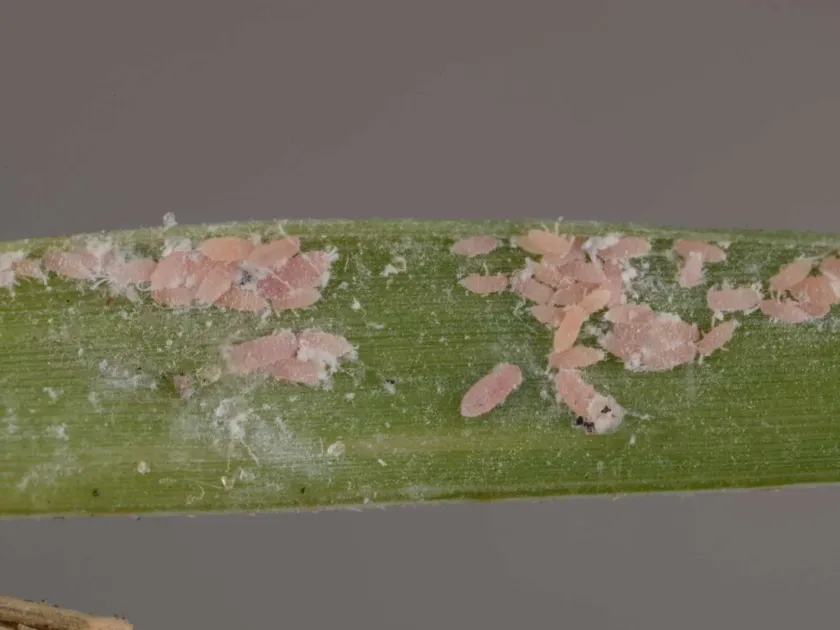
Description
How to identify
The Tuttle mealybug (Heterococcus tuttlei) belongs to the family Pseudococcidae, a group of insects known for their distinct waxy appearance. The adult females are characterized by an oval body covered in a white, powdery wax secretion, which provides protection against desiccation and environmental stress.
Sexual dimorphism is highly pronounced in this species: males are typically winged and short-lived, serving only to fertilize the females, while the sedentary females spend their lives feeding and laying eggs in waxy ovisacs. This biological structure is essential for their survival in diverse agricultural environments.
Detection is often challenging because these insects prefer to inhabit concealed areas such as leaf sheaths, stems, or under the glumes of cereal crops. Accurate identification by professionals usually involves microscopic examination of the dermal appendages and pore distributions.
The life cycle involves several nymphal instars, with the first instar, known as a "crawler," being the primary dispersal stage. These crawlers can be carried by wind or move actively to neighboring plants, establishing new colonies throughout the field.
Environmental factors, particularly humidity and temperature, play a crucial role in the development rate. In favorable conditions, multiple generations can occur within a single growing season, leading to significant population spikes that overwhelm plant defenses.
What it damages
Heterococcus tuttlei primarily infests grasses, with significant economic impact on cereal crops like wheat and barley. These crops provide the necessary sap required for the development of large mealybug colonies.
By inserting their piercing-sucking mouthparts into the plant tissues, the mealybugs extract vital nutrients, causing localized physiological stress. This sap extraction leads to stunted plant growth, chlorosis, and a visible reduction in the overall vigor of the crop.
Damage to the stems and leaves disrupts the plant's nutrient transport, which often manifests as malformed heads and shriveled grains. These impacts directly reduce both the quality and quantity of the harvest, posing a serious threat to profitability.
The indirect damage is equally concerning, as the insects produce honeydew, a sugary byproduct. This substance creates an environment conducive to the growth of sooty mold, which blocks sunlight and impairs photosynthesis, further weakening the plant.
In high-density infestations, the cumulative stress on the plant makes it significantly more susceptible to secondary viral infections and environmental hardships. If left unchecked, these infestations can lead to substantial yield losses across the affected field.
Signs of infestation
The most prominent sign of infestation is the presence of white, cotton-like masses on the stems or hidden within leaf sheaths. These are the protective waxy secretions produced by the mealybugs, which are often the first indicator of their presence.
Infected plants may exhibit yellowing or curling leaves that are often misdiagnosed as nutrient deficiencies or early-stage drought stress. A careful inspection of the lower stem and leaf axils usually reveals the hidden colonies of insects.
Honeydew accumulation on the foliage gives leaves a sticky appearance, which later turns black due to the growth of sooty mold. This blackened appearance on the stems or leaves is a reliable, albeit late, sign that the infestation has reached a critical level.
Early monitoring requires a close look at the plant bases, as the mealybugs tend to avoid direct sunlight. Using a hand lens during scouting can help differentiate between mealybug nymphs and other small pests or debris found on the plants.
Reduced plant height and non-uniform maturity within a field are common symptoms of localized pest hotspots. Regular scouting protocols are essential to detect these signs before the damage becomes irreversible across the crop stand.
Control measures
Effective management of the Tuttle mealybug relies on integrated pest management (IPM) strategies, combining cultural, chemical, and biological controls. Maintaining clean field margins by removing alternative grass hosts is the first step to reducing the source of infestation.
Crop rotation is a recommended cultural practice to disrupt the localized buildup of populations. By planting non-host crops in rotation, farmers can significantly reduce the overwintering success of the mealybug in specific areas.
Chemical control is most effective when applied early, targeting the vulnerable crawler stage before females develop thick, protective waxy layers. Systemic insecticides are preferred due to their ability to reach the pests hidden within leaf sheaths.
- Application of systemic insecticides from the neonicotinoid or organophosphate groups, depending on regional regulations.
- Encouraging natural predators and parasitoids, which often keep populations under control in balanced ecosystems.
- Routine monitoring of field edges, which are the most common entry points for the pest into the main crop area.
A proactive approach involving regular inspections and targeted insecticide applications provides the best defense. By integrating these methods, producers can maintain the pest population below the economic injury level and protect their cereal investments.
Taxonomy
- Latin name
- Heterococcus tuttlei
- Order
- Hemiptera (bugs, aphids, leafhoppers)
- Family
- Pseudococcidae
- EPPO code
- HETSTU
Discussion
No discussions yet — be the first.