
Bohemian mealybug
Heliococcus bohemicus
Description
How to identify
The Bohemian mealybug (Heliococcus bohemicus) belongs to the order Hemiptera and the family Pseudococcidae, commonly known as mealybugs.
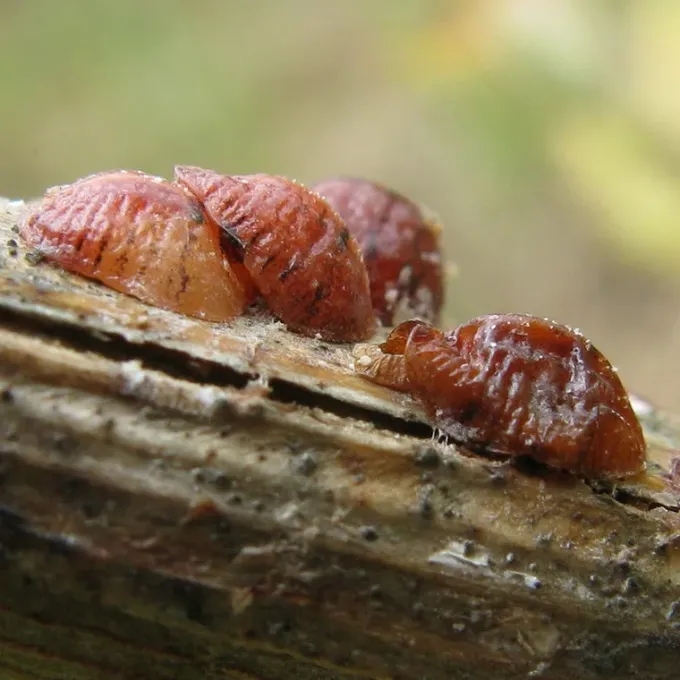
Adult females are oval-shaped, measuring about 3-4 mm in length, and are typically covered with a white, waxy secretion that protects them from external factors.
Males are smaller than females, possess wings, and are rarely seen due to their short lifespan focused primarily on reproduction.
The life cycle involves egg production within white, cotton-like ovisacs, which are tucked into the bark crevices of the host plant.
First-instar nymphs, known as crawlers, are the most mobile stage and are responsible for the spread of the infestation to new parts of the vine.
What it damages
The primary host of the Bohemian mealybug is the grapevine, although it can also affect various fruit trees and ornamental shrubs.
They feed by inserting their stylets into the plant tissue to suck phloem sap, which deprives the plant of essential nutrients and moisture.
Feeding leads to the weakening of the vines, stunted growth of young shoots, and a significant reduction in both yield quantity and sugar content.
A major indirect damage is the secretion of honeydew, which promotes the growth of sooty mold, covering the foliage and hindering photosynthesis.
Severe infestations can lead to leaf yellowing, early leaf drop, and in extreme cases, the decline of entire vines over several seasons.
When it appears
These pests overwinter primarily as second-instar nymphs under the loose bark of old wood or within cracks in the trunk.
In spring, as temperatures rise and sap flow begins, the nymphs emerge and migrate to young shoots to commence active feeding.
The peak period of reproduction usually occurs in late spring and early summer, coinciding with the vine's flowering stage.
There can be multiple generations per year, with the duration of each generation highly dependent on the ambient temperature and humidity.
As autumn approaches and temperatures drop, the population prepares for overwintering, seeking refuge in protected parts of the woody structure.
Signs of infestation
The most distinctive sign of infestation is the presence of white, woolly or cotton-like masses clustered on the bark and nodes of the vine.
Sticky honeydew deposits on leaves, shoots, and fruit clusters are a clear indication of a mealybug infestation in the canopy.
The development of a black, sooty coating on the leaves is a secondary symptom caused by fungi feeding on the insect's sugary waste.
Stunted shoot development and the presence of ants, which are often attracted to the honeydew, can serve as early warning signs.
Close inspection of the trunk and older woody parts in early spring often reveals colonies of nymphs coming out of hibernation.
Control measures
Effective management begins with cultural practices, such as removing old, loose bark where the pests hide during the winter months.
Applying dormant oil sprays in early spring is an essential preventative measure to reduce the overwintering population before bud burst.
During the growing season, systemic insecticides can be used to control active populations, ensuring thorough coverage of the woody parts.
Biological control, including the protection of natural predators like ladybird beetles and lacewings, plays a vital role in sustainable vineyards.
- Monitor vineyard blocks frequently during the vegetative season.
- Avoid excessive nitrogen fertilization which favors mealybug growth.
- Properly prune and destroy highly infested plant material.
Taxonomy
- Latin name
- Heliococcus bohemicus
- Order
- Hemiptera (bugs, aphids, leafhoppers)
- Family
- Pseudococcidae
- EPPO code
- HELCBO
Discussion
No discussions yet — be the first.