
Ferrisia gilli
Ferrisia gilli
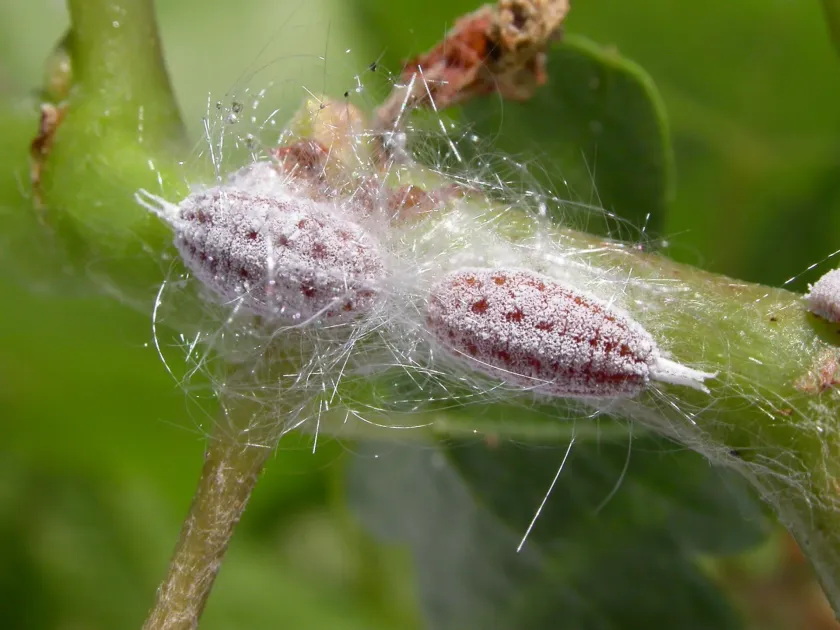
Description
How to identify
Ferrisia gilli is a species of mealybug (family Pseudococcidae) that has gained attention as a significant agricultural pest. Adult females are distinguished by their elongated, oval shape and the presence of a waxy, filament-covered body that gives them a distinct mealy appearance.
A key diagnostic feature of this species is the presence of two dark, longitudinal stripes on the dorsal side of the body, which are often obscured by the waxy secretion but visible upon close inspection.
The crawlers (first-instar nymphs) are highly mobile and play a critical role in the dispersal of the pest across the canopy of host plants or to neighboring trees via wind currents.
Unlike many other mealybug species, Ferrisia gilli is characterized by high reproductive rates through parthenogenesis, allowing populations to establish quickly in new environments.
Accurate identification is essential, as the species shares morphological similarities with other mealybugs, sometimes requiring expert examination of slide-mounted specimens for confirmation.
What it damages
This pest is a polyphagous insect that attacks a variety of economically important trees and shrubs, including grapevines, pistachios, almonds, and various ornamental citrus species.
The damage is primarily caused by both nymphs and adult females extracting sap from the plant's vascular system, leading to decreased vigor, stunted growth, and weakened overall health of the host plant.
Infestations on grapevines can be particularly devastating, as the insects congregate in clusters, damaging berries and stems, which often leads to poor fruit quality and reduced yield.
The excretion of honeydew by the mealybugs serves as a substrate for sooty mold growth, which covers leaves and stems, significantly reducing the plant's photosynthetic efficiency.
Severe infestations lead to bark necrosis, branch dieback, and in extreme cases, the total death of the tree if left untreated over several growing seasons.
When it appears
The life cycle of Ferrisia gilli is strongly dictated by climate, with warmer temperatures favoring more rapid development and increased survival rates of nymphs.
Overwintering occurs predominantly in protected areas such as bark crevices, branch unions, or under leaf litter, where nymphs and adult females survive the winter months.
As spring temperatures rise, the overwintered stages emerge from their hiding spots and begin to migrate toward new, developing shoots to feed and initiate the first generation of the year.
Multiple generations can occur throughout the growing season, with the highest population densities typically observed during the hot summer months.
As fall approaches and temperatures decline, the insects cease active dispersal and seek out suitable overwintering sites on the woody parts of the plant.
Signs of infestation
The most visible sign of an infestation is the presence of white, cotton-like masses on the bark, at the base of petioles, and on the surface of young shoots.
The development of black sooty mold on the foliage and branches is a strong indicator that a significant mealybug colony is active nearby, even if the insects themselves are hidden.
Trees and vines infested with this mealybug often show increased ant activity, as ants are attracted to the honeydew and will actively protect the mealybugs from natural enemies.
Leaf yellowing, premature senescence, and the wilting of young fruit bunches are symptomatic of heavy feeding damage on the plant's vascular system.
- White waxy secretions on branches and leaves.
- Sticky residue on stems caused by honeydew.
- Black sooty mold covering plant surfaces.
- Increased ant traffic on the plant canopy.
Control measures
Managing Ferrisia gilli is challenging due to the protective waxy layer covering the insects, which makes them highly resistant to many standard contact pesticides.
Dormant season applications of horticultural oils are highly recommended, as they can effectively smother overwintering stages hidden in bark crevices before they become active.
During the growing season, systemic insecticides are the most effective way to reach the feeding stages, though application timing is critical to coincide with the crawler emergence.
Cultural control measures, such as proper pruning to open the canopy, improve airflow and allow for better coverage of spray treatments, while simultaneously reducing the availability of favorable habitats.
Integrated Pest Management (IPM) strategies, which prioritize the conservation of natural predators such as lady beetles and parasitic wasps, can help keep population numbers below economic thresholds.
Taxonomy
- Latin name
- Ferrisia gilli
- Order
- Hemiptera (bugs, aphids, leafhoppers)
- Family
- Pseudococcidae
- EPPO code
- FERRGI
Discussion
No discussions yet — be the first.