
Ferrisia
Ferrisia
Description
How to identify
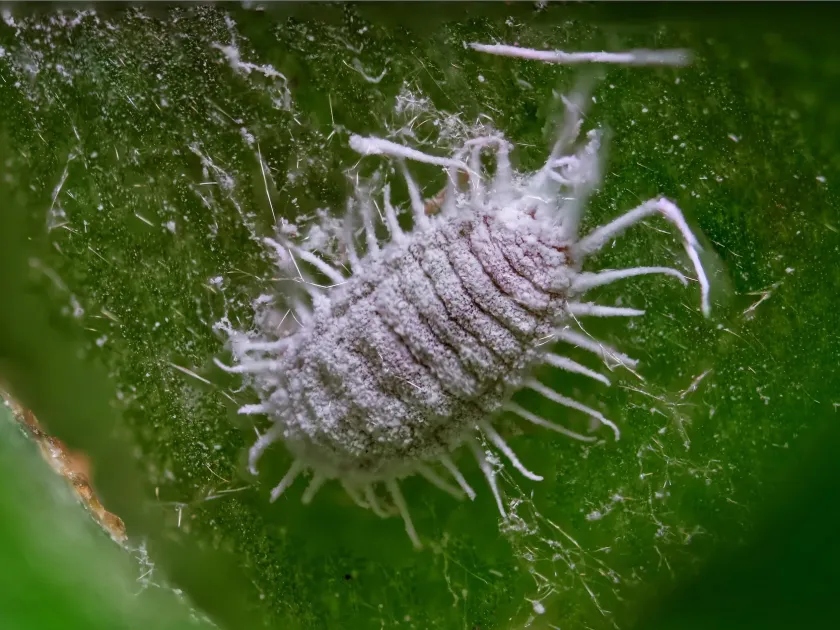
Ferrisia is a genus of insects within the Pseudococcidae family, commonly known as mealybugs. They are characterized by their small, soft bodies covered with white waxy secretions and elongated filaments along their sides.
A key identifying feature of this genus is the presence of long, waxy filaments that are often longer than the insect's own body. Some species also exhibit a characteristic dark longitudinal stripe on the dorsum, which can be seen through the wax.
Taxonomically, Ferrisia belongs to the order Hemiptera. The most prominent and economically significant species is Ferrisia virgata, which has a worldwide distribution, particularly in tropical and subtropical regions.
Identification can be difficult because these insects prefer to hide in secluded areas, such as leaf axils, deep within the canopy, or even near the root collar, often avoiding direct sunlight or observation.
For precise species identification, laboratory analysis focusing on the arrangement of dorsal and ventral pores and setae is required, as the general appearance of adult females can vary based on the host plant.
What it damages
Ferrisia species are polyphagous pests, capable of attacking a diverse range of crops, including citrus, cotton, cocoa, various legumes, as well as many ornamental and greenhouse plants.
Damage is caused by both nymphs and adults feeding on plant sap. This activity removes essential nutrients, leading to stunted growth, leaf chlorosis, deformation of shoots, and premature drop of flowers or fruit.
During feeding, the insects excrete large amounts of honeydew. This sticky substance promotes the rapid growth of sooty mold, which coats the foliage in a black layer, effectively blocking the light required for photosynthesis.
Furthermore, these mealybugs act as vectors for various plant viruses, posing a significant threat to production stability and crop quality in commercial settings.
Heavy infestations can lead to total crop failure, especially in plants already stressed by adverse environmental conditions, as the cumulative damage to the vascular system becomes irreversible.
When it appears
The biology of Ferrisia is heavily influenced by ambient temperature and humidity. In tropical climates, the insect breeds continuously, allowing for multiple overlapping generations throughout the year.
In greenhouse or indoor environments, the lifecycle remains active year-round due to stable climate control. This prevents the natural seasonal declines in population observed in outdoor settings.
Peak activity generally occurs in warm, humid conditions, where development cycles are accelerated. However, they are highly adaptable and can survive in the drier air often found in managed interior environments.
Dispersal primarily occurs during the 'crawler' stage (first-instar nymphs). These small nymphs are highly mobile and can be easily transported by wind currents, irrigation water, or human activity like maintenance tools.
The lifecycle consists of eggs, several nymphal instars, and the adult stage. Females produce protective waxy ovisacs to guard their eggs, significantly increasing survival rates against chemical and environmental stressors.
Signs of infestation
The most recognizable sign of a Ferrisia infestation is the presence of white, cotton-like masses on stems or the undersides of leaves. These are the waxy ovisacs and protective coverings of the colony.
Another critical indicator is the 'stickiness' of the leaves, caused by the honeydew excretion. This shiny layer is often the first visual clue before the actual insects are noticed by a grower.
The presence of ants is a strong indirect sign of infestation. Ants are attracted to the honeydew and will actively defend the mealybug colonies from natural predators, effectively spreading the pest across the host plant.
Plants under attack often show symptoms of decline: yellowing leaves, loss of turgor pressure, and wilting. Close inspection of leaf junctions usually reveals the white, stationary insects.
Eventually, the development of black sooty mold on leaves confirms an established and thriving colony that has likely been present for an extended period.
Control measures
Management of Ferrisia is challenging because the thick waxy layer of the mealybugs provides significant protection against many standard contact insecticides.
A successful control program emphasizes prevention through strict quarantine of new plant material. Regular scouting of existing collections is vital to catch infestations early before they become widespread.
Chemical control is most effective when using systemic insecticides, such as neonicotinoids or spirotetramat, which allow the active ingredient to move through the plant sap, reaching the pests wherever they hide.
In greenhouse settings, biological control is highly recommended. The use of natural enemies, such as the ladybird beetle Cryptolaemus montrouzieri, can effectively suppress mealybug populations without the need for heavy pesticide use.
- Sanitary pruning of severely infested plant parts.
- Application of horticultural oils to break down the waxy protective layer.
- Ant management to prevent the protection and spread of the pest.
- Use of yellow sticky traps for population monitoring.
Taxonomy
- Latin name
- Ferrisia
- Order
- Hemiptera (bugs, aphids, leafhoppers)
- Family
- Pseudococcidae
- EPPO code
- FERRSP
Discussion
No discussions yet — be the first.