
Gray mealybug
Exallomochlus hispidus
Description
How to identify
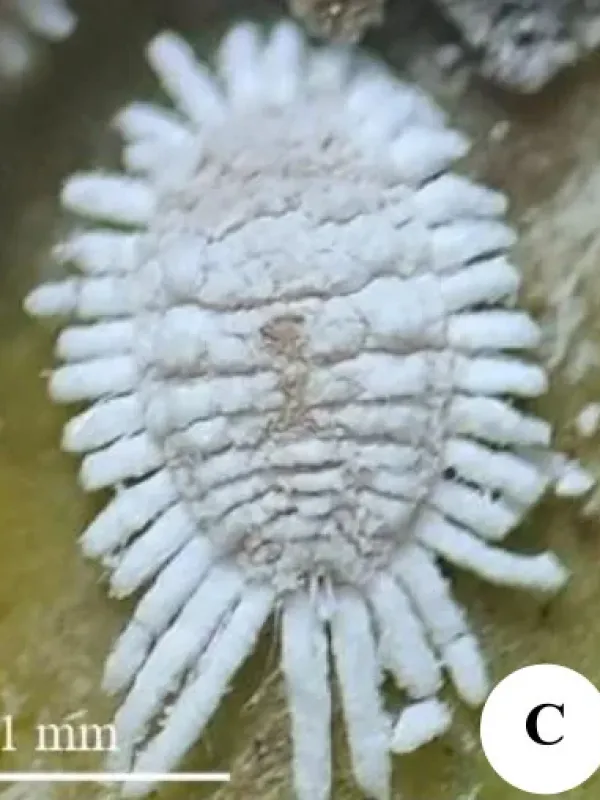
The gray mealybug, scientifically known as Exallomochlus hispidus, is a significant pest belonging to the Pseudococcidae family within the order Hemiptera. Adults are characterized by their soft bodies covered with a white waxy secretion that provides a powdery appearance.
Adult females are typically oval-shaped, measuring between 2 and 4 millimeters in length. They are distinguished by the presence of long, prominent bristles or hairs along the body margins, which is a key diagnostic feature for this specific species.
Males are rarely observed; they are winged and lack functional mouthparts, living only long enough to mate. The life cycle comprises egg, nymphal stages, and adult stages, with females often exhibiting parthenogenic reproduction.
The insects thrive in sheltered environments, such as leaf axils, twig bifurcations, and crevices in bark. These locations provide protection from predators and environmental stressors, making early detection challenging.
The waxy sacs created by females protect their eggs from desiccation and chemical treatments, which is a crucial aspect of their survival strategy and why they are difficult to eradicate.
What it damages
This pest is a highly polyphagous insect that attacks numerous economically important crops, including cocoa, coffee, citrus, and various tropical fruits. It causes damage by feeding on phloem sap.
Continuous sap feeding results in the loss of nutrients, leading to stunted growth, leaf chlorosis, and general physiological decline of the host plant. Severe infestations can cause premature dropping of flowers and fruit.
A major indirect damage factor is the production of honeydew, a sugary excretion that encourages the growth of sooty mold. This black fungal layer covers the leaf surface, severely inhibiting the plant's photosynthetic capacity.
Furthermore, Exallomochlus hispidus is known to act as a vector for various plant viral diseases, making it a critical threat to agricultural production and international trade due to quarantine regulations.
Root infestations can occur in some crops, leading to root system decay and reducing the plant's ability to uptake water and nutrients, which often results in the eventual death of the host.
When it appears
The development of Exallomochlus hispidus is highly dependent on temperature and humidity. In tropical and subtropical regions, the pest is active throughout the year, with continuous overlapping generations.
Higher temperatures, typically ranging from 25 to 30 degrees Celsius, accelerate the lifecycle, leading to rapid population growth. Humid conditions also favor the survival and dispersal of the first-instar nymphs (crawlers).
In greenhouse settings, the environment is often kept optimal for these pests, allowing them to maintain high population levels year-round, regardless of external seasonal changes.
Dispersal usually occurs during the crawler stage, when the tiny nymphs move to new parts of the host plant or are carried by wind, water, or agricultural equipment to adjacent plants.
Fluctuations in weather have limited impact on established colonies, as their waxy protective layer and hidden habitats provide a stable microclimate that buffers them from extreme conditions.
Signs of infestation
The most obvious sign of infestation is the presence of white, cotton-like masses on stems, leaf undersides, and fruit stalks. These are the egg sacs produced by the female mealybugs.
Leaves often appear shiny and sticky due to the honeydew secretion. Over time, the appearance of black sooty mold patches on the leaves is a clear indicator that the mealybug population is well-established.
Plants may show signs of yellowing, wilting, or distorted growth in new shoots. Because of the nutrient loss, the plant will appear generally weak and fail to thrive despite proper fertilization and irrigation.
Closer inspection of hidden areas often reveals clusters of the insects themselves. In the case of root infestation, the soil around the roots may contain small, white waxy particles.
Ant activity is frequently linked to mealybug presence, as ants feed on the honeydew and often protect the mealybugs from natural enemies, effectively encouraging the spread of the infestation.
Control measures
Effective management requires an integrated approach. Quarantine measures are the first line of defense to prevent the introduction of this pest into new areas via infested nursery stock.
For small-scale infestations, physical removal using soft brushes or cotton swabs dipped in alcohol or mild soapy water can be effective. Pruning and destroying heavily infested branches is also a necessary control step.
Biological control methods involve the release of specialized natural enemies, such as ladybird beetles (e.g., Cryptolaemus montrouzieri) or parasitic wasps that prey on various life stages of the mealybug.
Chemical control focuses on the use of systemic insecticides that are translocated within the plant tissues. Applying oils or soaps can also help dissolve the waxy layer of the mealybugs, making them more susceptible to other treatments.
- Regular monitoring of plant health.
- Isolation of infected plants to stop cross-contamination.
- Sanitation of greenhouses and farming equipment.
- Implementing habitat management to encourage native predator populations.
Taxonomy
- Latin name
- Exallomochlus hispidus
- Order
- Hemiptera (bugs, aphids, leafhoppers)
- Family
- Pseudococcidae
- EPPO code
- PSECHI
Discussion
No discussions yet — be the first.