
Wisteria mealybug
Dysmicoccus wistariae
Description
How to identify
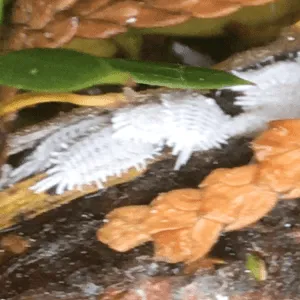
The Wisteria mealybug (Dysmicoccus wistariae) is a small sap-sucking insect belonging to the Pseudococcidae family. Adult females are oval-shaped, typically 2–4 mm long, and covered in a powdery white wax that gives them a cottony appearance.
The body of the adult female has short, waxy filaments along the margin. They are relatively sedentary, spending most of their adult life attached to the host plant.
The insect undergoes several nymphal stages, with the "crawler" stage being the most active period for dispersal across the plant's surface.
Their mouthparts are specifically designed for piercing plant tissues and extracting nutrient-rich sap, which is the primary source of their energy.
These pests thrive in humid and sheltered microclimates, frequently clustering in the axils of leaves, along stems, and in crevices of the bark.
What it damages
This species primarily targets various ornamental shrubs and trees, with wisteria, grapes, and citrus being common hosts for infestation.
By feeding on phloem sap, the mealybug depletes the plant's vital nutrients, which leads to stunted growth and reduced vigor in infested parts.
The feeding process involves injecting saliva into the host, which can cause significant tissue deformation, leaf chlorosis, and premature leaf drop.
The excretion of honeydew as a byproduct of feeding creates a sticky surface that fosters the growth of sooty mold, blocking photosynthesis in the leaves.
Severe infestations can eventually lead to branch dieback or the death of younger plants that lack sufficient resources to withstand the continuous stress.
When it appears
The Wisteria mealybug becomes active during the spring as temperatures rise, signaling the start of the breeding season for the overwintering population.
In greenhouse settings, they can complete multiple generations annually, provided the temperature remains consistently favorable throughout the year.
The peak of their activity usually occurs during mid-summer, when the warm weather accelerates the developmental cycle of the nymphs.
As temperatures drop in autumn, the insects look for protected overwintering sites, such as cracks in the bark or sheltered spots near the root crown.
The population density is largely influenced by the presence of favorable host plants and the lack of natural predators in the immediate vicinity.
Signs of infestation
The most noticeable symptom is the presence of white, cotton-like masses on the stems, bark, and underneath the leaves of the host plant.
Sticky, shiny residue on the leaves, known as honeydew, is a strong indication that an active colony of mealybugs is feeding on the plant.
Yellowing of the leaves and general wilting are clear physiological responses to the nutrient loss and systemic stress caused by the pests.
A black, sooty coating developing on the foliage is a secondary sign resulting from the colonization of fungi on the honeydew secretion.
Reduced shoot elongation and failure of buds to develop properly are indicators that the infestation has reached a significant level of severity.
Control measures
Early detection is crucial; inspecting the undersides of leaves and stem nodes periodically can help prevent a widespread outbreak.
For minor infestations, cleaning the affected areas with a cotton swab soaked in isopropyl alcohol can effectively remove and kill the insects.
Systemic insecticides applied to the soil or as a foliar spray are highly effective, as the poison is distributed throughout the plant's vascular system.
Horticultural oils and insecticidal soaps can be used to coat the insects, suffocating them while minimizing impact on beneficial predatory insects.
Encouraging biological control by releasing natural predators, such as ladybird beetles (e.g., Cryptolaemus montrouzieri), can provide sustainable long-term management.
Taxonomy
- Latin name
- Dysmicoccus wistariae
- Order
- Hemiptera (bugs, aphids, leafhoppers)
- Family
- Pseudococcidae
- EPPO code
- DYSMWI
Discussion
No discussions yet — be the first.