
Delottococcus aberiae
Delottococcus aberiae
Description
How to identify
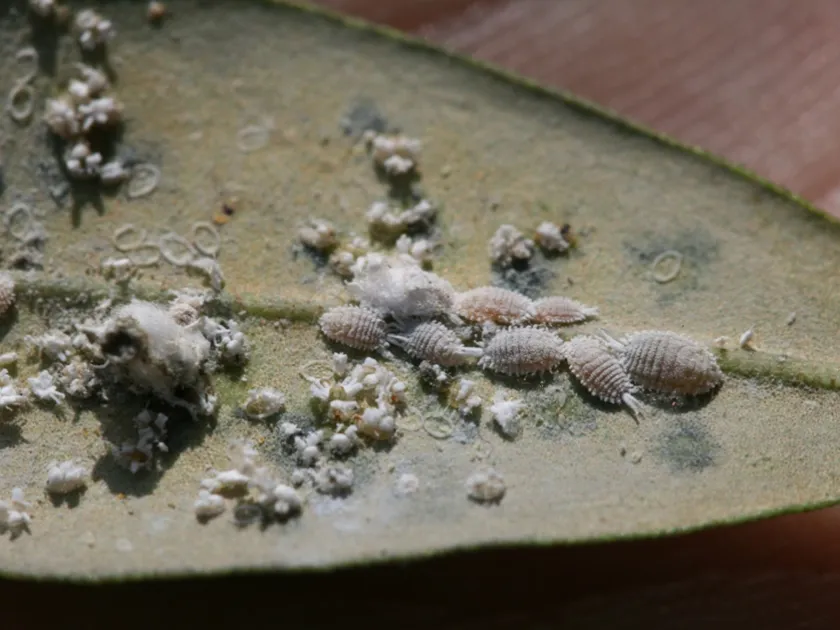
Delottococcus aberiae is a small insect belonging to the order Hemiptera and the family Pseudococcidae, commonly known as mealybugs. Adult females are oval-shaped, approximately 3 mm long, and covered with a white, powdery waxy secretion.
Unlike many other mealybug species, this pest is highly mobile during its early developmental stages, which facilitates its spread within citrus orchards.
Adult males are much smaller, possess wings, and have a very short lifespan dedicated exclusively to reproduction, as they do not feed during this phase.
Females lay eggs in protective waxy structures called ovisacs, which are often found in crevices of bark or at the base of leaves, providing security against harsh conditions.
Accurate identification usually requires microscopic examination to observe the specific arrangement of wax filaments along the female's body margin.
What it damages
The primary hosts of Delottococcus aberiae are citrus trees, including oranges, lemons, and mandarins. It is known to be a highly polyphagous pest capable of infesting various plant parts.
The insect feeds by inserting its stylets into the plant tissue and sucking out sap, which causes severe nutritional stress to the host tree.
Damage to fruits is particularly concerning, as it results in malformation, stunted growth, and a significant reduction in commercial fruit quality.
Excessive feeding leads to the excretion of honeydew, which creates a sticky surface on leaves and fruits, serving as a medium for the growth of sooty mold.
In cases of heavy infestation, the tree may experience significant defoliation and a drastic reduction in total fruit yield for the season.
When it appears
The seasonal activity of the pest typically begins in the spring when temperatures consistently remain above the threshold required for development.
Peak population growth occurs during the summer months, as warmer temperatures accelerate the life cycle and allow for multiple overlapping generations.
Activity slows down as autumn approaches and temperatures drop, but the pest continues to feed and search for overwintering sites on the tree.
During the winter, the pest survives as nymphs or adults, finding shelter in bark crevices, leaf axils, or other protected areas on the tree structure.
In subtropical regions with mild winters, the pest can maintain continuous cycles of reproduction without a distinct period of dormancy.
Signs of infestation
Initial signs of infestation include the presence of white, cotton-like masses on the undersides of leaves, along branches, and near the fruit peduncles.
Visible deformation of young shoots and curling of the leaves are clear indicators that the plant's sap is being depleted by a growing colony.
Sticky honeydew secretions on the surface of leaves and fruit attract ants and promote the rapid spread of black sooty mold fungus.
The presence of ants patrolling the branches is often a secondary sign that a mealybug colony is active, as ants feed on the honeydew produced.
- Cotton-like white waxy clusters
- Stunted growth of young twigs
- Sticky honeydew residue
- Black sooty mold covering foliage
- Leaf drop and fruit distortion
Control measures
Integrated Pest Management (IPM) is essential, starting with monitoring programs that utilize pheromone traps to detect population spikes early.
Chemical control involves the application of targeted insecticides, preferably those with systemic action to reach the insects hidden in crevices.
Good horticultural practices, such as pruning to open the tree canopy, improve airflow and light penetration, making the environment less favorable for the pest.
Biological control using introduced or native natural enemies, such as parasitic wasps or ladybird beetles, can play a significant role in suppressing populations.
Strict quarantine measures on the movement of nursery stock and fruit are critical to preventing the introduction of this pest into unaffected citrus-growing areas.
Taxonomy
- Latin name
- Delottococcus aberiae
- Order
- Hemiptera (bugs, aphids, leafhoppers)
- Family
- Pseudococcidae
- EPPO code
- DLTCAB
Discussion
No discussions yet — be the first.