
Delottococcus
Delottococcus
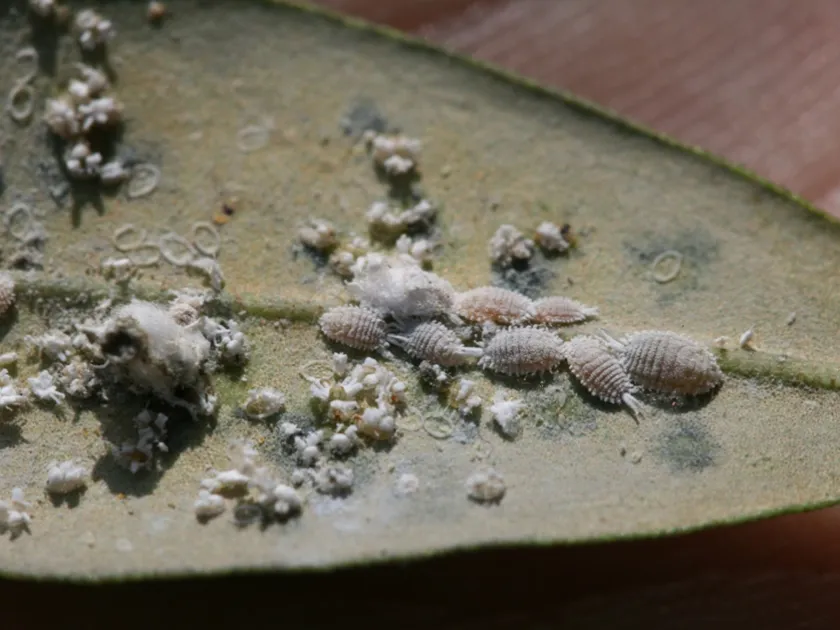
Description
How to identify
Delottococcus is a genus of mealybugs belonging to the family Pseudococcidae within the order Hemiptera. These small insects are well-known for their white, powdery waxy secretions that protect their bodies.
Adult females are typically sedentary, attaching themselves to plant tissues to feed on phloem sap. Their bodies are oval-shaped and often covered with long wax filaments, which serve as a primary defense against predators and desiccation.
Males, in contrast, are smaller and possess wings, allowing them to fly and locate mates. Their life cycle is more complex, involving a pupal stage, though the primary damage to crops is caused by feeding females and nymphs.
Morphological identification of the genus often requires specialized knowledge, as many mealybug species share similar external features, making microscopic examination of morphological structures essential.
These insects rely on specific host plants to complete their development, often exploiting the nutrient-rich sap to support large, multi-generational colonies throughout the growing season.
What it damages
Delottococcus is a polyphagous pest capable of attacking a wide range of agricultural and ornamental plants. It is particularly notorious for damaging fruit trees, vineyards, and various citrus species.
By piercing and sucking sap from plant tissues, these insects cause stunted growth, wilting, and weakening of the plant's structural integrity. This nutrient depletion is often lethal if not addressed.
Besides direct physical injury, they are known vectors for various plant viruses, which can compromise the health of an entire orchard or vineyard, leading to significant economic losses.
Feeding often occurs in concealed areas such as branch crotches, beneath loose bark, or around the petioles, which allows the infestation to persist undetected until it becomes severe.
The cumulative effect of feeding results in distorted leaves, yellowing foliage, fruit drop, and a general decline in the plant's overall photosynthetic capacity and vigor.
When it appears
The activity of Delottococcus begins in early spring, as rising temperatures trigger the emergence of nymphs from their overwintering sites in cracks and crevices.
Peak activity typically occurs during the warmer summer months when environmental conditions are optimal for rapid reproduction and multiple generation turnovers.
The number of generations per year is largely dictated by the regional climate, with warmer environments supporting continuous breeding cycles throughout the growing season.
As autumn approaches and temperatures drop, the metabolic activity of the pests decreases, and they seek sheltered locations to enter a dormant state for the winter.
Monitoring programs are most effective when initiated during the early stages of vegetation, allowing for the detection of small colonies before they reach outbreak levels.
Signs of infestation
The presence of white, cotton-like masses on leaves, stems, or fruit is the most characteristic sign of a Delottococcus infestation, indicating egg-laying sites and colony concentration.
Excreted honeydew is another major indicator; this sticky substance often covers plant surfaces and attracts sooty mold, which manifests as a black coating on leaves.
Visible signs of plant stress include leaf curling, yellowing (chlorosis), and premature abscission of leaves or fruit, which disrupts the aesthetic and economic value of the crop.
In cases of heavy infestation, large colonies may be visible as white patches clustered around nodes, bark fissures, or the undersides of leaves, requiring close inspection.
- White, fuzzy wax formations on foliage and stems.
- Sticky residue (honeydew) on leaves and surrounding plant parts.
- Development of dark, sooty mold on leaf surfaces.
- Deformed growth and stunted development of new shoots.
Control measures
Effective management of Delottococcus requires an integrated approach that combines cultural practices, biological controls, and judicious chemical applications.
Cultural methods include proper pruning to improve air circulation and canopy light penetration, which creates a less favorable environment for mealybug establishment.
Chemical control usually involves the use of systemic insecticides that are absorbed by the plant, reaching the insects even in protected feeding sites where contact sprays might fail.
Biological control agents, such as ladybird beetles and certain parasitic wasps, can be highly effective in reducing pest numbers when introduced into an integrated pest management (IPM) program.
To ensure long-term control, it is essential to alternate insecticides with different modes of action to prevent the development of resistance and to minimize the impact on beneficial insect populations.
Taxonomy
- Latin name
- Delottococcus
- Order
- Hemiptera (bugs, aphids, leafhoppers)
- Family
- Pseudococcidae
- EPPO code
- DLTCSP
Discussion
No discussions yet — be the first.