
Tomicobia seitneri
Tomicobia seitneri
Description
How to identify
Tomicobia seitneri is a species of parasitic wasp belonging to the family Pteromalidae. It is a highly specialized parasitoid that targets various species of bark beetles, playing a crucial role in regulating their populations within forest ecosystems.
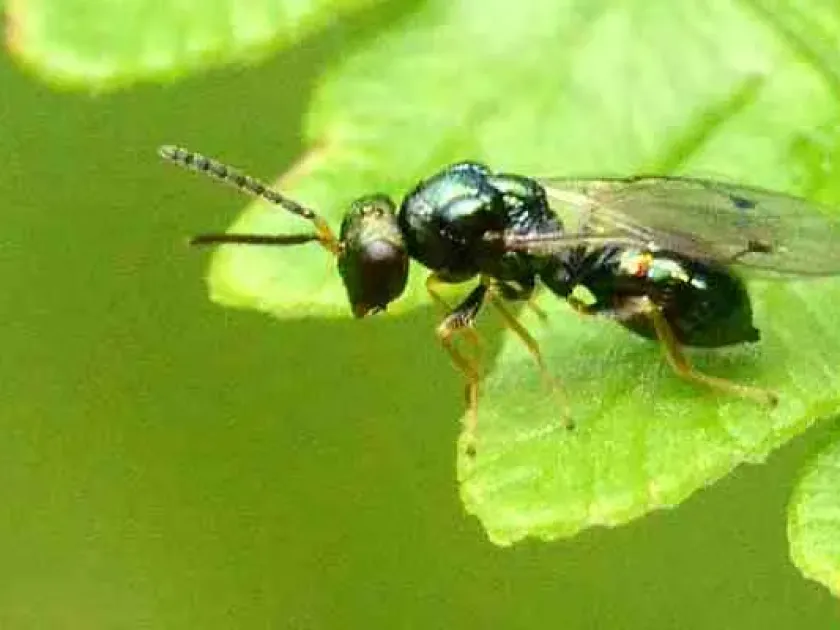
Adult wasps are small with a dark, often metallic appearance. Their morphology is characteristic of the Pteromalidae family, featuring specific wing venation patterns that help experts distinguish them from other chalcid wasps.
The biology of T. seitneri is inextricably linked to the host insects. Females are equipped with a specialized ovipositor that allows them to detect and infect adult bark beetles, often while they are active beneath the tree bark.
They are typically found in coniferous forests, where bark beetles like Ips typographus are prevalent. Without these specific hosts, T. seitneri cannot complete its life cycle, making it an obligate parasitoid.
Due to their small size and cryptic habits, these wasps are rarely seen by the casual observer. They are primarily identified through microscopic examination and by rearing them from infested host samples.
What it damages
Tomicobia seitneri does not cause damage to plants or timber. On the contrary, it is classified as a beneficial insect. By parasitizing bark beetles, it reduces the damage these pests cause to trees.
The larvae of the wasp develop inside the body of the adult bark beetle. This process prevents the beetle from completing its reproductive cycle, effectively acting as a natural pest control agent.
In high-density bark beetle populations, the presence of these wasps can significantly reduce the number of beetles emerging from a tree, thus lessening the pressure on forest stands.
While they may not stop a major outbreak on their own, they contribute to the natural balance. Their activity is a component of the forest's immune system, preventing the unchecked growth of pest populations.
It is important for foresters to recognize T. seitneri as an ally rather than a threat, as it provides a valuable ecosystem service in conifer plantations.
When it appears
The activity period of T. seitneri is synchronized with the emergence and flight of its bark beetle hosts. This typically occurs in the spring and summer when beetles are actively colonizing new trees.
The life cycle involves multiple stages that take place inside the host or within the host's galleries. The synchronization ensures that the wasp offspring have access to the beetle during its most vulnerable stage.
Larval development occurs throughout the summer months. The wasp feeds on the internal tissues of the beetle, gradually killing the host as it matures into its pupal stage.
Overwintering usually occurs in the larval or pupal stage inside the bark, alongside the overwintering generation of bark beetles. This allows the wasps to survive winter conditions safely.
With the return of warm temperatures in the spring, the adult wasps emerge, immediately beginning the search for new host beetles to start the next generation.
Signs of infestation
The primary sign of Tomicobia seitneri presence is the discovery of parasitized beetles when inspecting bark beetle galleries. Affected beetles often show reduced activity and signs of internal decay.
A definitive sign is the emergence hole found on the body of an adult bark beetle. These tiny circular holes indicate that an adult wasp has completed its development and exited the host.
When collecting bark samples in the field, researchers look for dead beetles that lack signs of external mechanical damage but show clear evidence of parasitoid emergence.
Rearing beetles in laboratory conditions is the most reliable way to confirm the presence of T. seitneri. If the wasps emerge from the collected beetles instead of the beetles reproducing, the parasitism is confirmed.
A declining bark beetle population accompanied by an increase in parasitized individuals is a strong biological indicator that T. seitneri is active and functioning within the area.
Control measures
Since Tomicobia seitneri is a beneficial insect, control measures should be focused on conservation rather than eradication. The best approach is to minimize human interference that would harm the wasp population.
- Restrict the use of broad-spectrum insecticides in forest stands to protect natural parasitoid populations.
- Maintain forest heterogeneity, which provides necessary habitats for both the host and the parasitoid.
- Carry out selective sanitary logging to avoid removing trees that act as nurseries for beneficial wasps.
- Avoid mass-trapping with chemical pheromones during the peak activity of the parasitoids if possible.
- Prioritize integrated pest management (IPM) strategies that favor natural regulatory processes over chemical applications.
Taxonomy
- Latin name
- Tomicobia seitneri
- Order
- Hymenoptera
- Family
- Pteromalidae
- EPPO code
- TOMISE
Discussion
No discussions yet — be the first.