
Scutellista nigra
Scutellista nigra
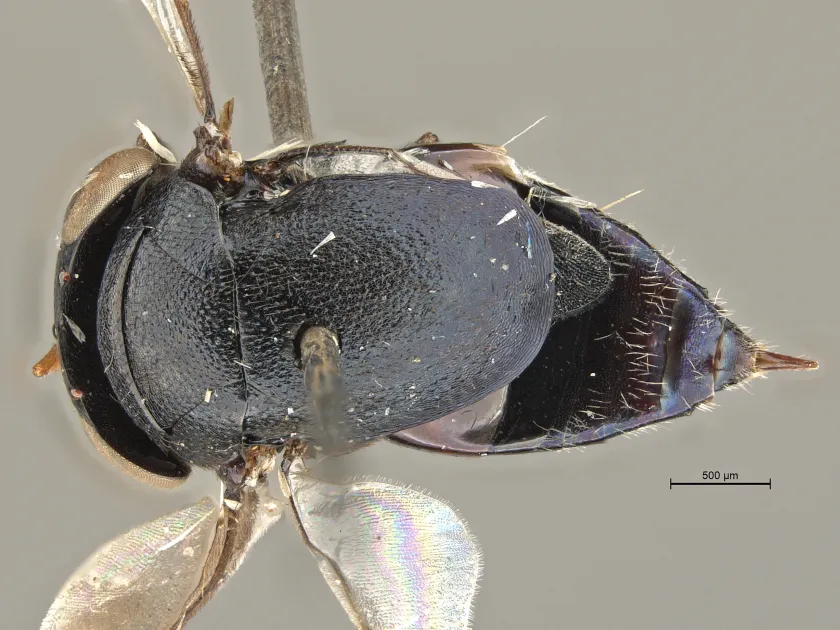
Description
How to identify
Scutellista nigra is a member of the Hymenoptera order, specifically the Pteromalidae family. It is widely recognized in agronomy as an entomophagous insect, although its role can be dual depending on the ecosystem stability.
The adult insect has a compact, black, shiny body, typically measuring 2–3 mm in length. Its morphological features are highly adapted for searching and parasitizing sedentary scale insects.
The wings are transparent with a venation pattern typical of the Pteromalidae family. The thorax and head are heavily sclerotized, providing resilience against harsh environmental conditions.
The larvae are specialized parasites that inhabit the space under the scale of their host. Their mouthparts are designed to consume the host's hemolymph efficiently.
Pupation occurs underneath the protective shell of the deceased host, providing the developing wasp with a safe environment from environmental stressors and predators.
What it damages
The primary hosts of Scutellista nigra are various species of Coccidae, most notably the black scale (Saissetia oleae). The larva consumes the contents of the host under the scale covering.
Damage occurs when Scutellista nigra outcompetes other primary parasitoids, leading to an imbalance in the natural biological control system of the crop.
In commercial citrus or olive orchards, an excessive population of this wasp can interfere with established biological pest management programs, causing secondary outbreaks of scales.
Affected crops include olive trees, citrus (lemons, oranges), pomegranate, figs, and various ornamental shrubs susceptible to scale infestation.
The indirect damage is characterized by a decrease in the effectiveness of other parasitoid species, which in turn leads to a higher overall burden of scale insects on the plants.
When it appears
The life cycle of Scutellista nigra is intrinsically linked to the phenology of its host. In warmer climates, it can complete multiple generations within a single growing season.
Adult activity peaks during the periods when the host scale insects are in a developmental stage suitable for oviposition by the parasitoid.
Wintering typically occurs in the larval or pupal stage protected beneath the scale of a dead adult host, allowing the species to survive low-temperature periods.
As spring temperatures rise, adult wasps emerge and begin the search for new host colonies to initiate the next generation.
Environmental factors such as humidity and ambient temperature significantly influence the developmental rate of the wasp throughout the year.
Signs of infestation
The primary sign of its presence is the discovery of empty or hollow scale insect shells on the twigs and branches of host trees.
Microscopic examination of the host shell often reveals the presence of cast larval skins or fecal material left by the Scutellista nigra larva.
A distinctive feature of a parasitized scale is the deformation or increased convexity of the shell caused by the growing parasite within.
Absence of specific exit holes normally left by other wasp parasitoids may indicate that Scutellista nigra was the agent that destroyed the host colony.
Visible signs on the crop include a gradual loss of vigor in scale populations, leading to reduced honeydew production and slowed colony growth.
Control measures
The main strategy for managing this insect is to maintain high biodiversity within the orchard to prevent any single parasitoid species from disrupting the ecosystem.
Minimizing the use of broad-spectrum insecticides is crucial, as Scutellista nigra is highly sensitive to most common chemical pesticides.
Agrotechnical practices, such as proper pruning and thinning of the canopy, help manage scale populations naturally, reducing the reliance on specific parasitoids.
Biological control programs should be monitored by entomologists to ensure a stable balance of species and to prevent the dominance of one parasitoid over others.
- Avoid prophylactic spraying of systemic insecticides.
- Establish hedgerows or wild areas to provide refugia for beneficial insects.
- Monitor scale insect population dynamics using pheromone traps to make informed decisions.
Taxonomy
- Latin name
- Scutellista nigra
- Order
- Hymenoptera
- Family
- Pteromalidae
- EPPO code
- SCUENI
Discussion
No discussions yet — be the first.