
Blue scutellista
Scutellista caerulea
Description
How to identify
Blue scutellista (lat. Scutellista caerulea) is a parasitic insect belonging to the order Hymenoptera and the family Pteromalidae.
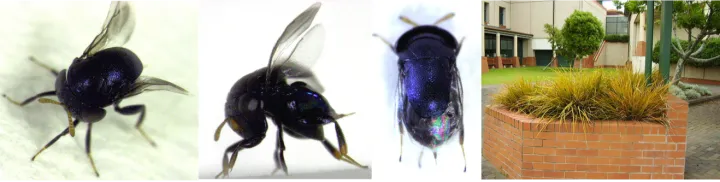
The adult form is a small chalcid wasp, recognized by its distinct metallic blue or dark-colored body.
Adults typically measure between 2 and 3 millimeters in length, often remaining unnoticed due to their size and rapid movement.
The wings are clear and feature specific venation patterns characteristic of the Pteromalid family.
The larval stage is white or cream-colored and develops hidden inside the scale or shell of its insect host.
What it damages
The primary hosts for the larvae of this insect are various scale insects, most notably the black scale Saissetia oleae.
While often considered a beneficial predator, its presence indicates a heavy infestation of scale insects that are actively damaging the host plant.
Scale insects feed by sucking sap from the plant, leading to stunted growth, leaf yellowing, and overall plant decline.
Large colonies of scale insects cause significant stress to citrus, olive, and ornamental plants, potentially leading to branch dieback.
The accumulation of honeydew produced by the scales often leads to the growth of sooty mold, which blocks light and impairs photosynthesis.
When it appears
The development of Scutellista caerulea is synchronized with the lifecycle of its host scale insects.
Activity is most pronounced during warm months, which correlate with the peak reproductive periods of the scales.
The insect undergoes complete metamorphosis, with the adult stage being the primary mobile phase for dispersing and locating new hosts.
Depending on the climatic zone, multiple generations can occur within a single growing season.
Overwintering typically occurs in the larval stage, safely encased under the shell of a host scale insect, protecting it from environmental extremes.
Signs of infestation
The most common sign of infestation is the observation of numerous scale insects on leaves and branches, some of which appear "empty" or damaged.
Small, perfectly circular exit holes on the surface of the scales indicate that an adult wasp has emerged from the shell.
The presence of shiny, sticky honeydew on the leaves is a clear indicator that a colony of scale insects is currently active on the plant.
General wilting or yellowing of foliage in specific parts of the canopy suggests a localized infestation of sap-sucking insects.
Physical inspection of the underside of the scale shields often reveals the presence of the parasitic larvae inside.
Control measures
Managing scale insects, which serve as the host, is the most effective way to address the presence of this species.
Pruning heavily infested branches is an effective mechanical method to reduce the total population density within a garden or orchard.
Horticultural oils or insecticidal soaps can be applied to coat the scales, effectively suffocating them without leaving toxic residues.
Systemic insecticides should be used as a last resort, ensuring they are applied in a manner that protects non-target beneficial insects.
- Regular monitoring of plant health for early detection of scales.
- Maintaining plant vigor through appropriate irrigation and fertilization.
- Encouraging natural predator populations to maintain ecological balance.
Taxonomy
- Latin name
- Scutellista caerulea
- Order
- Hymenoptera
- Family
- Pteromalidae
- EPPO code
- SCUECY
Discussion
No discussions yet — be the first.