
Pirene penetrans
Pirene penetrans
Description
How to identify
Pirene penetrans belongs to the order Hymenoptera, family Pteromalidae. It is a tiny parasitic insect that completes its development inside plant tissues.
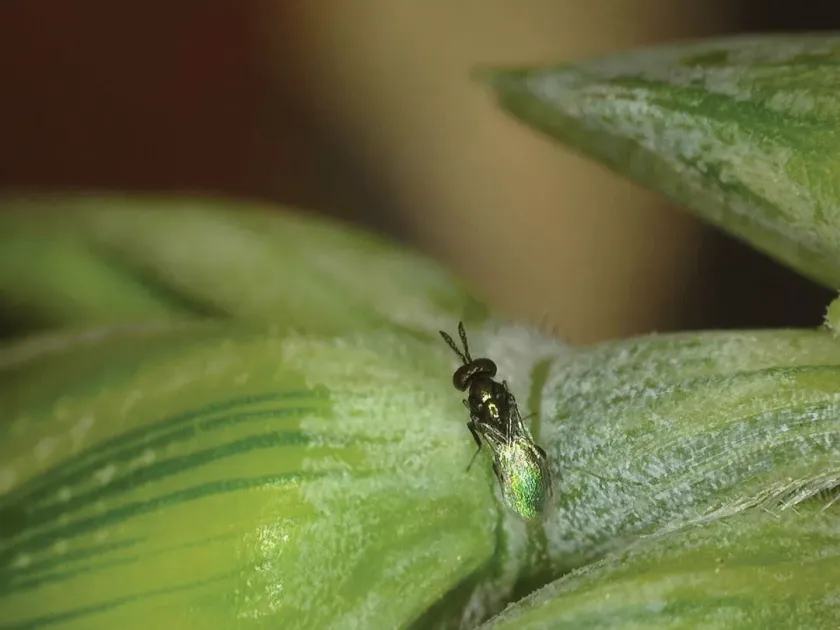
Adults exhibit the typical morphology of pteromalid wasps, often with a metallic luster. Measuring only a few millimeters, they are difficult to spot in the field without special equipment.
The larvae are internal feeders. They are legless, white to yellowish in color, and specially adapted to live within the stems of cereal crops.
The biology of the species is closely linked to the growth phases of small grains. They undergo a complete metamorphosis including egg, larva, pupa, and adult stages.
The insects overwinter primarily as larvae inside stubble or crop residues, making late-season field management critical for control.
What it damages
The primary hosts for this pest are cereals, including wheat, barley, and rye. Infestations can significantly reduce crop yields during population outbreaks.
Larvae damage cereal stems by feeding on internal tissues. This disrupts nutrient flow and grain filling, leading to deformed or stunted plants.
Damage is often characterized by weakened stems, which increases the risk of lodging during adverse weather or strong winds.
Affected spikes may appear underdeveloped or produce shriveled, thin grain, directly impacting both the quality and quantity of the harvest.
In high humidity conditions, the damaged stem sections can become susceptible to secondary fungal infections, further exacerbating yield loss.
When it appears
The adult flight typically coincides with the active growth phases of cereal crops, particularly during tillering and stem elongation.
Egg-laying occurs within the tissues of young stems. Larval population peaks are generally observed during the first half of the growing season.
Depending on regional climate conditions and host availability, one or more generations may occur throughout the year.
The most critical period for potential damage is during spike formation, as nutrient disruption at this stage leads to severe grain losses.
By late summer, the insects prepare for diapause, seeking shelter in crop residues to survive until the following season.
Signs of infestation
Visual symptoms of infestation include premature yellowing and drying of individual stems or patches in the field, often appearing as "whiteheads."
Dissecting the stem often reveals larval tunnels or the larvae themselves hidden within the tissue.
A telltale sign is a characteristic bend or break in the stem at the point where the larva has been feeding, visible during field inspections.
Small exit holes observed in stubble after harvest indicate that adult wasps have emerged from their pupation sites.
A noticeable decrease in the thousand-kernel weight in infested areas is an indirect indicator of high pest pressure.
Control measures
A core strategy for control is integrated agricultural management, specifically deep plowing after harvest to bury stubble containing larvae.
Crop rotation is vital. Avoiding the planting of cereals after cereal predecessors significantly reduces the risk of population buildup.
Selecting varieties with natural resistance or tolerance to stem-boring pests helps minimize yield losses despite the presence of the insect.
When the economic threshold is reached, systemic insecticides that penetrate plant tissues are required for effective control.
Chemical applications must be timed precisely to target adult activity before the eggs are laid deep within the stem tissue.
Taxonomy
- Latin name
- Pirene penetrans
- Order
- Hymenoptera
- Family
- Pteromalidae
- EPPO code
- PIREPE
Discussion
No discussions yet — be the first.