
Pachyneuron muscarum
Pachyneuron muscarum
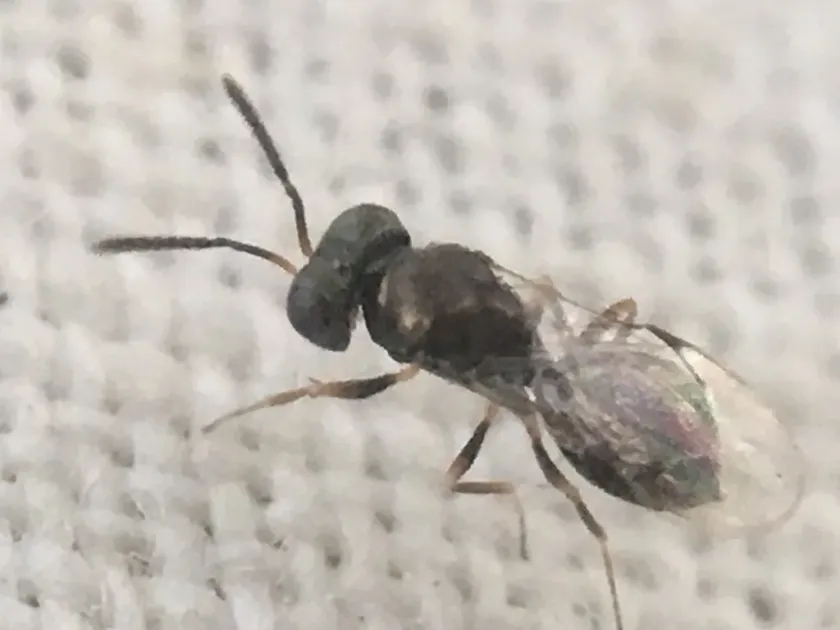
Description
How to identify
Pachyneuron muscarum belongs to the family Pteromalidae within the order Hymenoptera. These are minute chalcid wasps that often function as secondary parasites in agroecosystems.
Adults are characterized by their small size and typically dark, metallic-colored bodies. Their wings are transparent with distinct venation characteristic of the pteromalid family.
The insect's head is proportionate to its body, and the antennae are elbowed. Identifying this species in the field is difficult and requires a binocular microscope to examine wing vein patterns.
The biology of this species is closely linked to primary parasites, such as braconids or other wasps that infest aphids or flies. Thus, it acts as a high-trophic-level entomophage.
Larvae develop inside the pupae or larvae of their hosts. They live a cryptic lifestyle, making it challenging to detect their presence during early stages of crop infestation.
What it damages
From an agronomic perspective, Pachyneuron muscarum is often classified as a harmful object because it parasitizes beneficial entomophages, such as aphidiids.
By destroying primary parasites that control aphid populations, Pachyneuron indirectly triggers aphid outbreaks on agricultural crops.
Greenhouse facilities and vegetable crops are most affected, especially where biological control programs release beneficial wasps to manage pests.
Damage involves reducing the effectiveness of natural pest population regulators. Consequently, harmful phytophage populations are left unchecked, leading to reduced yields.
In field conditions, the harmful impact is observed on cereals, vegetables, and ornamental crops where aphids and their natural enemies are present.
When it appears
The insect's activity directly correlates with the activity of its hosts—aphids and their primary parasites. Peak abundance usually occurs in late spring and summer.
In greenhouse environments, Pachyneuron muscarum generations can occur continuously if a host base and suitable temperature regimes are available.
Adult emergence from diapause begins when stable warm temperatures are established, typically when soil or air temperatures reach 15–20 degrees Celsius.
The species' seasonal dynamics are highly dependent on climatic factors; high humidity and moderate temperatures accelerate the insects' metabolism.
In autumn, insects enter diapause or complete their life cycle within host puparia, overwintering in plant debris.
Signs of infestation
The primary sign of this species' presence is a decrease in the effectiveness of biological control programs when using entomophages against aphids.
Visually detecting the wasps on plants is extremely difficult due to their microscopic size. Often, their presence is only confirmed using yellow sticky traps.
Microscopic analysis of mummified aphids reveals characteristic exit holes that differ in shape from those of primary parasites.
An indirect sign is the increase of aphid colonies despite initial releases of entomophages in greenhouses or fields.
The presence of parasites can be confirmed through laboratory analysis by collecting and incubating infested material (aphid mummies).
Control measures
The main control method is monitoring the entomophage composition in the agroecosystem for timely detection of hyperparasitism.
It is necessary to avoid excessive use of broad-spectrum pesticides, as they destroy both beneficial entomophages and hyperparasites, disrupting the ecological balance.
When implementing biological control, regular quality audits of released entomophages are recommended to check for hyperparasite contamination.
Strict quarantine measures are essential when importing entomophages for greenhouses to prevent the introduction of hyperparasites.
- Regular use of yellow sticky traps to monitor population dynamics.
- Timely removal and destruction of plant debris where wasps overwinter.
- Use of selective pesticides safe for beneficial entomofauna.
Taxonomy
- Latin name
- Pachyneuron muscarum
- Order
- Hymenoptera
- Family
- Pteromalidae
- EPPO code
- TORYMU
Discussion
No discussions yet — be the first.