
Muscidifurax zaraptor
Muscidifurax zaraptor
Description
How to identify
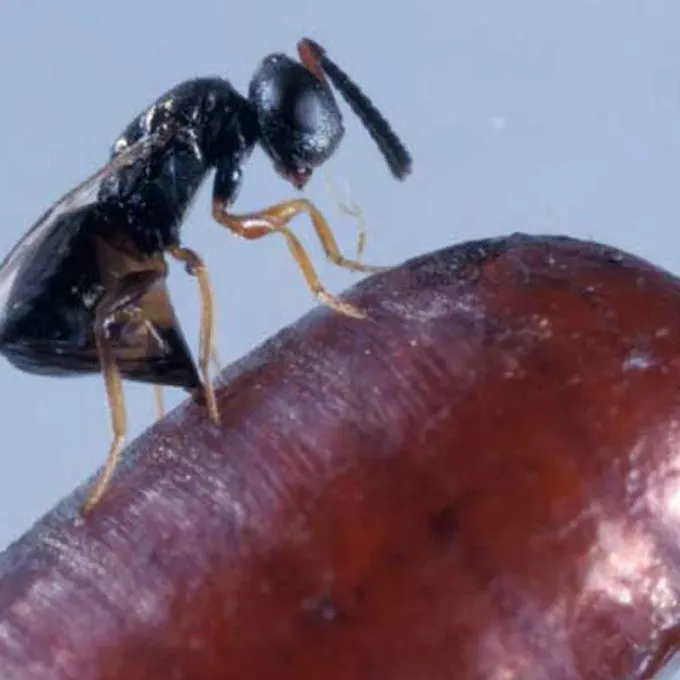
Muscidifurax zaraptor is a tiny parasitic wasp belonging to the Pteromalidae family. Adult individuals typically measure between 2 to 3 millimeters and possess a dark, almost black exoskeleton.
These insects belong to the Hymenoptera order. They are highly specialized parasitoids, equipped with an ovipositor specifically evolved to pierce the pupae of various fly species.
The wings of the wasp are transparent with distinct venation patterns. The head features large, well-developed compound eyes, which are critical for locating hosts in dense agricultural environments.
Its biology is intrinsically linked to the detection of organic substrates where fly larvae aggregate. Females are highly sensitive to chemical cues emitted by decomposing organic matter.
It is crucial to recognize that Muscidifurax zaraptor is not a plant pest; rather, it is a vital beneficial insect used globally for integrated pest management in livestock facilities.
What it damages
This species does not cause any damage to agricultural crops or ornamental plants. Its ecological role is strictly restricted to the biological suppression of fly populations.
The primary hosts for this parasitoid are the pupae of various filth flies, including the common house fly and stable fly. By attacking these hosts, the wasp effectively reduces pest numbers.
The larval stage of the parasitoid develops inside the fly puparium, feeding on the host tissue and preventing the emergence of new adult flies.
There is no harm caused to vegetation, as adult wasps feed on nectar or fly hemolymph, which poses no risk to plant health or crop yield quality.
The deployment of this insect offers a sustainable alternative to chemical control methods, promoting cleaner and more efficient livestock production systems.
When it appears
The activity level of Muscidifurax zaraptor is highly dependent on ambient temperature, with an optimal range between 20 and 28 degrees Celsius for reproduction.
In temperature-controlled livestock environments, the reproduction cycle can occur year-round, provided that a sufficient density of host pupae is present.
Activity peaks during warmer months, corresponding with the natural population explosions of flies in farm settings, making it the ideal time for deployment.
Lower temperatures slow down the wasp's metabolism, although the species demonstrates significant resilience and can enter a state of dormancy if necessary.
For best results, entomologists recommend releasing these wasps at the start of the fly season to establish a robust population before the pest numbers peak.
Signs of infestation
The most definitive sign of successful parasitism is the presence of empty fly puparia with a small, neat circular exit hole created by the emerging adult wasp.
A noticeable decrease in the population of adult flies within a facility over several weeks is a clear indicator that the parasitoid population is established and working.
Upon inspecting manure or bedding material, one may observe small black wasps actively searching and probing the surface to locate fly pupae.
The lack of viable fly pupae in samples collected from the site, combined with the presence of exit-holed shells, confirms effective biological suppression.
Laboratory monitoring using sentinel pupae is a common practice to verify the parasite's activity and determine the necessity for additional releases.
Control measures
No control measures are needed against Muscidifurax zaraptor as it is a beneficial organism. Instead, farmers are encouraged to protect and foster its presence.
The use of broad-spectrum contact insecticides should be minimized, as these chemicals are highly toxic to the parasitoids and can disrupt biological control efforts.
Maintaining appropriate moisture levels in the bedding or waste substrate significantly enhances the survival and pupation success of the wasp.
Integrated Pest Management (IPM) strategies heavily rely on the strategic release of this wasp to maintain fly populations below economic injury levels.
- Reduce reliance on chemical pesticides
- Monitor microclimate conditions
- Consistent fly population tracking
- Apply sustainable waste management practices
Taxonomy
- Latin name
- Muscidifurax zaraptor
- Order
- Hymenoptera
- Family
- Pteromalidae
- EPPO code
- MUSDZA
Discussion
No discussions yet — be the first.