
Heterolaccus
Heterolaccus
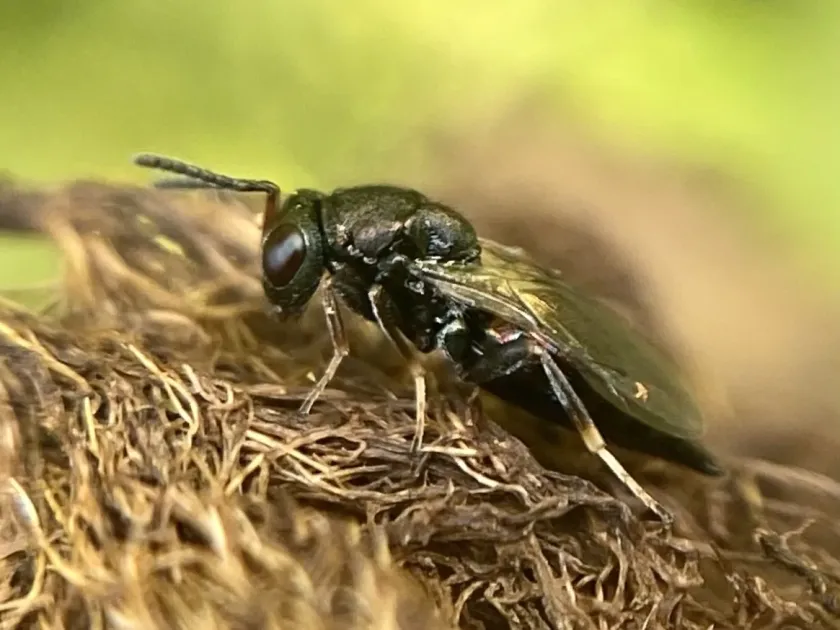
Description
How to identify
Heterolaccus is a genus belonging to the Pteromalidae family within the order Hymenoptera. These insects are classified primarily as parasitoids, acting as specialized natural agents that influence insect populations.
Adults exhibit a distinctive metallic sheen, usually ranging from deep green to blue-black. They possess a robust body structure with complex wing venation characteristic of the Pteromalidae group.
The larval stage is parasitic, developing inside the bodies of other insects. Identification usually requires expert entomological examination of morphological traits, such as antennae structures.
These insects are highly efficient at locating hosts, even in hidden environments. They utilize chemical signals emitted by plants or hosts to pinpoint their targets during the egg-laying process.
In field conditions, they are often overlooked due to their small size, typically appearing during sweeps or being caught in specialized sticky traps used for pest monitoring.
What it damages
The damage caused by Heterolaccus is often indirect but ecologically significant. By parasitizing beneficial insect predators (like lacewings or ladybird larvae), they undermine the natural biological control of primary crop pests.
When the population of natural predators is depleted by these parasitoids, aphid and mite outbreaks become more frequent, forcing farmers to increase chemical usage.
Crops such as cereals, vegetables, and orchard trees can suffer when the natural enemy complex is disturbed. The loss of beneficial insects directly leads to lower yield quality and increased production costs.
The presence of Heterolaccus in agricultural systems requires careful assessment to determine whether it is acting as a neutral presence or as an agent disrupting sustainable control programs.
Agronomists must balance the pressure from these insects by fostering environments where beneficial predatory insects can thrive despite the presence of parasitoids.
When it appears
The seasonal cycle is dictated by the availability of host insects and climatic conditions. Activity generally commences in early spring as temperatures consistently remain above the development threshold.
Throughout the growing season, multiple generations may occur depending on the latitude and local climate. Warmer summers promote faster reproductive cycles.
The highest activity levels coincide with the peak population of their hosts, usually during mid-summer when aphid and lepidopteran pest populations are also at their maximum.
As autumn approaches, the insects prepare for diapause. They typically overwinter as larvae inside the protective remains of the host, surviving in crop residues or soil.
Weather patterns, specifically long-term temperature trends, significantly influence the overwintering success rate and the subsequent emergence density of the next season.
Control measures
Effective management strategies focus on maintaining ecological stability. The indiscriminate use of broad-spectrum pesticides is the primary cause of imbalances involving Heterolaccus.
Integrated Pest Management (IPM) practices recommend using selective insecticides that target specific pests while sparing beneficial predatory insects and parasitoids.
Preservation of field margins and hedge rows provides necessary shelter and alternative food sources, helping to stabilize the relationship between predators, parasitoids, and pests.
Regular field scouting and monitoring are essential to detect changes in the composition of insect populations before they reach economic threshold levels.
- Prioritize selective biological pesticides over synthetic ones.
- Maintain biodiversity in and around the crop field.
- Conduct periodic entomological assessments to track population trends.
Taxonomy
- Latin name
- Heterolaccus
- Order
- Hymenoptera
- Family
- Pteromalidae
- EPPO code
- HTRLSP
Discussion
No discussions yet — be the first.