
Eupteromalus americanus
Eupteromalus americanus
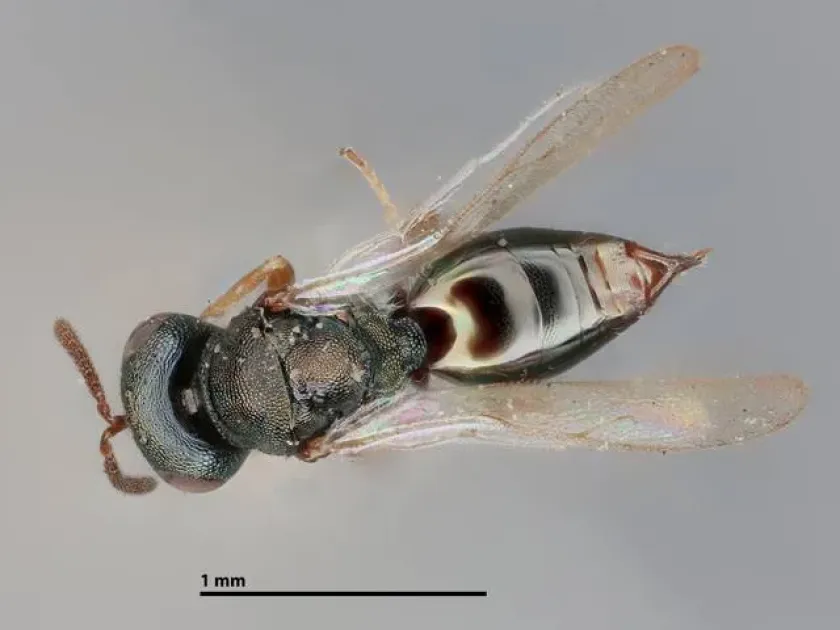
Description
How to identify
Eupteromalus americanus belongs to the order Hymenoptera, family Pteromalidae. These tiny parasitic wasps are often recognized by their metallic sheen and specific morphological features of their wings and antennae.
Identifying this species requires microscopic examination, as they are extremely small and often blend into the complex insect communities found within agricultural fields.
They are primarily known for their role as hyperparasitoids, meaning they often parasitize the larvae or pupae of other parasitic wasps that are themselves natural enemies of crop pests.
The life cycle involves the female wasp locating a host — usually a larva of a primary pest or another parasitoid — and depositing an egg inside or near it.
The larvae are white, legless grubs that develop within the host's body, consuming it from the inside out until they pupate and eventually emerge as adults.
What it damages
The damage caused by Eupteromalus americanus is primarily indirect, as it disrupts the biological control programs by attacking beneficial primary parasitoids.
By reducing the population of effective natural enemies of wheat pests, such as Hessian flies or various grain midges, the presence of this species can trigger pest outbreaks.
This disruption of the food chain is a significant concern for integrated pest management (IPM) strategies, which rely on natural regulation of insect populations.
While the wasp itself does not feed directly on plant tissues, its ecological impact on the stability of the crop's natural pest suppression is substantial.
In highly managed fields, high numbers of these wasps can lead to increased pest pressure, requiring interventions that might have otherwise been avoided.
When it appears
Adult activity begins in the spring, triggered by rising temperatures that also mark the emergence of their host species, ensuring the availability of food sources.
Multiple generations can occur throughout the growing season, allowing the wasp population to adapt quickly to different stages of crop development.
Peak occurrence is often aligned with the tillering and heading stages of small grains, which provide critical habitats for both pests and their associated parasitoids.
Overwintering typically happens in a quiescent state, with insects hiding within crop residues, stubble, or the upper layers of the soil to survive harsh winters.
The synchronization between the emergence of the wasps and the life cycle of their hosts is a critical biological feature that drives their seasonal prevalence.
Signs of infestation
Detection in the field is difficult due to their microscopic size, and signs are generally restricted to changes in the overall parasitism rates of primary pests.
A reduction in the emergence of primary beneficial wasps from collected host larvae is often the first indicator that hyperparasitism is occurring.
Entomologists often use sweep nets and yellow sticky traps to collect samples, which are then analyzed in laboratory settings for precise identification.
Physical evidence of their presence may include minute exit holes on plant stems, though these are indistinguishable from those left by many other Hymenopteran species.
Laboratory dissection of collected pest larvae remains the most reliable method for confirming the presence and influence of Eupteromalus americanus in a specific region.
Control measures
Management strategies should focus on maintaining a balanced ecosystem that favors primary parasitoids rather than attempting to eradicate this specific species.
Avoiding the use of broad-spectrum insecticides is crucial, as these chemicals often harm beneficial insects more than the target pests, leading to secondary outbreaks.
Cultural practices, including proper residue management and crop rotation, help mitigate the overwintering success of these insects, thereby limiting early-season numbers.
Integrated Pest Management programs should incorporate monitoring for hyperparasitism levels to determine if biological regulation is currently functioning effectively.
Promoting biodiversity around crop fields, such as field margins with flowering plants, can support a wider variety of natural enemies, potentially buffering against the negative effects of hyperparasitoids.
Taxonomy
- Latin name
- Eupteromalus americanus
- Order
- Hymenoptera
- Family
- Pteromalidae
- EPPO code
- EUPMAM
Discussion
No discussions yet — be the first.