
Dibrachys microgastri
Dibrachys microgastri
Description
How to identify
Dibrachys microgastri is a species of parasitic wasp belonging to the order Hymenoptera and the family Pteromalidae. These insects are often classified as secondary parasites or hyperparasitoids.
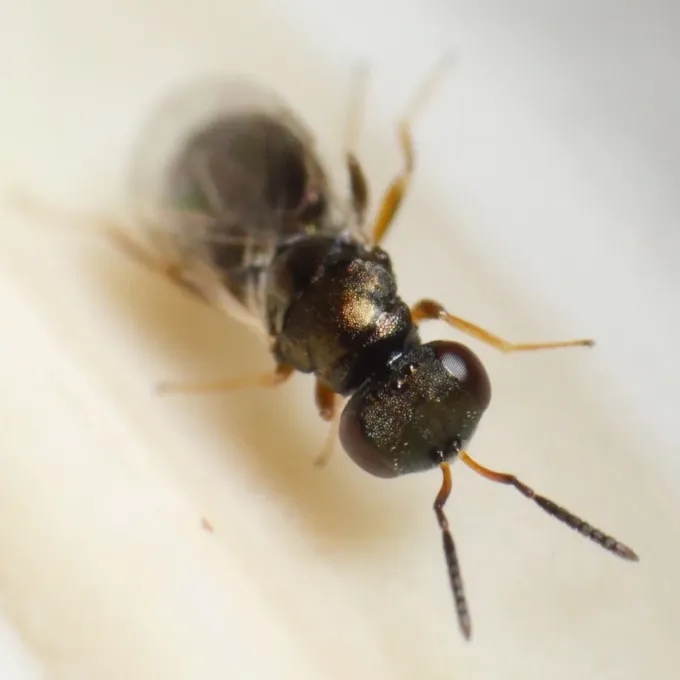
Adult specimens typically range from 1.5 to 3 mm in length. Their bodies are generally dark-colored, often exhibiting a metallic or bronze sheen characteristic of the Pteromalidae family.
The wings of the imago are transparent with distinct venation. They possess a large head and elbowed antennae, which are specialized organs used for locating hosts for oviposition.
The larvae of this species follow a parasitic lifecycle, developing either inside or on the surface of the pupae and larvae of other insects, effectively reducing the populations of beneficial primary parasitoids.
Due to their small size, identification requires magnification tools. In the field, microscopic examination is often necessary to distinguish this species from other related pteromalids.
What it damages
The primary agricultural impact of Dibrachys microgastri is its role as a hyperparasitoid, attacking larvae and pupae of primary parasitoids that control major crop pests.
This pest is frequently found in grain storage facilities, where it targets the pupae of stored-product insects, and in agroecosystems where it interferes with beneficial insect populations.
The damage is indirect but significant: by suppressing populations of beneficial biological control agents, Dibrachys microgastri allows primary pests to proliferate unchecked.
Because of this biological trait, the species is considered a detrimental factor in integrated pest management (IPM) programs that rely on the introduction of other wasps for biological control.
In stored grain environments, it may disrupt the natural equilibrium of insect populations, complicating the biological regulation of grain-infesting pests and reducing the efficacy of beneficial species.
When it appears
The activity period of the insect is highly dependent on the presence of suitable hosts. In temperature-controlled storage facilities, activity can persist year-round.
In outdoor field conditions, the emergence of adults typically coincides with the pupation period of host species, which most commonly occurs during the spring and summer months.
The life cycle includes stages of egg, larva, prepupa, and pupa. The rate of generation development is strongly influenced by ambient temperatures and humidity levels.
In temperate climates, the species is capable of producing multiple generations within a single growing season, allowing for rapid population growth when conditions are favorable.
During winter or periods of extreme cold, the species enters a state of diapause, overwintering as larvae or pupae within the protective cocoons of their hosts.
Signs of infestation
A key indicator of Dibrachys microgastri infestation is the discovery of small, circular exit holes in host cocoons, marking where adults have emerged after development.
Presence of this pest can also be inferred from a sudden decline in the effectiveness of primary parasitoids previously introduced to control crop pests in a specific area.
Visual inspection of infested substrates or cocoons often reveals debris from the host tissue and the presence of characteristic larval excrement near the development site.
In grain storage environments, the presence of the wasp can be detected using pheromone traps or sticky boards placed near identified storage hotspots.
Reduction in the success rate of primary parasitoids during monitoring programs often serves as a warning sign of a hyperparasitoid infestation within the field or storage facility.
Control measures
Management of this species is complex due to its ecological role. The primary strategy focuses on maintaining strict storage hygiene and managing primary pest populations.
Effective preventive measures in grain storage include thorough cleaning of facilities to remove residual plant matter where pupae might overwinter.
Chemical control must be applied with extreme caution; localized treatments are preferred to minimize negative impacts on the beneficial insect fauna present in the ecosystem.
- Regular disinsection of storage rooms.
- Use of fine-mesh screens on ventilation systems.
- Monitoring of beneficial insect populations in agroecosystems.
- Avoiding broad-spectrum insecticides during peak parasite activity.
When designing biological control programs, it is essential to analyze the species composition of parasitoids to exclude the risk of introducing or encouraging hyperparasitoids like Dibrachys microgastri.
Taxonomy
- Latin name
- Dibrachys microgastri
- Order
- Hymenoptera
- Family
- Pteromalidae
- EPPO code
- DIBRCA
Discussion
No discussions yet — be the first.